Published : 23 Oct 2025, 03:40 AM
Updated : 21 Aug 2026, 02:37 PM


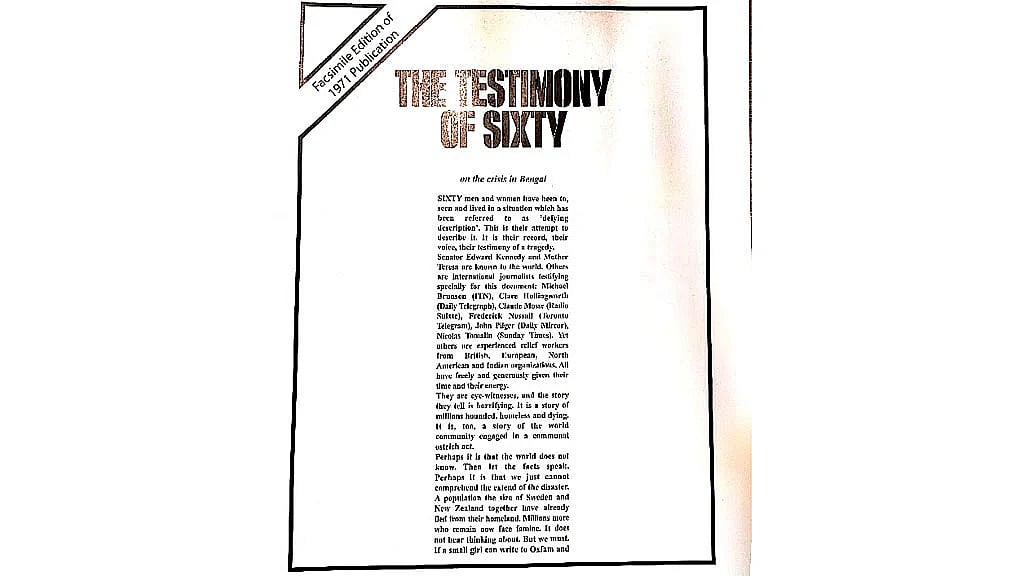
The Testimony of Sixty on the Crisis in Bengal carried statements and articles written by famous figures such as Mother Teresa and Senator Edward Kennedy, along with well-known journalists such as Anthony Mascarenhas, John Pilger, Nicolas Tomalin, Clare Hollingworth, and Martin Woollacott.
I personally collected many of the statements from people in Kolkata and I remember one day sending a telex to Oxfam full of statements which took 75 minutes to send over the wires. Copies of The Testimony of Sixty were handed over to many heads of governments, and its publication coincided with the opening of that year’s United Nations General Assembly, where it was distributed to all ambassadors to the UN.
The day before the official publication date, Oct 21, 1971, the British Post Office assisted Oxfam with telephone directories from all over the UK to pile up 49 million names on the pavement outside an Oxfam shop which was situated at 49, Parliament Street, London.
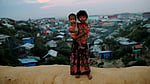
Nine million represented the number of Bangladeshi refugees at that time in India and the other 40 million names represented the number of people displaced inside (then) East Pakistan who were facing extreme hunger.
What is interesting to record is that, although the US was firmly supporting Pakistan in 1971, Senator Edward Kennedy, who had visited India and the refugee camps in August 1971, brought The Testimony of Sixty to the attention of the US Senate, and it was published in full on Oct 28, 1971 in the “Congressional Record,” only one week after it was published by Oxfam in the UK.
Introducing the Testimony of Sixty to the US Senate, the Congressional Record states the following:
“Mr Kennedy: ‘Mr President, the crisis in East Bengal is a story of human misery on a scale unequalled in modern times. It is a story of systematic terror and military repression, of indiscriminate killing and the killing and dislocation of millions of civilians.
‘It is a story of death and disease, of too little food and water, of fetid refugee camps without hope and a countryside stalked by famine.
‘And throughout it all, the world has barely murmured a word.
‘Perhaps this is because we are conditioned in the world we have created to accept such suffering and injustice. To many, the plight of the Bengali people is just another link in the chain of war-ravaged populations stretching around the world in recent years.
‘But, perhaps, Mr President, the public is silent because it does not know.
‘To bring the facts more forcibly to the public’s attention, the noted British charity, Oxfam, has recently published an impressive brochure entitled ‘The Testimony of Sixty on the Crisis in Bengal.’ No one who reads this document can remain unmoved or uninformed to the plight of the Bengali people.
‘To share this eloquent statement with Members of the Senate, I ask unanimous consent that it be printed at this point in the record.’”
There being no objection, the testimony was ordered to be printed in the record.
It is important to note that, although the US government supported Pakistan at that time, there was a huge outpouring of generosity and concern by the American people who put the fledgling Oxfam-America clearly on the map at that time.
In addition, over half a million dollars of medical supplies donated by American companies were sent to Oxfam for use in the refugee camps, and later, after liberation, in Bangladesh.
In 2007, the Liberation War Museum brought out an English facsimile edition of the Testimony of Sixty so that more people could learn more about the history of how this nation was formed and the pain and suffering that was involved. On Dec 16, 2009, the daily Prothom Alo published a Bangla facsimile edition which has reached many more readers.
This, then, is the story of how this historical document was prepared and why it was prepared. As someone who witnessed the very painful birth of Bangladesh, I am astonished that there are many who still deny that genocide took place in Bangladesh in 1971. I strongly recommend that they read The Testimony of Sixty, wherein the eye-witness accounts will bring tears to their eyes.
Not long ago I was reminded that about 75 percent of Bangladesh’s population was born after 1971, so it is important that they know some of the true history of the emergence of Bangladesh and to also ensure that everyone comes to terms with the genocide which has recently, as well as over the last few decades, taken place in Myanmar’s Rakhine state.