Home
+
Published : 26 Jun 2026, 11:57 PM
Relentless Resurgence
The 5.5 million gap: A massive data discrepancy leaves millions of vulnerable children unaccounted for between two major health drives
“Flawed” planning: Experts blame a rushed field-level microplan and poor grassroots data collection for underestimating the target
False coverage? Reported 103 percent measles vaccine coverage actually drops to 77 percent when measured against Vitamin A campaign data
Herd immunity at risk: With actual coverage well below the 95 percent herd immunity threshold, deadly measles transmission continues to rage
The government's nationwide Vitamin A supplementation campaign is targeting around 5.5 million more children than were included in the recent measles-rubella vaccination drive, prompting public health experts to question the accuracy of the vaccination campaign's reported coverage.
The discrepancy involves children aged between 6 months and 5 years who were eligible for both initiatives.
Some public health experts argue the gap raises serious concerns over the measles-rubella campaign's planning and coverage.
They say authorities had insufficient time to collect data from grassroots health workers before the vaccination drive, resulting in an incomplete field-level “microplan” and an underestimation of the target population.
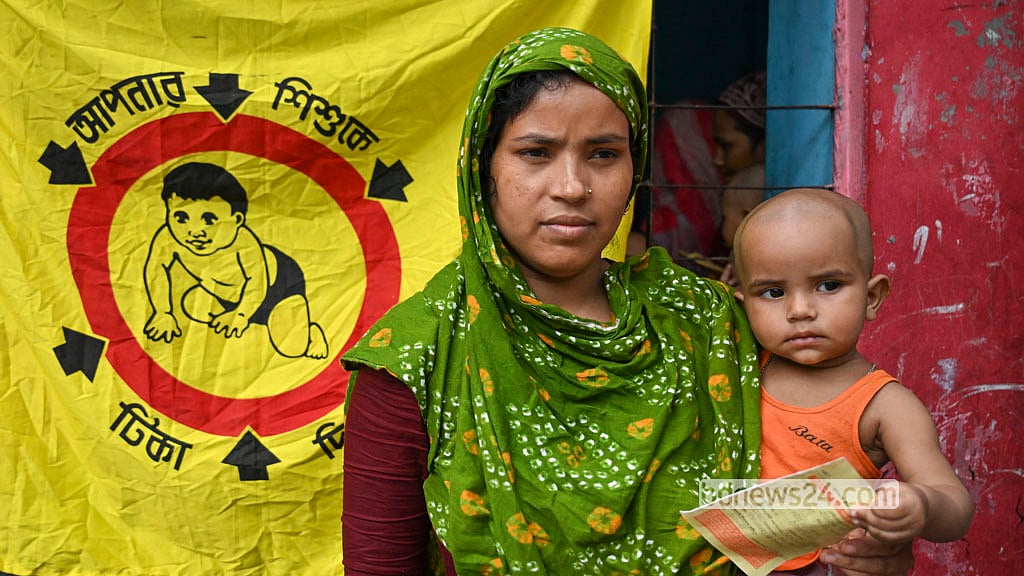
Amid growing criticism over rising measles infections and deaths, the government launched an emergency vaccination campaign on Apr 5 across 30 high-risk Upazilas, targeting children aged between 6 and 59 months.
The initiative was extended to four city corporations on Apr 12 before expanding nationwide on Apr 20. The campaign ended on May 20.
According to the Directorate General of Health Services (DGHS) bulletin published on Jun 26, the campaign achieved 103 percent coverage, vaccinating 18.48 million children.
From Sunday, however, the government will begin its nationwide Vitamin A campaign for the same age group, aiming to provide capsules to 24 million children.
Speaking at a press briefing at the Secretariat on Thursday, State Minister for Health MA Muhit said children would receive a single Vitamin A capsule between 8am and 4pm.
Those aged 6 to 11 months will receive blue capsules, while children aged 12 to 59 months will be given red capsules.
Why the Gap?
Public health experts say both campaigns should have targeted roughly the same number of children.
Instead, official figures show a difference of about 5.5 million.
They argue this indicates the measles vaccination campaign underestimated the target population, which may explain why measles transmission has yet to be brought under control.
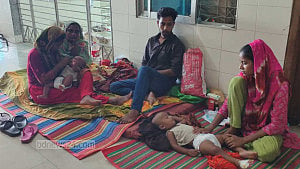
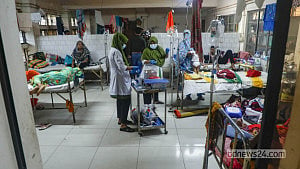
Deaths linked to measles and measles-like viral symptoms have now exceeded 700.
Prof Mahmudur Rahman, former director of the Institute of Epidemiology, Disease Control and Research (IEDCR), said one possible reason was differing population estimates.
"For vaccination programmes, Gavi [The Vaccine Alliance] generally follows Bangladesh Bureau of Statistics data. The latest statistics appear to have underestimated the number of children, which could explain the large difference between the vaccination and Vitamin A targets."
He said another contributing factor may have been weaknesses in the Expanded Programme on Immunization's (EPI) microplanning.
"Every eligible child must receive the measles vaccine. Without that, it is impossible to control transmission."
Mohammad Yunus Ali, director of the National Nutrition Services, said the Vitamin A target was compiled using data submitted by civil surgeons across the country.
"We requested child population data from every civil surgeon and combined those figures to determine our campaign target."
Asked about the difference with the vaccination campaign, he said: "I do not know how the EPI collected its data. We prepared our list using our own methodology."
Public health and immunisation expert Dr Tajul Islam Bari said the government's vaccination target had been set too low.
"The official coverage being reported is therefore inaccurate. The Vitamin A campaign figure is the correct one."
Using the Vitamin A target, he said actual measles vaccination coverage would fall to 76.66 percent, well below the 95 percent needed to achieve herd immunity.
"We remain almost 18 percentage points short. That is why measles transmission continues. Eligible children must be vaccinated quickly."
Health Services Division Secretary Md Quamruzzaman Chowdhury said one possible explanation was that some areas had already received measles vaccines through World Health Organization-supported initiatives.
He added that international organisations, including the WHO, had helped determine vaccination targets, making major errors unlikely, but said authorities would review the figures.
Questions over Coverage
Despite the DGHS reporting more than 100 percent vaccination coverage, experts remain unconvinced.
DGHS Director General Pravath Chandra Biswas said the campaign had been highly successful.
"As a result, measles infections, confirmed cases and deaths have declined. Measles will not disappear overnight, but transmission has begun to fall. We hope it will decline significantly by the end of June."
However, deaths involving measles symptoms continue, leading experts to question whether all eligible children were included in the campaign.
Public health expert Mushtuq Husain said the official coverage reflected only those counted within the government's target population.
"Many children may have been left out because there was not enough time to prepare the microplan before the campaign. During an outbreak, every child must be vaccinated."
Prof Be-Nazir Ahmed echoed those concerns, saying measles can only be controlled once vaccination coverage exceeds 95 percent.
"If coverage had genuinely exceeded 100 percent, measles transmission would already have been under control. The continued spread suggests there are problems with the reported coverage."