Home
+

Published : 11 Jun 2026, 05:44 PM
The BNP government is putting troubled banks under risk-based watch as it seeks to bring back confidence and stability in Bangladesh’s financial sector, which has been in crisis for years.
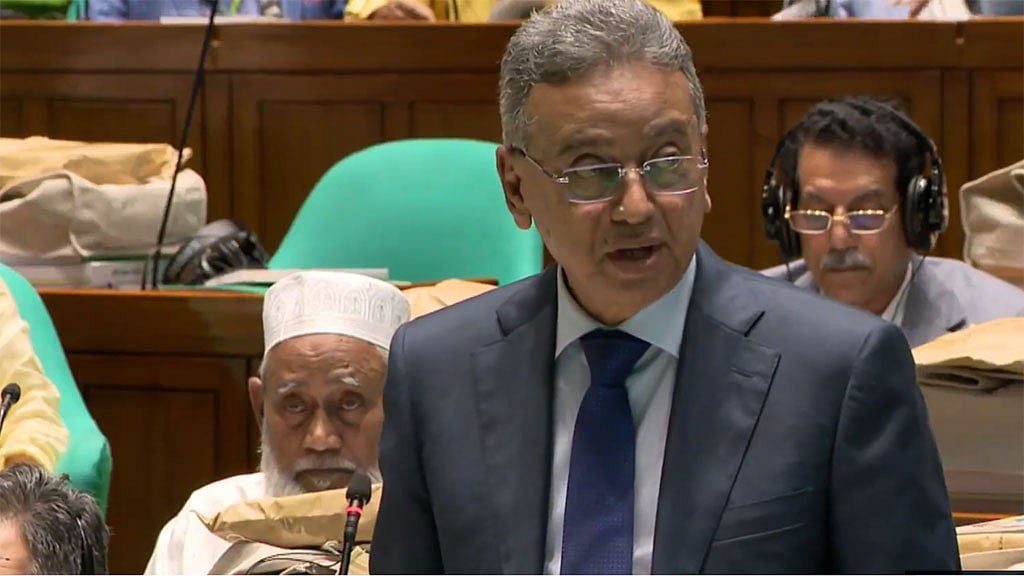
Presenting the Tk 9.38 trillion budget for FY2026-27 in parliament on Thursday, Finance Minister Amir Khosru Mahmud Chowdhury said weak banks would be brought under enhanced oversight, with recapitalisation and management reforms introduced where necessary.
“To rebuild the financial strength of weak banks, a risk-based supervisory framework will be introduced, alongside recapitalisation and management reform measures where required,” he said.
The minister noted that the government is spending nearly Tk 400 billion in the current fiscal year to recapitalise distressed banks.
In the chapter on financial-sector stability in his budget speech, Khosru said the government's objective was to restore discipline, transparency and accountability in banking and finance, rebuild depositor confidence and encourage investment through capital market reforms.
He painted a bleak picture of the sector's condition, saying the banking system's capital adequacy ratio had deteriorated from 7.3 percent at the end of the BNP government's previous term in 2005 to negative 2.64 percent by the end of 2025.
Private-sector credit growth has also slowed sharply, falling from 18.3 percent in FY2005-06 to 6.5 percent in FY2024-25, according to figures presented in parliament.
Khosru blamed years of “looting, mismanagement, scams and flawed policies” for damaging both the banking sector and the capital market, eroding investor confidence in the process.
He said restoring order in the banking and financial sectors was among the government's highest medium-term priorities as it seeks to revive investment and support economic recovery.
To achieve that goal, the government has outlined a series of reform measures, including reducing defaulted loans, improving transparency in loan approvals and rescheduling, and strengthening accountability in bank management.
The minister said initiatives had already been launched to restructure banks and protect depositors' funds. Efforts were also under way to recover money allegedly laundered abroad.
He said political appointments and interference in banking operations had been halted, while legal changes had been introduced to curb family influence over bank management.
The government also plans to align the banking sector with international standards on risk management, capital adequacy and corporate governance to improve long-term stability and competitiveness.
Access to finance will be expanded for women, young entrepreneurs and marginalised groups as part of a broader financial inclusion strategy.
Khosru said the government remained committed to structural reforms in both banking and capital markets to build a modern, resilient and sustainable financial system.
He also signalled a shift in economic strategy, saying the government wanted to move away from a debt-driven model towards an investment-led economy by encouraging greater use of equity financing.