Published : 26 Sep 2025, 07:50 AM
Updated : 21 Aug 2026, 01:51 PM


The government’s initiative to merge five weak Shariah-based banks into a larger Islamic bank has run into a series of challenges, including legal complications, and unless these issues are resolved, the merger process risks stalling.
Bangladesh Bank has begun seeking legal solutions on questions such as how administrators will function in the banks, how depositors and stock market shareholders will be protected, and whether the merger can be completed before a political government takes office.
Under the Bank Company Act, if the banks are merged rather than liquidated, depositors must be repaid in full, requiring the government to ensure sufficient funds.
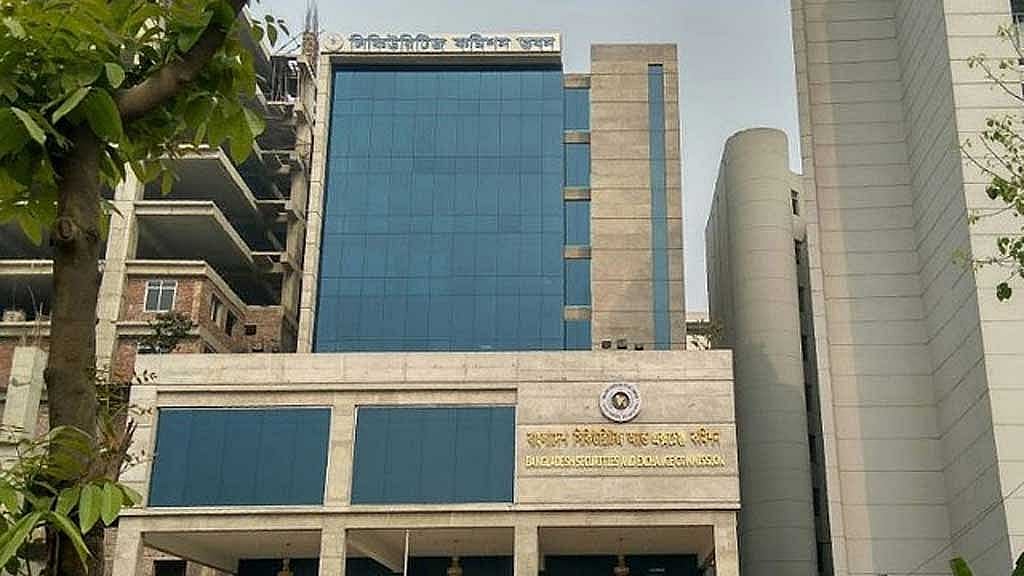
At the same time, the Bangladesh Securities and Exchange Commission (BSEC) rules stipulate that the interests of ordinary investors must be fully safeguarded.
As a first step toward the merger, Bangladesh Bank decided on Sept 16 to appoint administrators to the five banks.
Confirming the decision after a special meeting of the central bank’s board of directors, spokesperson Arief Hossain Khan told bdnews24.com: “A decision has been made under the Bank Company Act to merge the five banks. To proceed with the process, the board has now decided to appoint administrators.”
BB SILENT ON NAMES, BUT EVERYONE KNOWS
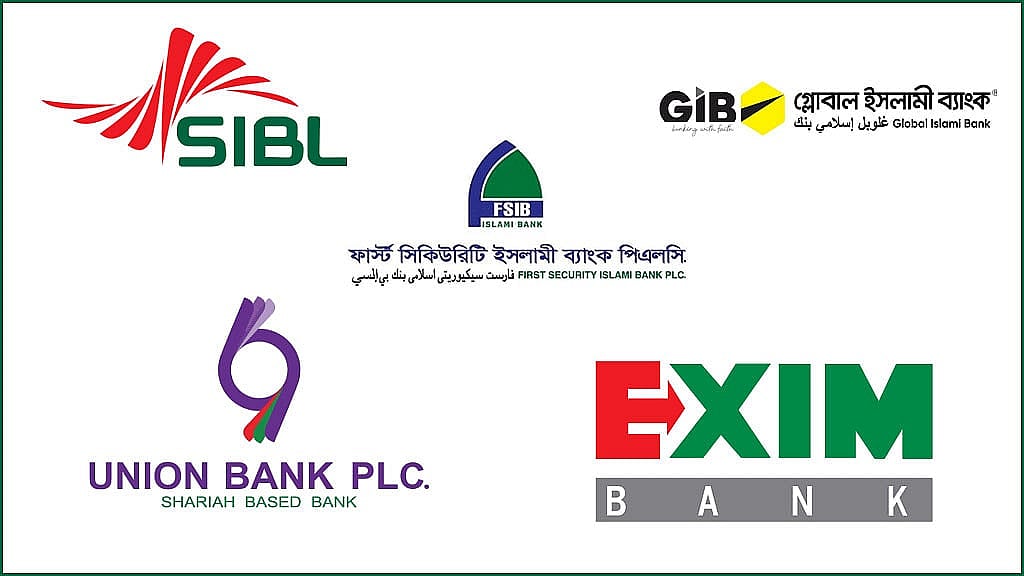
Although the government plans to merge five Islamic banks into a single new Shariah-based entity, neither Bangladesh Bank nor the Ministry of Finance has formally disclosed their names.
Yet, no one has disputed the names circulating in the media: First Security Islami Bank, Global Islami Bank, Union Bank, EXIM Bank, and Social Islami Bank. All five are listed on the country’s stock exchange.
To finalise the merger process, Bangladesh Bank has already held meetings with the boards of these banks.
The plan is to combine them into a fully state-owned Shariah-based bank, transferring all assets and liabilities into the new institution.
Among the five, EXIM Bank and SIBL have raised objections to the merger. Their directors argue that, given time, they could recover independently.
According to Bangladesh Bank officials, the proposed merged bank would have a paid-up capital of Tk 350 billion. Of this, the government would contribute Tk 200 billion as equity, while the remaining Tk 150 billion could come from the Deposit Insurance Trust Fund. A proposal has already been sent to the finance ministry.
The initiative follows the political change of Aug 5 last year, when the Awami League government was toppled in the July Uprising. As part of financial sector reforms, new boards were installed at the five banks.
Until then, EXIM Bank had been under the control of Nazrul Islam Mazumder, chairman of Nassa Group, while the other four were controlled by Chattogram-based businessman Shah Alam.
According to Governor Ahsan H Mansur, during their control, “hundreds of thousands of crores of taka” were siphoned out of these banks. To address the situation, Bangladesh Bank formed a special taskforce and commissioned foreign auditors to determine the banks’ “true” financial health.
Meanwhile, the BSEC has yet to be formally briefed on the central bank’s decision regarding the five listed banks, though it has begun monitoring developments.
Following media reports, the BSEC and Dhaka Stock Exchange (DSE) have already written to three of the banks seeking clarification on the merger.
In response, all five banks have informed investors via the DSE that no formal decision has yet been taken regarding a merger.
A senior Bangladesh Bank official said the central bank plans to formally announce the process once the legal review is complete, covering the Bank Resolution Ordinance 2025, the Bank Company Act, the Bank Deposit Insurance Act, the draft Deposit Protection Ordinance, and the BSEC Act.
WILL DEPOSITORS GET ALL THEIR MONEY BACK?
Because the banks are being merged rather than liquidated, there is a legal obligation to return the full value of deposits and ordinary shareholders’ investments.
Senior officials at Bangladesh Bank and the Ministry of Finance said a final decision will be taken after reviewing the report of a “working committee” formed by the ministry.
Whether through merger-and-acquisition or simple consolidation, the law guarantees that depositors will receive their money in full.
Bangladesh Bank spokesperson Arief said: “Depositors are worried right now, and many are trying to withdraw funds. I would request those who don’t urgently need the money not to do so. There is no risk to anyone’s deposits. The banks are not shutting down; they are merging into a new bank. All deposits will simply be transferred to the new institution.”
He added, “The new bank will be under government ownership, so there is no need for concern over deposits.”
In the case of liquidation, depositors would only be entitled to compensation of up to Tk 200,000 per account under the Deposit Insurance Act.
Arief Hossain clarified, “But these banks are not going into liquidation, so the issue of limited compensation does not arise. We have said that if necessary, support may be drawn from the Deposit Insurance Fund, nothing more. That fund could be used if required.”
WHAT THE LAW SAYS
Under Section 58 of the Bank Company Act, 1919 (amended 2023), the government may acquire any bank or company to protect depositors from loss, safeguard depositor interests, or uphold banking policy.
Section 58(e) states: “The government, after consultation with Bangladesh Bank, may by notification in the official gazette, from the date specified in such order, acquire any banking company -- in whole, in part, or any of its subsidiaries -- thereafter referred to as the ‘acquired bank’.”
Sub-section 4 of the same section adds that under any scheme, the government may transfer a banking company to another institution, with liabilities to be borne either by the government or the receiving bank.
In addition to this Act, the government is reviewing the Bank Resolution Ordinance 2025 for the merger.
Section 10(g) of the Ordinance mandates the protection of depositors’ interests in full.
Sub-section 2 of the same clause specifies that, for Islamic banks, Bangladesh Bank may clarify the objectives of resolution through regulations as needed.
This means that Bangladesh Bank will need to frame a separate set of rules for the merger of Shariah-based banks, something that has yet to be done.
The Ordinance also requires that administrators must be independent and impartial, and their appointment must be announced through public notices. These notices are to be published in two newspapers and on the concerned bank’s website. As of Thursday, no such notices had been issued.
Bangladesh Bank spokesperson Arief said the process of appointing administrators is ongoing, but he could not specify when the appointments might be made.
WHAT BANGLADESH BANK IS PLANNING
Discussions with Bangladesh Bank officials and members of the financial-sector reform taskforce indicate that a new bank will be created to absorb the merger. The working name under consideration is United Islami Bank.
Using powers under the Bank Resolution Ordinance, a Bank Restructuring Resolution Fund will be established. This fund will finance the merger, capitalise the new entity, and manage the transition.
According to a central bank official, the World Bank and IMF have confirmed support amounting to Tk 50 billion, while another Tk 100 billion would be drawn from the Deposit Insurance Fund.
Initially, the new bank will take on all assets and liabilities of the five Shariah-based banks.
At a later stage, when conditions are favourable, the institution may be sold to a third party or a financial company. For this interim period, the Bank Resolution Ordinance refers to the entity as a “bridge bank.”
Section 30 of the Ordinance defines a bridge bank as: “A bank licensed by Bangladesh Bank, formed under resolution to maintain the essential operations and effective management of a scheduled bank, with the eventual objective of selling it to a third party.”
DOES BSEC KNOW AND WHAT IT WILL DO?
Although the merger process of the five banks has already begun, neither Bangladesh Bank nor the government has yet involved the BSEC.
One key unanswered question is what happens to ordinary investors if the listed banks are merged.
Mohammad Ferdous Alam, who has invested in EXIM Bank and Social Islami Bank shares through the stock market, told bdnews24.com: “I bought shares from the market, like hundreds of thousands of small investors. We never sat on the boards, took loans, or managed these banks. We invested in good faith, hoping for dividends at year-end.
“We have no fault here. So why should we be denied shares in the new bank? If we are not given shares, then at least compensate us.”
Against this backdrop, a finance ministry official said the ministry would begin discussions with Bangladesh Bank on a proposal to provide compensation to general investors.
BSEC has said that since the five banks are not going into liquidation, it expects a solution similar to past corporate mergers, where ordinary investors received proportional shares in the new entity.
For this, BSEC intends to place a position before Bangladesh Bank and the government under Section 77 of the Bank Resolution Ordinance 2025.
The regulator also said it will demand that ordinary investors be allocated new shares, while excluding those shareholders held responsible for misusing bank assets and funds.
BSEC spokesperson Abul Kalam told bdnews24.com: “The Commission will make every effort to safeguard investors’ interests as required by law”.
Section 77 of the Ordinance, under the heading “Persons Responsible for Fraudulent Use or Misuse of Bank Assets or Funds”, defines “responsible persons” as including:
• significant shareholders,
• the chairman, board members, managing director/CEO, senior management and other accountable officials,
• related persons or entities,
• those convicted of dishonest misappropriation of property under sections 403 and 404 of the Penal Code 1860,
• offenders under section 2(s) of the Money Laundering Prevention Act 2012,
• or any other natural or legal persons identified by Bangladesh Bank or another competent authority.
World Bank’s former lead economist for Dhaka Office Zahid Hussain, however, cautioned that compensation may become a political decision.
He told bdnews24.com, “Financial institutions operate under law and international banking practice. Compensation does not fit within sound financial management. The proper course is to value assets and liabilities, then apply international norms.”
He questioned who the true shareholders are.
“At first glance they may appear to be ordinary shareholders, but many shares may have hidden owners. It is necessary to examine who actually owns them, and whether the shareholdings align with the declared assets and tax files of those in whose names they are registered,” he said.
WHY THE MERGER COULD STALL
Merger means combining everything -- the assets, staff, branches, loans, deposits, technology, HR policies, internal employment rules, investment policies, depositors, shareholders, and liabilities of five banks -- into a single institution.
Economist Zahid notes that the process has two dimensions.
“One is the decision to merge, which the government has already taken. Here, troubled banks have no say because they have failed to run themselves.
“The other is the technical side. Each of the five banks has its own policies in every area. These must be harmonised into one, particularly the technological ‘systems’. A consolidated proposal will also require asset valuations and reports on liabilities.”
He argues that this massive task now needs to be placed at the top of Bangladesh Bank’s priority list.
The taskforce has been instructed that Bangladesh Bank and the government want to bring the merger to its final stage by December, as the national election schedule may be announced in February.
But the taskforce says two new laws must be enacted before December:
• the Deposit Protection Act, currently only in draft ordinance form;
• and the Distressed Asset Management Act (DAMA), which has not yet been drafted.
The latter would allow the merged banks’ non-performing loans to be sold off. Without these two laws in place and operational before the election, the merger cannot be completed.
If this timeline slips, there is uncertainty whether a new government will pursue the plan at all.
Zahid warned: “If these banks remain in their current state, the biggest risk is that they will continue to burden the financial sector. The collusion and corruption carried out in these banks with regulatory support is unprecedented globally.
It would not be unfounded to expect that once a new political government takes office after the upcoming elections, powerful interests in the financial sector will try to obstruct this merger process.”