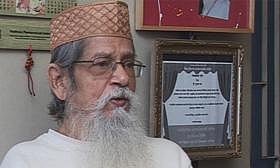
Dhaka, Nov 16 (bdnews24.com) — Acclaimed filmmaker, actor and cultural activist Subhash Dutta died at the age of 82 at 7am on Friday.
The director of films such as 'Sutarang' (Hence), 'Arunodoyer Agnishakhi', (Witness to the rising sun) and 'Dumurer Phool' (The Unseen Flower), Dutta was awarded the Ekushey Padak, the highest award for civilians in the country, in 1999 for his contributions to the film industry.
He died at his own residence at RK Mission Road in the capital.
Film Directors' Association President Mohammad Hannan said Subhash Dutta was suffering from heart problem along with several other old-age complications. He was hospitalised for some days last year, he said.
Dutta's elder son Shibaji Dutta said his father's last rites would be performed in Postogola crematorium in the capital on Saturday evening. The mortal remains would be kept at Ramkrishna Mission at 9am and at Central Shaheed Minar at noon under arrangements of Sammilita Sangskritik Jote for the people to pay their last respects. The body will be take to Bangladesh Film Development Corporation premises
Dutta is regarded as one of those few great filmmakers who dedicated themselves to establishing cinema as an eloquent medium of art in Bangladesh. He made a good number of films that immensely contributed to the making of the golden era of Bengali cinema.
The news of this talented filmmaker's death came like a shock to many, including Prime Minister Sheikh Hasina and Leader of the Opposition Khaleda Zia.
Dutta left behind two sons, two daughters and many grandchildren to mourn his loss. His wife passed away in 2001.
Dutta was born in Dinajpur on Feb 9, 1930. His professional life started working as a painter of film posters. He also worked in the film 'Matir Pahar' as the art director in the beginning of his career.
Dutta made his debut as an actor with Ehtesham and followed it up with 'E Desh Tomar Amar' (This Country Yours and Mine), and became an instant hit with the audience.
He directed his first movie in 1962 'Abirbhab'. Released in 1964, it earned rave reviews and won an award at the Frankfurt Festival. The film was sent to the Cambodian Film Festival in 1969 and won special appreciation from the Queen of the country.
He directed such popular films as Palabadal (The Role Reversal) and Nouka (Boat), and acted in Rajdhanir Bukey (In the Heart of the Capital), Harano Din (The Bygone Days) and Talash (The Search).
Dutta also acted in theatres. He played a role in Aryannak Natyadal's first production 'Kobor' in 1972.
In an interview with bdnews24.com last year, he had said he was inspired into filmmaking by Satyajit Ray's 'Pather Panchali' in 1975. Later, some of Dutta's films were considered remarkable contributions to the film industry.
His first film as director, 'Sutarang', based on a love story of two teenagers, was released in 1964. Mina Pal, now popularly known as Kobori, kicked off her career with that film.
Pakistani military had captured Dutta in Dhaka during the Independence War of 1971, but a Pakistan Army Captain released him after recognising him as a popular figure even in Pakistan, since he had also acted in some Urdu movies.
Remembering those days during the Independence War, he said, "When I went somewhere, people followed me around and said, Subhash Dutta ja raha hain (Subhash Dutta is going). I don't know if I was more noticeable because of my miniature size."
The man later created 'Arunodoyer Agnishakhhi', considered one of the best movies he created. 'Bashundhara' (The Mother Earth), released in 1977 based on Alauddin Al Azad's famous novel, another of his creation, is still a gossip of today's filmmakers.
For any role, Dutta would study people of that profession or kind, and then create the character realistically. In his film 'Binimoy' (Trade-off), he made Kobori play a dumb girl. He attended a school for the dumb to make the character convincing.
'Sutarang' was pitched in the Asian Film Festival of Frankfurt while 'Dumurer Phool' was screened at the Moscow Film Festival.
Subhash Dutta's other notable films are 'Aina-O-Abshisthha' (The Mirror and the Residue), 'Abirbhab' (The Appearance), 'Alingon' (The Embrace), 'Nuri', Sokal Sondhya (The Days and Nights) and Phoolsajya (Bed of Flowers).
He also made some plays and telefilms for the television.
Apart from the Ekushey Padak, he also received many other awards including National Film Award for his contribution to the film industry.
bdnews24.com/mmr/srs/trb/nir/bd/1754h