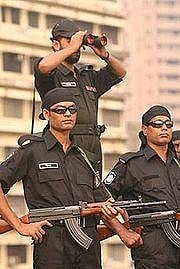
Dhaka, Dec 24 (bdnews24.com) — The UK government faces a legal challenge to its support for Bangladesh's anti-crime elite force Rapid Action Battalion (RAB).
Lawyers are to seek a judicial review of the legality of training assistance provided to RAB, arguing that it places the UK in breach of its obligations under international law.
The legal challenge is being mounted by Phil Shiner of Public Interest Lawyers, which represents the family of Baha Mousa, the Iraqi hotel receptionist tortured to death by British troops in 2003, according to a report run by The Guardian.
Members of RAB have been held responsible for hundreds of extrajudicial killings since the unit was established in 2004. The unit itself admits to being responsible for more than 600 deaths, which it euphemistically attributes to 'crossfire'.
Dhaka has resisted pressure to disband the unit, as influential British newspaper The Guardian reported, with one government minister declaring last year: "The government will need to continue with extrajudicial killings, commonly 'called crossfire'."
Details of British support for RAB were revealed in US embassy cables released by WikiLeaks and reported by the Guardian on Wednesday.
bdnews24.com was the first to run the news in Bangladesh.
They show that the government has been providing training in 'investigative interviewing techniques' and 'rules of engagement'.
At least some of the training has been provided by serving police officers who travelled to Bangladesh under the auspices of the National Policing Improvement Agency (NPIA), a body established three years ago to promote good practice in UK policing and share it with overseas police.
In a letter to the Foreign Office and Home Office, Phil Shiner of Public Interest Lawyers alleged that the UK had 'aided and assisted Bangladesh in breaching peremptory norms of customary international law'. The UK must withdraw its support for RAB, conduct a prompt investigation and possibly pay compensation to the unit's victims.
Shiner said: "The British public by now should be sick of our governments' hypocritical approach to torture and unlawful killings. It pretends to condemn both, but in practice it aids and assists states that they know are violating these basic rights. This represents a serious violation of international law."
The British Foreign Office has defended the training as 'fully in line with our laws and our values'. A spokesman sought to suggest it was providing only 'human rights training' for RAB, although NPIA says other training has been given, and RAB's head of training told the Guardian he was unaware of any human rights training since he was appointed last June.
NPIA asked whether it was appropriate for British police to be training members of "a government death squad", and whether courses in investigative interviewing techniques might not render torture more effective, and said the support had been approved by the government and the Association of Chief Police Officers.
RAB officers say they received British assistance as recently as last October, five months into the coalition government.
The leaked cables make clear that the United States believed RAB would be an ideal partner in counter-terrorism operations, but was unable to offer the sort of assistance the British have been providing because of the US law, which prohibits training or financial support to overseas military units responsible for gross human rights abuses.
Complaints about British support for RAB are to be raised at a human rights advice group established last month by William Hague, the foreign secretary. Sapna Malik, a lawyer and member of the group, said: "The reports make for very disturbing reading and I intend to raise this issue at the foreign secretary's advisory group on human rights."
Human Rights Watch, the New York-based NGO that has been condemning RAB as a death squad for more than four years, said the UK should withdraw its support immediately.
Meenakshi Ganguly, the group's South Asia director, told the Associated Press: "Criminals should be arrested, prosecuted and punished, not randomly picked up and killed in an effort to put an end to the activities of which they are suspected. The UK and the US should stop their co-operation unless there are immediate and visible efforts to reform RAB, and hold those responsible for human rights violations to account."
Human rights activists say they were particularly dismayed to learn of the British support for RAB, as the unit enjoys a degree of popular support in Bangladesh, and is likely to be disbanded only as a result of pressure from other governments. They argue that British support lends a degree of legitimacy to RAB and to the methods it employs.
bdnews24.com/adk/mr/1120h