Published : 09 Aug 2023, 03:46 AM
Updated : 11 Aug 2023, 09:34 PM


Moinul Hoque Chowdhury, Special Correspondent, bdnews24.com
Flooding caused by heavy downpour and onrush of water from the upstream is very common by the end of monsoon in Bangladesh’s north and northeastern region.
This time the hilly districts in the southeast are experiencing devastation from widespread flooding.
Hundreds of thousands of people have been stranded in Chattogram, Bandarban, Rangamati, Khagrachhari and Cox’s Bazar after days of rains.
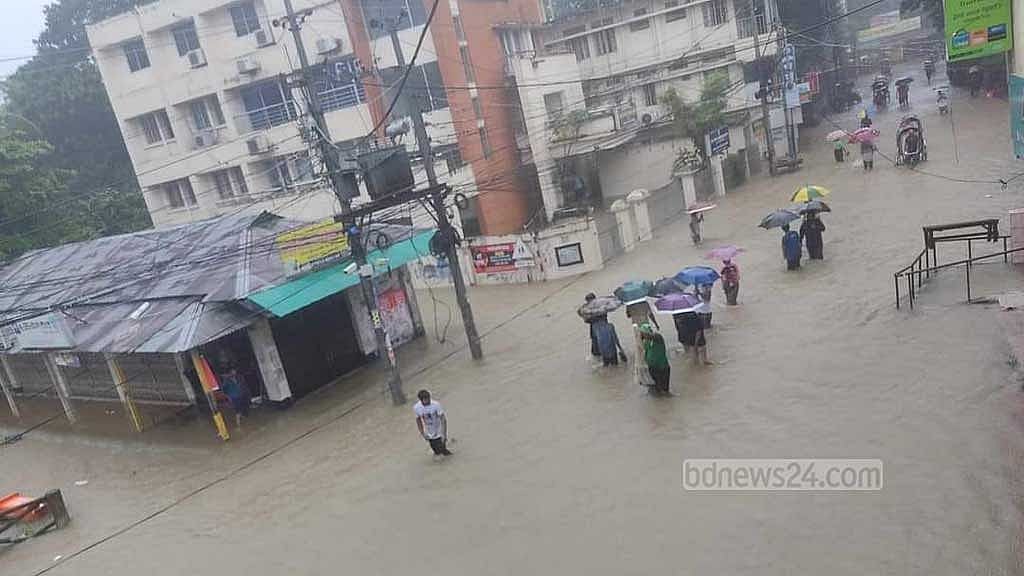
The situation appears to be worse in Bandarban than in the other districts, with mobile and internet connectivity outages since Sunday night, and important government offices in the city submerged in knee-deep water.
Roangchhari, Ruma and Thanchi Upazilas have been totally cut off while long-haul bus services from the town have been suspended.
The town is situated in relatively low-lying land along the Sangu River in the district which has the highest hills of the country.
Locals said the removal of stones from the river for sale led soil from hills excavated for urbanisation to gather in the riverbed and cut the capacity of the Sangu to carry more water, causing the flooding of the town.
Photos showed many one-storey buildings in the town have gone almost totally under water, with only the rooftops left.
AKM Zahangir, chairman of Sadar Upazila Parishad, said: “Water used to flow through the falls throughout the year once. But now they are gone, the rivers carry the water. There’s no alternative route for the water to go away.”
“And if the Shankha River (Sangu) overflows, Ruma, Thanchi and Bandarban must go under water. The Matamuhuri River will inundate Lama, Alikadam and Naikkhyangchhari in such a case. This is the reality.”
Zahangir said deforestation caused the soil to fill up the rivers, causing them to overflow.
In 1997, Bandarban experienced extensive flood damage after it took six to seven hours for the water to recede, according to him.
This time, the floods have been continuing for three days.
Zahangir thinks the situation will be worse in the future if deforestation and hill cutting for unplanned urbanisation continue.
AKM Saiful Islam, a professor of the Institute of Water and Flood Management at the Bangladesh University of Engineering and Technology, agreed with Zahangir.
“The places through which the water can flow are being destroyed. Canals and Beels are losing their carrying capacity. And we are transforming the soil through unplanned urbanisation.”
He said in Bandarban, like other places in Bangladesh, drains get clogged by solid waste that is not properly disposed of.
“And the places through which water used to be infiltrated are being transformed into buildings and roads. We’re also occupying the lakes and ponds that used to hold the water.”
The BUET professor also highlighted the effects of climate change in such rare natural disasters. “We have a little rain sometimes. But when we have downpours, it rains heavily.”
Sharif Chowhan, president of Chattogram-based environmental organisation People’s Voice, blamed the government’s inaction in saving the hills for deadly landslides during rain in recent years.
“Deadly landslides will continue if the government doesn’t act tough,” he said.