Home
+
Published : 08 Feb 2025, 04:41 AM
The difference between Bangladesh before and after Aug 5, 2024, in terms of state philosophy and political trajectory, is vast.
Yet, for many of its citizens, the impact of these changes is not immediately felt in their day-to-day lives.
For Aftabur Rahman, a middle-aged college employee in Dhaka’s Tejgaon, the most pressing issue remains the same: the unrelenting challenge of making ends meet.
When asked about the changes he has noticed in Bangladesh under the interim government over the past six months, he started by mentioning the market prices.
“I searched seven shops to buy a one-litre bottle of soybean oil. They charged me Tk 190. The government has changed, but nothing has changed in the market."
While the Muhammad Yunus-led government set the price of soybean oil at Tk 175 per litre in December 2024, Aftab claims shopkeepers are charging more, citing "crisis" as the reason.
"When I mentioned the fixed price, the shopkeeper told me to go buy it from the government."
Amid the heat surrounding the ousted Awami League's programme and the election-focused activities of political parties supporting the mass uprising, the caretaker administration led by Yunus has completed six months in office.
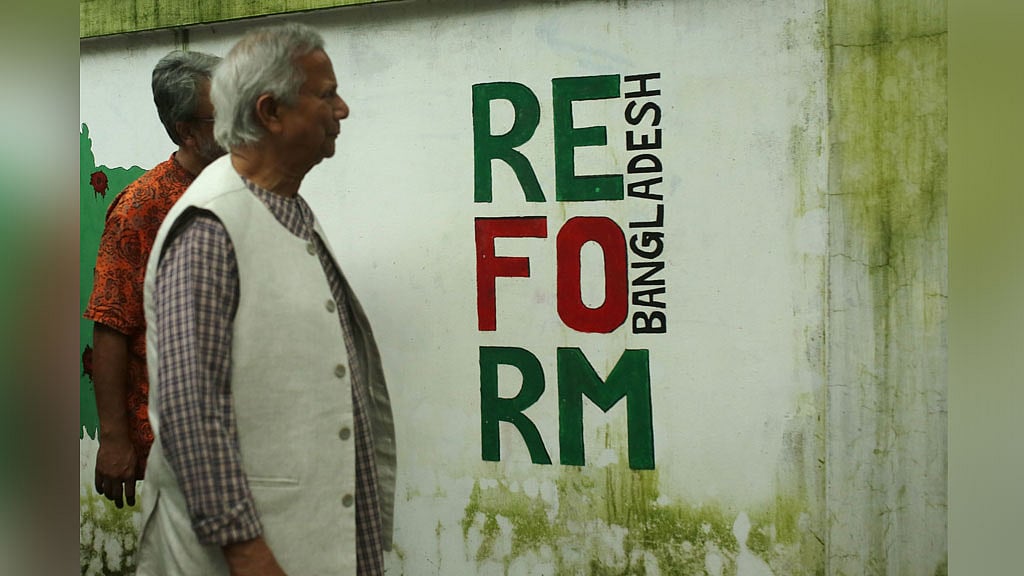
The government’s key promise was to reform the state, but those efforts are still limited to awaiting commission reports.
Now, it is focused on securing political consensus among parties on the reforms and laying out a roadmap for future changes.
Analysts and citizens alike point out that the law and order situation has yet to improve to a level that would restore public confidence.
Meanwhile, the interim government is focusing on prosecuting numerous crimes committed during the 15-year rule of the Awami League.
Despite the government's assurances of steering the economy back on track with different initiatives, analysts argue that most macroeconomic indicators are yet to show promising results.
Ordinary citizens, especially the lower and middle classes, continue to suffer from the rising prices of essentials.
The political commentators believe that, in contrast to the situation on Aug 8, 2024, when the Yunus government took office, there has been little visible progress.
Zobaida Nasreen, a professor at Dhaka University, remarked that the interim government has long surpassed the time when it was expected to show substantial progress.
"Most of the aspirations and promises arising from the mass uprising remain unfulfilled. The reforms have not even begun.
“One of the government’s biggest flaws is that the law and order situation has yet to improve. The government is still relying on mobs to maintain control.”
Prof Zobaida, referring to the demolition of Sheikh Mujibur Rahman's house at Dhanmondi-32, said: "Despite numerous threats on Facebook, the government has failed to provide adequate security.
“There are shortcomings in ensuring both public and state property safety."
A student-led movement that emerged from a High Court order reinstating the quota system in government jobs evolved into an anti-government protest.
The powerful impact of the protests led to the fall of the Sheikh Hasina regime in August 2024.
Hasina, Bangladesh’s longest-serving prime minister and once a towering figure in South Asia’s political landscape, fled to India seeking refuge.
Just three days after her 15-year rule ended, an interim government, headed by Chief Advisor Yunus, took charge.
Student leaders who had led the movement that toppled the Awami League government were also included in this new administration.
During the regime change, police came under intense public scrutiny for accusations of "extrajudicial killings" while suppressing the movement.
Amid attacks on stations and looting of weapons, police virtually abandoned the field.
After taking office, Yunus accused the Hasina government of running an "authoritarian dictatorship" and promised sweeping state reforms.
He has since been saying that after carrying out the reforms, elections will be held and the responsibility will be handed over to the elected government.
However, political parties, including the BNP, are pressing for elections to be held sooner, with the expectation that the core reforms be implemented by the next elected government.
As part of the reform initiative, six commissions were formed in early October to focus on constitutional, electoral, administrative, police, judiciary, and Anti-Corruption Commission reforms.
The reports from these commissions have been handed over to the chief advisor.
Based on the reports of these six commissions, the government has formed a “National Consensus Building Commission” to engage in discussions with political parties to advance the reform process.
The commission is headed by Yunus and includes the heads of the six reform commissions as members.
Law Advisor Asif Nazrul said the complete report of the reform commissions formed after the political upheaval last August will be released on Feb 8.
“At the same time, the heads of the commissions will present unanimous recommendations on what needs to be done immediately or mid-term and what the elected government can do on that day," he added.
After receiving the reports from the last two of the six commissions, Chief Advisor’s Press Secretary Shafiqul Alam said on Wednesday: The timing of the next national election will depend on the implementation of the “July Charter”, which will be finalised based on consensus among political parties and civil society regarding reform commissions’ reports.”
The National Consensus Building Commission is expected to start talks with political parties in mid-February, according to the interim government.
Based on those discussions, the implementation of the reform measures will be planned.
Prof Zobaida highlighted the “fragmentation” in the reform commission's reports.
“They are not connected; there are contradictions. Although the issue of pluralism is presented in the report of the Constitutional Reform Commission, the government is bowing to a specific religious group.'"
REFORM VS ELECTION
Parties supporting the anti-Hasina movement are continuing their political activities within the government's reform agenda.
The Anti-discrimination Student Movement and National Citizens’ Committee announced the formation of a new political party.
However, the BNP leaders accused them of attempting to form the party with “government assistance”.
Although political parties said they will give time to the government for reforms, they are emphasising the need for a national election.
In contrast, the interim administration is insisting that elections will be held after the “necessary” reforms are completed.
In December 2024, Chief Advisor Yunus said the 13th national election could potentially take place by the end of this year or in the first half of the next.
In an exclusive interview with Japan’s state broadcaster, NHK World, on Wednesday, he hinted that elections may be held by the end of this year.
Political analysts suggest that while the BNP supports reforms, its strategy appears to be exerting pressure on the government to ensure swift elections.
Recently, there was a heated exchange between ICT Advisor Nahid Islam and BNP Secretary General Mirza Fakhrul Islam Alamgir regarding elections, reforms, and the formation of a new student-led political party.
Fakhrul remarked that if the interim government is involved in the formation of political parties, their neutrality may come into question.
He added that if it cannot maintain impartiality, there will be a need for a “neutral government” during the election period.
In response, Advisor Nahid stated that if student leaders in the interim government join political parties, they will leave the administration before doing so.
Ahead of the elections, BNP and Jamaat-e-Islami are attempting to align with smaller political parties that are opposed to the Awami League.
In the context of electoral strategies, the BNP leaders are now speaking out against their long-time ally, Jamaat.
Kazi Mohammad Mahbubr Rahman, an associate professor of political science at Dhaka University, told bdnews24.com: "Political parties are giving time to the interim government for its work and reforms."
"If the demands of the parties are not properly fulfilled after some more time, the parties may take a different stance.
A NEW POLARISATION IN POLITICS WITHOUT AL
Since losing power, Awami League chief Hasina has been in India.
While some of her party's senior leaders have been arrested, most are still in hiding.
Charges were brought against Sheikh Hasina and others at the International Crimes Tribunal, accusing them of committing 'genocide' during the crackdown on the student movement.
The Awami League government's crackdown on the student movement has been considered “genocide” and charges have been filed against Sheikh Hasina and others at the International Crimes Tribunal.
The interim government has initiated the process of trying them.
Between Jul 5 and Aug 5, 2024, over 50 allegations of “genocide and crimes against humanity” were filed with the investigation agency and prosecution office of the tribunal.
In two of these cases, the tribunal issued arrest warrants against Hasina, her family members, and several Awami League leaders.
On Dec 23, Bangladesh sent a diplomatic letter to India requesting the extradiction of the ousted prime minister for trial.
However, India has yet to provide an official response to Bangladesh on the matter.
Despite some initiatives by the Awami League over the past six months, they have been unable to regain their footing in the political arena, mainly due to the positions of the interim government, BNP, Jamaat, and other political parties.
The party announced a series of protest programmes in February, including a nationwide dawn-to dusk hartal on Feb 18.
On the night of Wednesday, marking six months since the government's fall, an announcement was made that Hasina would address the student community.
The move immediately provoked sharp reactions from the Anti-discrimination Student Movement.
After that, a “Bulldozer March” was announced towards Sheikh Mujibur Rahman’s residence at Dhanmondi-32.
As Hasina’s speech was being delivered, thousands gathered at the site.
That very night, excavators and cranes were brought in to demolish the house, a historic witness to Bangladesh’s liberation struggle, which had been set on fire on Aug 5, 2024, the day the Awami government ousted.
At one point, a military unit arrived at the scene but withdrew shortly after. While police took no visible action, Dhaka Metropolitan Police Commissioner Sheikh Sajjat Ali stated that they remained on "high alert”.
Apart from Hasina’s residence, Sudha Sadan in Dhanmondi, the homes of her relatives across the country were set on fire and looted.
The interim government blamed Hasina’s "incendiary remarks" for the destruction.
To prevent her from making "false claims" from India, the government summoned acting Indian high commissioner in Dhaka and handed over a protest letter.
India’s Ministry of External Affairs issued a statement expressing concern over the attacks on Bangabandhu’s house, calling the incident “sad”.
Chief Advisor Yunus urged all to refrain from destroying Hasina’s family properties and attacking Awami League supporters.
Although the Awami League has not been officially banned, the Movement and the Citizens’ Committee are actively advocating to prevent the party from participating in elections.
Prof Mahbubur said, “It would not be accurate to say that the Awami League no longer exists. The party is not actively engaging in programmes, but it is still announcing some in certain areas.
“The Awami League has not been banned. The government, the BNP, and others have spoken about its political space. However, the trials remain a key factor. How they navigate these challenges and make a return remains to be seen.”
In this political climate, religious-based parties have become highly active. The Jamaat-e-Islami, which has suffered repression during the Awami League's 15 years in power, is working to reorganise its grassroots base.
Similarly, the Islami Andolan Bangladesh is seeking to emerge as a new force in the country's politics.
On Jan 8, BNP Chairperson Khaleda Zia went to London for medical treatment. This raised two recurring questions in political discussions.
Many BNP leaders and activists have been counting the days, hoping for the return of their exiled leader.
However, they are yet to receive an answer on when BNP's Acting Chairman Tarique Rahman will return to the country.
And from there, the second question arises. Social media was buzzing with speculation—has the “Minus Two” formula from fifteen years ago been implemented after all?
ECONOMIC OUTLOOK
When asked about the interim government's success in managing the economy over the past six months, Zahid Hussain, a former lead economist at the World Bank's Dhaka office, said: “While there has been notable progress in balancing international transactions, there is little to celebrate in the overall economy.”
This progress has largely been driven by export growth and a surge in remittance inflows.
According to Zahid, despite ongoing labour unrest, factory closures, blockades, and deteriorating law and order, exports have continued to expand at a rate of 12-13 per cent—an achievement that required considerable efforts to maintain production and ensure worker participation.
There has also been a significant rise in remittances. “In January, remittances reached $2.18 billion, a marked improvement from the previous average of $1.70 billion, though it slightly weakened in January,” he said.
However, Zahid highlighted two critical issues where economic progress is lacking: inflation and investment.
“There’s no success in these areas. While imports have grown, it’s mainly for consumer goods and raw materials.
“In the garment sector, production is necessary for exports, but capital machinery imports are still in the negative. This reflects a lack of confidence in investment.”
Despite these concerns, the economist acknowledged that government policies are now more aligned with implementation, particularly in monetary policy and the Annual Development Programme, or ADP.
Still, he pointed out that the areas most affecting ordinary people—rising costs, employment opportunities, and wages—have seen no tangible improvement.
When asked to rate the government’s economic performance on a scale of 10, Zahid Hossain gave a score of five, saying even this assessment was generous.
Prof Zobaida said, “While vegetable prices may have slightly decreased, we’re still seeing job insecurities and layoffs.
“Many external aids have been cut off or not renewed. The government is struggling to secure funds, and interest rates have been raised, all of which point to a fragile economic situation,” she concluded.
LAW AND ORDER IMPROVES, NORMALCY ELUSIVE
For three days, Bangladesh teetered on the brink of anarchy following the collapse of the Awami League government and the delayed installation of an interim administration.
Police, facing an onslaught of public anger, abandoned their stations as the country found itself effectively leaderless.
In the absence of law-enforcing agencies, residents took it upon themselves to guard their communities against looters and criminals.
Six months later, despite relative stability, a return to normalcy remains elusive. Calls for policing reform have grown louder, but the government's response has been cosmetic at best.
Among its initiatives: a change in the uniforms of law enforcement personnel. A reform commission, established to overhaul the system, has submitted its findings to the Office of the Chief Advisor.
Crime, meanwhile, continues unabated. Reports of kidnappings and murders fill the headlines, while accusations of police inaction fuel public frustration.
Vigilante justice is on the rise, with mobs increasingly taking enforcement into their own hands. The interim government, which came to power buoyed by student and public support, has struggled to rein in the growing lawlessness.
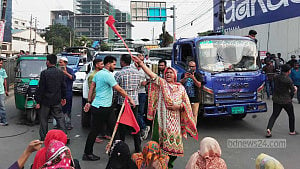
Protests have become a near-daily occurrence, with demonstrators frequently blocking roads to press their demands.
The government’s apparent inconsistency in responding to these demands—acceding to some while ignoring others—has only exacerbated tensions.
In an effort to ease the crisis, officials have announced plans to involve former military officers and students in traffic management.
But experts warn that such measures do little to address deeper structural issues.
Nurul Huda, former inspector general of police, believes restoring the force’s effectiveness will be a long and arduous process.
"Police have suffered significant losses in both manpower and equipment," he told bdnews24.com.
"Many officers are facing criminal charges. It will take time to rebuild morale and restore functionality. Work is under way, but recovery will not be immediate."
Huda also sounded skeptic over the recommendations of the Police Reform Commission.
“From what I have observed," he said, "they have yet to address many fundamental tasks. There is nothing new in the report from the Police Reform Commission. It offers no fresh insights.
"And the points it raises remain valid, regardless of whether they appear in the commission’s findings—they are already part of daily practice.”
“For instance," he explained, "the question of whether force should be used is clearly outlined in the law. While reiterating them is not necessarily harmful, it is hardly transformative."
Meanwhile, Prof Zobaida argues that the government’s selective responsiveness has fuelled widespread unrest.
"Why are protests erupting so frequently? Because when the government concedes to one group’s demands within an hour, others take note and follow suit," she pointed out.
"Some voices are heard, while others are ignored. The government has shut down avenues for dialogue."
She went further, accusing the government of tacitly “encouraging” mob justice.
[Writing in English by Sheikh Fariha Bristya and Ruhshabah Tabassum Huda]