Published : 09 Jul 2026, 07:26 PM
Updated : 08 Sep 2026, 09:23 AM


Production has resumed at nine jute mills after lease agreements were signed as part of the government's initiative to revive closed state-owned industries, Commerce Minister Khandakar Abdul Muktadir has announced.
He said that out of the 25 closed jute mills, 20 have been selected for leasing, and lease agreements have already been finalised for 14 of them. Production has begun at nine mills.
"These mills have created employment opportunities for approximately 9,500 people and are currently producing around 160 metric tonnes of jute products daily," the minister said.
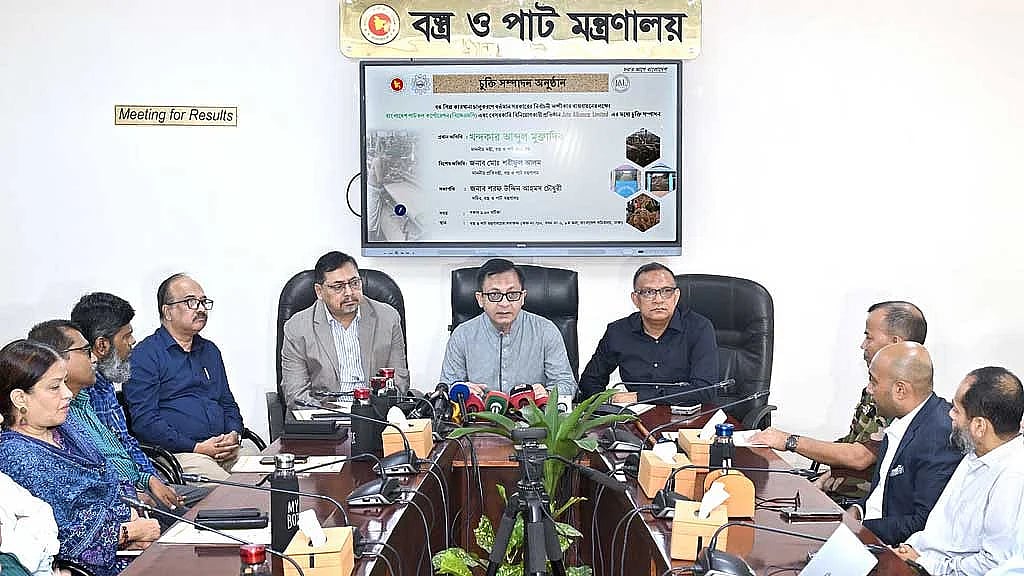
He made these remarks at a press briefing on Thursday following the signing of an agreement to lease an additional 14.80 acres of land belonging to the Narsingdi unit of Bangladesh Jute Mills Limited (BJML) to Jute Alliance Limited. The event took place at the conference room of the Ministry of Textiles and Jute at the Secretariat.
The minister said that the new initiative is expected to attract around Tk 10.5 billion in investment.
"With this investment, it will be possible to produce goods worth nearly Tk 30 billion annually, while creating employment for an additional 3,000 people," he said.
He added that the government's objective is to transform idle state-owned industrial assets into productive, employment-generating resources.
"If state-owned assets remain idle for a long time, they become liabilities rather than assets. Therefore, revitalising closed mills through modern technology and new investment, and bringing them back into production and economic activity, is one of the government's top priorities," he said.
The minister noted that instead of operating businesses directly, the government is encouraging efficient private-sector investment.
"Various Public-Private Partnership (PPP) models—including long-term leases, revenue-sharing arrangements, and joint ownership structures—are being implemented to revive state-owned industrial enterprises."
He expressed optimism that production activities would become visible in most of the currently closed industrial establishments within the next two years.
Regarding the Narsingdi facility, the minister said that 34.5 acres of the mill's total 77.02 acres had previously been leased to Jute Alliance Limited.
"That facility is currently producing around 40 tonnes of jute products per day and has generated employment for approximately 3,200 people. The addition of more land will further increase the company's production capacity and investment potential."
Responding to a question about export earnings, the minister said that global conflicts, declining demand in European markets, and new tariff policies have reduced consumer spending in international markets.
However, he noted that Bangladesh's ready-made garment (RMG) industry is gradually shifting toward higher-value man-made fibre products and other value-added products.
He hoped that once this transition is complete, Bangladesh will be able to earn more foreign currency even by exporting the same volume of goods.
State Minister for Textiles and Jute Md Shariful Alam said that reopening closed industrial establishments is one of the current government's key election commitments.
He added that, in phases, production activities will also be restarted at other closed enterprises under the Bangladesh Jute Mills Corporation (BJMC), Bangladesh Textile Mills Corporation (BTMC), and other state-owned industries through private-sector investment.
Speaking on behalf of Jute Alliance Limited, Mohammad Mostafa Haider said that, under the government's initiative to reopen closed jute mills, the company has created employment for nearly 3,000 people over the past two years.
He said the factory's daily production capacity has been increased from 35 metric tonnes to 50 metric tonnes, and that 100 percent of its products are being exported.
He further announced that, in the next phase, the company plans to invest Tk 10 billion in a seed crushing project with a daily processing capacity of 3,000 tonnes. The project will be implemented with the support of the International Finance Corporation (IFC).
According to him, the project will produce soybean oil and soybean meal, helping strengthen the country's food security while creating approximately 3,000 additional jobs.
The event was also attended by Cabinet Secretary Nasimul Ghani and Secretary of the Ministry of Textiles and Jute Sharaf Uddin Ahmed Chowdhury.