Home
+
Published : 14 Jul 2026, 02:18 AM
For almost a decade, Bangladesh's most influential street artist has remained a mystery.
The creator behind the iconic "Subodh" murals has never revealed an identity, spoken publicly or granted an interview.
Yet the anonymous artist known only as HOBEKI has become one of Bangladesh's most recognisable voices of political dissent, making anonymity an integral part of the artist's identity.
Now, that mystery appears to have crossed a border.
According to The Federal, an Indian digital news media outlet, a mural carrying HOBEKI's unmistakable signature has surfaced in India's northeastern state of Sikkim, prompting a police investigation and sparking debate over whether the elusive Bangladeshi artist -- or someone inspired by the artist's work -- has brought Bangladesh's most enduring protest symbol onto Indian soil.
The artwork was recently discovered on the Majitar Nala Bridge along the Gangtok-Rangpo Road.
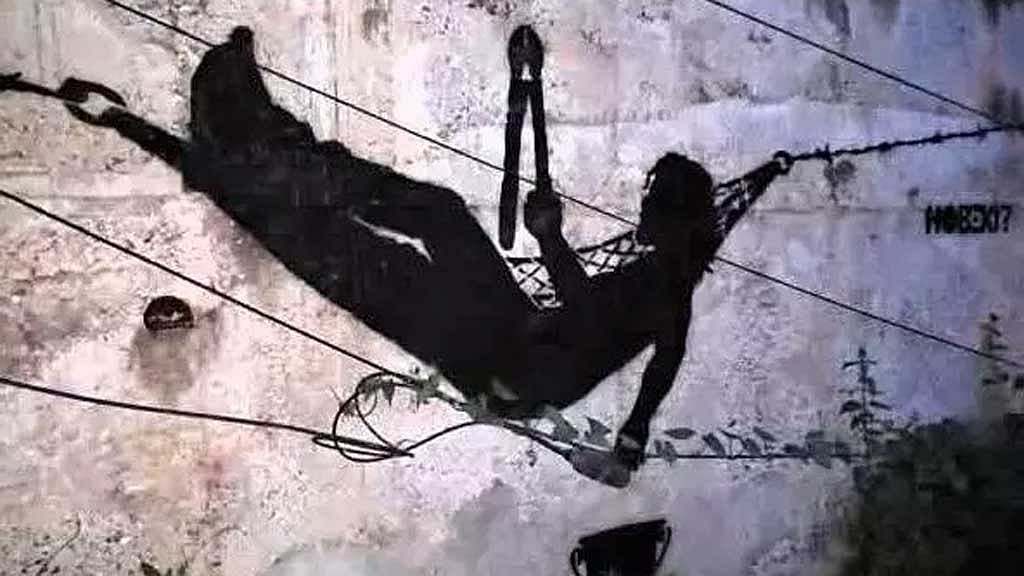
Painted in stencil and spray paint across a concrete wall measuring roughly 20ft by 12ft, it depicts Subodh, the frail, anonymous figure that has appeared unexpectedly on walls across Bangladesh since 2017.
Its location has amplified the intrigue.
The Gangtok-Rangpo Road serves as Sikkim's main connection with the rest of India and feeds directly into the Siliguri Corridor -- the narrow stretch of land linking India's northeastern states with the mainland.
Bordered by Bangladesh, Nepal, Bhutan and China's Tibet Autonomous Region, the corridor is regarded as one of India's most strategically sensitive transport and security routes.
"Any unusual activity in the region, however symbolic, inevitably attracts official attention. And that is exactly what has happened here," Probir Pramanik, a Siliguri-based journalist who has covered the strategically sensitive region for more than three decades, told The Federal.
According to the publication, Sikkim police have launched an investigation to determine who painted the mural and whether it has any direct connection to HOBEKI.
Investigators reportedly believe the artwork may have been created by a Bangladeshi student enrolled at a private university in Sikkim who has since returned home during the university vacation.
"We suspect the mural is the handiwork of a Bangladeshi student studying in Sikkim. We have already questioned him over the phone," a senior police official familiar with the investigation told The Federal on condition of anonymity.
Authorities are also trying to establish whether the mural was painted by HOBEKI personally, reproduced by one of the anonymous artist's followers, or simply copied by an admirer of the internationally recognised protest symbol.
"We are in touch with the suspect and are trying to find answers to those questions," another police official told The Federal, declining to disclose further details because the investigation remains ongoing.
No charges have been filed.
The emergence of the mural has also revived interest in the story behind Subodh, a figure that has become inseparable from Bangladesh's political and cultural landscape.
When the character first appeared on walls in Dhaka in 2017, Subodh was portrayed as a thin, weary young man seemingly trapped by fear and repression.
Accompanied by the signature "HOBEKI?" -- a Bengali play on words meaning "Will it happen?" -- the murals questioned authority without explicitly naming political parties or leaders.
Captions such as "Subodh, run away. The times are not in your favour" and "Subodh, there is nothing in your fate" resonated widely during a period of growing political polarisation, censorship and shrinking space for dissent, The Federal reported.
Over time, the image spread far beyond the walls where it first appeared. Artists, students and activists reproduced the figure across Bangladesh, transforming Subodh into a widely recognised symbol of silent resistance.
Several original murals later disappeared after attracting public attention, adding to the mythology surrounding the anonymous artist.
The symbol acquired fresh significance during Bangladesh's student-led uprising in July 2024.
As demonstrations against the Sheikh Hasina government spread across the country, new Subodh murals appeared throughout Dhaka.
Remaining anonymous, HOBEKI encouraged supporters to download stencil templates and recreate the artwork themselves, enabling identical images to proliferate across the capital without the artist's physical presence.
By the time the movement culminated in the fall of the Awami League government, Subodh had become one of the defining visual symbols of the uprising.
The mural discovered in Sikkim, however, presents a noticeably different interpretation.
Instead of appearing frightened or fleeing, Subodh is shown lying shirtless in a hammock suspended from strands of barbed wire while holding a wire cutter.
Beneath the hammock sits an empty bucket, with the familiar "HOBEKI?" signature beside the image.
According to The Federal, the imagery has invited several interpretations. The barbed wire could represent international borders, the wire cutter may symbolise breaking through barriers, while the hammock might suggest refuge or arrival after escape.
The empty bucket, positioned in the Teesta river basin, has also been viewed by some observers as a possible reference to the unresolved Teesta water-sharing dispute between India and Bangladesh.
None of those interpretations, however, can be independently verified. HOBEKI has offered no public explanation, and the artist's carefully guarded anonymity continues to prevent any direct clarification.
The timing has also attracted attention.
India resumed tourist visa services for Bangladeshi citizens on Jun 28 after a suspension of nearly two years. Around the same time, Bangladesh's best-known protest symbol appeared in India for the first time.
The development also comes as New Delhi closely watches China's expanding engagement with Bangladesh, particularly Dhaka's efforts to secure Beijing's support for the long-delayed Teesta River Comprehensive Management and Restoration Project.
Police told The Federal that the mural does not appear, at first glance, to pose any security threat. Even so, investigators continue to examine why it was created at such a sensitive location.
Meanwhile, unidentified individuals have defaced the artwork, underscoring the curiosity and controversy it has generated while the mystery surrounding both the mural and its elusive creator remains unresolved.