Home
+
Published : 02 Apr 2025, 03:33 AM
The increasing frequency of earthquakes in Bangladesh and the surrounding region has given a reason for caution to experts, who believe these are signs of an impending major earthquake.
They predict that a major earthquake could rattle the borders of Bangladesh and India “at any time”, potentially capable of levelling the unplanned infrastructure of Dhaka.
Experts also see a lack of preparation in facing a strong earthquake and the massive destruction one could cause, and the disaster management ministry admitted it as well.
A powerful magnitude 7.7 earthquake in Myanmar laid devastation on Mar 26, causing devastation by tearing down buildings, bridges and infrastructure as thousands of people were found dead or injured after the dust settled on the worst earthquake in the country in over a century.
The US Geological Survey predicts the death toll could pass a staggering 10,000 in the coming days.
The seismic waves of the Myanmar quake, the epicentre of which was traced near Mandalay, also hit Thailand and some places in Bangladesh. Thailand reported fatalities and damages, though Bangladesh did not suffer the brunt of the tremors.
Yet the frequent earthquakes in this region are a cause for concern for Bangladesh as well.
The Fire Service and Civil Defence are also worried that an earthquake of similar intensity could occur in Bangladesh, with the Chattogram, Sylhet, Mymensingh and Dhaka regions in particular at high risk.
On Saturday, the fire service, in a statement, advised preparation and awareness at all levels to face an earthquake.
The stats of recent years show as many as 27 earthquakes shook Bangladesh and nearby regions in 2021. The following year another 19 occurred, 35 in 2023, 54 in 2024 and 22 in 2025 until Mar 5.
Nine of the quakes originated in Bangladesh in 2021, seven in 2023 along with two others on the Bangladesh-India border, 13 in 2024 and four in 2025 until Mar 5. None of the quakes in 2022 were sourced to Bangladesh.
These earthquakes measured magnitudes of 2.8 to 6 on the Richter scale.
Prof Mehedi Ahmed Ansary of BUET’s Department of Civil Engineering believes these quakes were a prelude to a stronger one.
He said, on average, a magnitude 7 earthquake occurs in this region every 150 years and a magnitude 8 earthquake occurs every 250 to 300 years. Quakes of magnitude 7 to 8.5 historically occurred from 1762 to 1930 in this region.
“But no powerful earthquake hit [Bangladesh] over the past 100-150 years. Now a magnitude 7 earthquake may occur, but a magnitude 8 quake is unlikely.
A powerful earthquake will occur between 2020-2030, he said.
“A powerful earthquake is preceded by smaller ones, we call these foreshocks. We’re seeing many foreshocks and the frequency is higher over the past two-three months.”
Geologist Prof Syed Humayun Akhter agrees with the idea.
He explained that the energy accumulated by the smaller quakes would emit one around magnitude 8.2 to 9.
“Although Bangladesh is a less earthquake-prone country, it’s near the top of the list for countries at risk. If the amount of energy stored at the junction of the India-Burma plate is released, a magnitude 8.2 to 9 quake will occur. It can happen tomorrow, it can happen 50 years later. All we can tell is that it will be catastrophic. The earthquakes in the subduction zones are very dangerous.”
Prof Humayun has said earthquakes, volcanic eruptions, and the formation of mountains all depend on the lithospheric plates forming the crust. The lithosphere, extending 70-100km deep below the surface of the earth, is divided into 13 plates.
These plates residing over the asthenosphere, a warm and soft region within Earth's upper mantle, remain moving.
To the north of Bangladesh is the junction of the Indian Plate and the Eurasian Plate; to the east is the junction of the Burmese Plate and the Indian Plate. As the plates are moving, Bangladesh’s territory is slowly moving with it as well.
Analysing the geological structure of Bangladesh, he said among the faultlines that can potentially emit a powerful earthquake were the Dauki Fault on the Sylhet-Meghalaya border and the Sitakunda-Teknaf Fault along the Chittagong coast.
Apart from those, there are numerous cracks in the plains of the country, including the Chittagong Hill Tracts, which can cause earthquakes. There are cracks in the east, west, north, and south of Dhaka, that is, all around it.
Meteorologist Rubayet Kabir from the Earthquake Monitoring and Research Centre, Bangladesh Meteorological Department, said with the rising stats on earthquakes, the number of observation stations is increasing as well, and so is awareness; as a result, earthquakes are being detected as soon as they occur.
Bangladesh currently has 13 earthquake observatories, which is a huge leap from only one in 1954.
Rubayet said, “We’re able to detect all the earthquakes due to having more stations and social media is dragging the spotlight on even minor earthquakes, the campaign is also more now. I won’t say right now from stats that it has increased. Earthquakes are like sine waves. It rises and then falls. But the frequency of earthquakes has increased over the past few years.”
PROJECTED DESTRUCTION
In 2009, a joint survey by the Combined Disaster Management Programme (CDMP) and Japan International Cooperation Agency (JICA) showed an earthquake measuring magnitude 7 or above on the Richter scale would level 72,000 buildings and damage 135,000 others.
On Feb 6, 2023, Turkey and Syria experienced two separate quakes, measuring magnitudes 7.8 and 7.5. More than 50,000 people died in both countries combined in the tragedy, while 520,000 apartments of 160,000 buildings were left in ruins in Turkey.
Mehedi expressed deep concerns about the devastation an earthquake of significant magnitude could bring to Bangladesh.
He warns that the country is particularly vulnerable due to its dense population and lack of preparedness.
“An earthquake of this magnitude will definitely happen in Bangladesh,” he said, pointing to potential epicentres along the Bangladesh-India border, in Madhupur, or Sreemangal.
“But the damage here will be greater because we have a large population,” he noted.
Citing historical patterns, he emphasised that the infrequency of such quakes—occurring roughly every 150 years—has left them outside the collective memory of the population.
“Several hundred thousand people will die here,” he cautioned.
Meanwhile, Humayun warned that the potential toll of an earthquake in Dhaka is staggering.
He estimates that if even 1 percent of the buildings in the capital were to collapse, the immediate death toll could reach 200,000, with an additional 500,000 to 700,000 people left stranded.
“Although the distance from the earthquake’s origin to Dhaka is 70km to 150km, we have not achieved the capacity to recover from the damage we will suffer,” he said.
He pointed to a lack of government planning and inadequate preparation as critical shortcomings that would exacerbate the catastrophe.
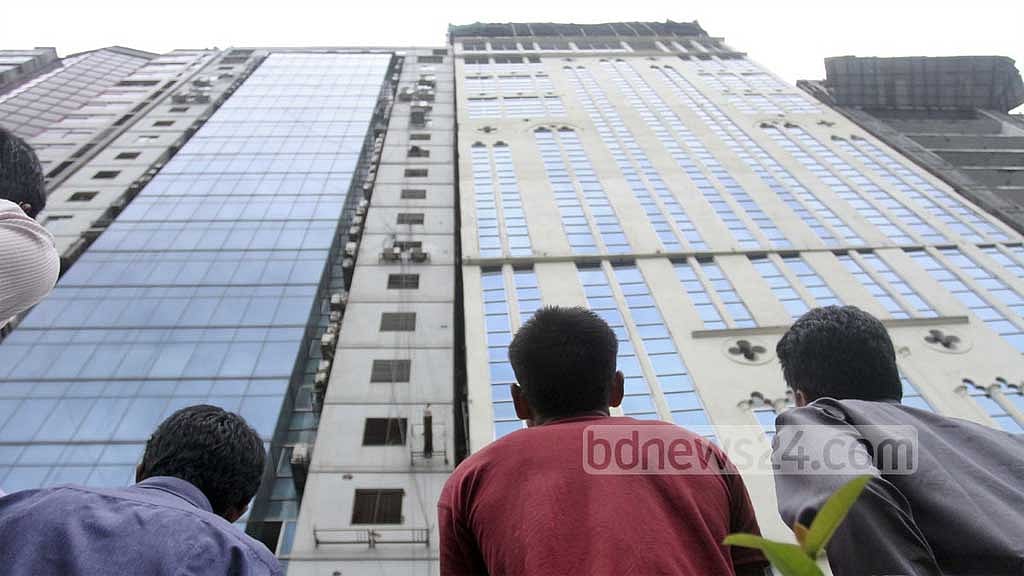
According to him, the city’s dense population, combined with its unplanned urbanisation and a general lack of public awareness, makes Dhaka particularly vulnerable.
Rubayet underscored the dangers posed by weak infrastructure and a lack of adherence to building codes.
He believes that awareness surrounding earthquake safety remains dangerously low in Bangladesh, while many large structures are not constructed according to seismic regulations.
“If structures are built according to rules, the risk of earthquakes is reduced,” he explained.
“If structures are not built to withstand earthquakes, there is a problem.”
He also warned of secondary hazards, such as fires that frequently follow major quakes.
“When an earthquake occurs, buildings collapse, large structures can collapse,” he said.
“Fire tornadoes often occur, and if such a fire tornado happens in Dhaka city, it will be a massacre.”
The city’s narrow roads and extreme population density, he added, would make rescue and recovery operations even more difficult.
For Adil Muhammad Khan, a professor at the Department of Urban and Regional Planning at Jahangirnagar University, the core issue lies in the substandard quality of Dhaka’s buildings.
He argues that much of the city’s expansion has taken place on unstable, reclaimed land, where structures were built on poor-quality soil.
As a result, he fears that a significant portion of the city’s buildings will suffer damage in a major earthquake.
“Millions of buildings will be damaged, and some buildings will collapse, perhaps 20 percent of the buildings will remain standing,” he said.
Beyond structural collapse, he warns of cascading hazards, such as ruptured utility lines.
“There will also be a lot of cracks, and there are utility lines, which can create a catastrophic situation,” he noted, adding that many of these lines are substandard and illegally installed.
A fire sparked by such damage, he fears, could make the situation even worse.
The professor also raised concerns about post-earthquake recovery efforts, noting that Dhaka’s acute shortage of open spaces could significantly hamper rescue operations.
WHAT KIND OF PREPARATIONS ARE REQUIRED?
Experts agree that without planned urbanisation and greater public awareness, Bangladesh will remain vulnerable to catastrophic earthquake damage.
Humayun believes decentralising Dhaka is crucial to reducing earthquake risks.
He argues that the western region of Bangladesh would suffer less damage in the event of a major quake, making it a logical alternative for relocating essential services and infrastructure.
“As a result, Dhaka will have to be decentralised,” he said.
“If important things can be moved to the western part, Dhaka can be quickly restored even if it is damaged.”
He stressed that an earthquake is inevitable.
“There is no doubt that an earthquake will happen, whether today or tomorrow,” he warned, adding that both public awareness and the country’s capacity to recover must be strengthened.
“Meanwhile, the government is not prepared,” he noted, pointing to a critical gap in disaster planning.
To improve preparedness, Humayun called for regular earthquake drills across Dhaka’s urban wards.
Rubayet emphasised the importance of earthquake-resistant construction at all levels—from government projects to private buildings.
“The geology of the area must be maintained during construction,” he said.
“In the event of an earthquake, elevators and escalators cannot be used, there must be no rush,” he explained, stressing that people must also be taught to turn off electrical and gas connections to prevent secondary disasters.
“These rules must be spread through awareness,” he said.
To tackle earthquake damage, Mehedi Advises that both new and old buildings must be strengthened, fire service preparedness increased, and preparations should be made in advance. The fire service’s search and rescue system must be reinforced.
“For the buildings that already exist, government directives will be needed to make them earthquake-resistant. If the government doesn’t issue such instructions... the government itself also needs to understand whether there is an earthquake risk or not.”
Urban planner Adil said to avoid damage, the tendency to construct buildings by filling land indiscriminately must stop, and the quality of construction must be monitored.
“The city must be allowed to expand with consideration for the seismic quality of the soil. Weak buildings must be identified and owners must be compelled to strengthen them — even this would improve the buildings’ resilience to some extent. And there is no alternative to creating open spaces. Utility services must be developed with structural safety through a 5-to-10-year master plan.”
Lt Col Mohammad Tajul Islam Chowdhury, director (Operations and Maintenance) of the Fire Service and Civil Defence Department, said to reduce earthquake-related damage, the fire service and civil defence have prepared themselves through training.
"At the same time, we are advising others to be aware of this issue through campaigns. We are also working to increase our own capacity. More than 55,000 volunteers have already been trained to assist during earthquakes."
The Ministry of Disaster Management and Relief Secretary Mostafizur Rahman has acknowledged that Bangladesh is not in a very good position in terms of the preparation required to tackle earthquake damage.
He said, “We have been able to equip the fire service and the army to some extent. But I don’t think we have yet managed to implement any integrated system. However, there is an ongoing project under which we will move toward integrated earthquake management.”
In July 2015, the Urban Resilience Project was launched to address earthquake and natural disaster risks. The second phase of this project has now begun.
Under this project, a centre will be built that will remain intact even during an earthquake and will coordinate everything in the post-disaster period, according to Mostafizur Rahman.
“The organisations involved will be brought together under one umbrella, and there will be arrangements to ensure that relief logistics are stored in one place — this is still in its initial stages.”
He also said initiatives will be taken to raise public awareness in order to avoid risks.