Home
+
Published : 13 Jul 2026, 01:31 AM
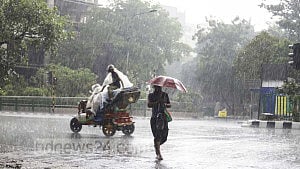
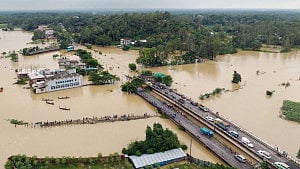
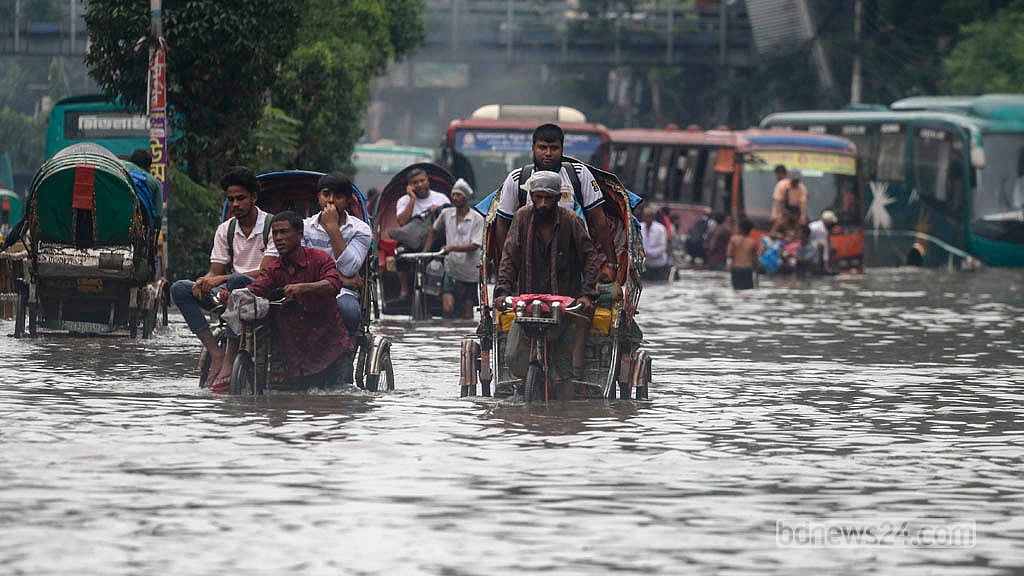
Another spell of torrential rain has left large swathes of Dhaka underwater, paralysing the capital and exposing fresh doubts over its ability to cope with increasingly intense downpours.
Floodwater entered homes and businesses across several neighbourhoods on Sunday, while severe waterlogging forced Dhaka University and several other educational institutions to suspend examinations.
The latest flooding has reignited criticism of the city's drainage network despite improvement works undertaken by the two city corporations after years of similar complaints.
Dhaka South City Corporation (DSCC) Chief Engineer Nur Azizur Rahman said a comprehensive drainage master plan was being prepared with support from the Institute of Water Modelling (IWM).
Although city corporations assumed responsibility for drainage management in 2020, effective work had long been delayed, he said, adding that DSCC now operates two pumping stations while drain-cleaning continues.
According to the Bangladesh Meteorological Department (BMD), Dhaka recorded 175mm of rainfall in the 24 hours to 6pm on Sunday, including 38mm within just three hours between 6am and 9am.
Azizur said the existing drainage network generally copes with rainfall of up to 30mm, but heavier downpours can leave water standing for two to three hours, particularly in low-lying areas.
He, however, could not say when the masterplan would be completed.
By late Sunday morning, roads in Jatrabari, Kutubkhali, Shonir Akhra and parts of the Dhaka-Chattogram Highway remained submerged.
Waterlogging also hit Fakirapool, Arambagh, Shantinagar, Kakrail, Motijheel, Dilkusha, Banani, Khilkhet and Naya Paltan, where waist-deep water was reported in places.
Dhaka North City Corporation (DNCC) Chief Engineer Brig Gen Syed Rakibul Hasan said a World Bank-backed canal restoration project had yet to move beyond discussions.
While claiming floodwater had receded from most affected areas, he acknowledged prolonged inundation in Mirpur and elsewhere, blaming encroached canals, clogged drains and narrowed waterways.
He also admitted poor coordination among government agencies.
"WASA's sewer lines and the city corporation's drainage network are interconnected in many places, but they are not managed in an integrated manner," he said.
He added that projects by WASA, the metro rail and the elevated expressway often damaged drainage infrastructure.
RAJUK Chief Town Planner Ashraful Islam disagreed that coordination alone was to blame, noting that legal responsibility for drainage now rests with the city corporations.
He attributed worsening waterlogging to rapid urbanisation, construction debris blocking drains and the loss of natural water retention, saying local retention ponds and preserving ponds identified in official surveys were essential to easing pressure on drains.
Urban planner Adil Muhammad Khan, executive director of the Institute of Planning and Development, said a drainage masterplan alone would not solve the problem.
He called for integrated urban planning that protects canals, wetlands, retention areas and green spaces while ensuring enough open ground around buildings to allow rainwater to seep naturally into the soil.