Home
+
Published : 13 Jul 2026, 01:03 AM
Ripe or Ruined?
The 10-hour trick: Wholesalers across Dhaka use hidden chemicals to turn raw green bananas into market-ready yellow fruit overnight
Economic turnaround: Traders bypass natural four-to-six-day ripening times to meet high demand and deliver artificially spotless fruit
Dangerous misuse: Inspectors regularly seize banned chemicals, including rice pesticides and calcium carbide, hidden inside warehouses
Slow poisoning: Experts warn that these chemical-soaked fruits trigger digestive issues and long-term liver and kidney damage
The alley behind Badamtali's bustling fruit wholesale market in Old Dhaka has a name of its own: Kolapatti -- Banana Lane.
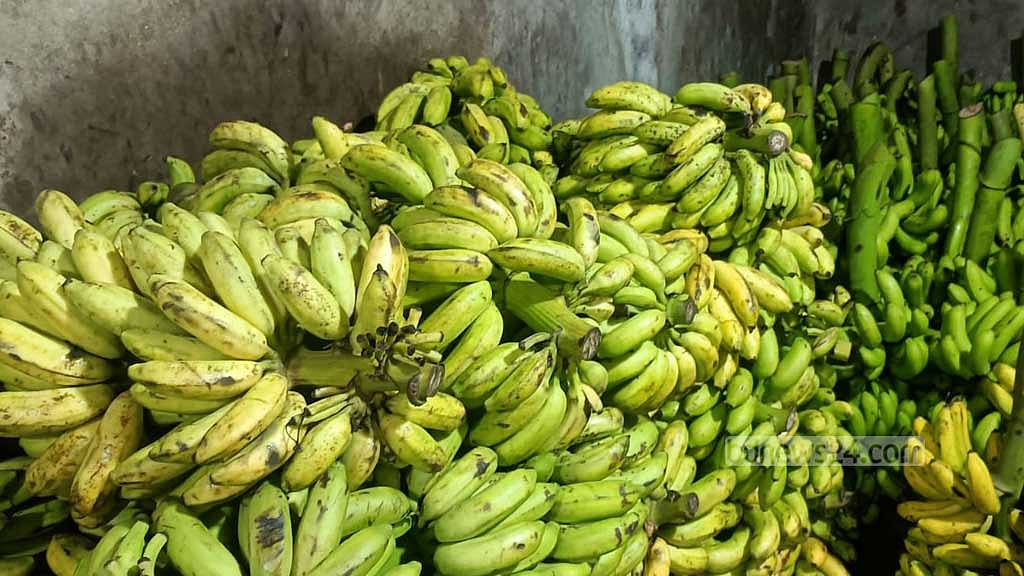
Every day, truckloads of raw bananas from Pabna, Faridpur and Narsingdi arrive here. By the following morning, the green fruit turns a bright, market-ready yellow.
The transformation takes barely 10 to 12 hours.
It is not unique to Badamtali. Similar practices unfold nightly at Karwan Bazar, Tejturi Bazar, Jatrabari and Tongi, where wholesalers promise customers ripe bananas within hours of placing an order.
How can fruit that naturally takes several days to ripen be ready overnight?
An investigation by bdnews24.com found workers openly describing chemical ripening methods, even as some traders denied using anything beyond traditional techniques.
Food safety experts and consumer rights officials, however, say inspections continue to uncover widespread misuse of ripening agents -- and, in some cases, banned pesticides.
Overnight Transformation
Workers describe a remarkably simple process.
Raw bananas are stacked inside dark, sealed rooms. Water mixed with chemicals is sprayed over the piles before they are tightly wrapped with thick plastic sheets or tarpaulins to trap heat and gas. By morning, the fruit turns yellow.
Others say bunches are dipped directly into chemical solutions before being covered.
One worker in Badamtali said, "Without medicine, they don't ripen. Some dip them in drums. Others spray chemical water and wrap them tightly."
Standing beside stacks of green bananas waiting for buyers, he added: "These bananas are completely raw. When orders come, they are ripened. Order six or seven hours ahead and we'll prepare them."
Experienced traders say chemically ripened bananas are easy to recognise.
Naturally ripened fruit has thinner skin and a different texture, one worker said.
Similar scenes emerge elsewhere.
At Cherag Ali in Tongi, one of the capital's largest banana hubs, trucks carrying raw fruit arrive every afternoon. Workers there described mixing chemicals into drums of water before dipping banana bunches and sealing them overnight beneath plastic sheets.
Space constraints create another method in Karwan Bazar and Tejturi Bazar, where traders often spray chemicals directly onto bananas inside trucks or wooden crates converted into makeshift gas chambers.
A tea seller near one warehouse summed it up bluntly.
"They're all green now. Come back in the morning -- they'll all be yellow."
Why Traders Do It
Banana sellers insist economics drives the practice.
Demand regularly outstrips supply. Naturally ripening bananas takes four to six days, while chemicals reduce the process to less than half a day.
The faster turnaround also produces uniformly bright, spotless fruit that attracts customers.
"Chemically ripened bananas look better," one trader said. "Customers avoid fruit with black spots."
Another explained that transporting bananas while still green prevents spoilage during long journeys from northern districts.
What Officials Are Finding
Consumer rights inspectors say raids repeatedly uncover banned practices despite regular enforcement.
Mohammad Abdus Salam, assistant director of the Directorate of National Consumer Rights Protection's Dhaka office, said inspections in Badamtali, Karwan Bazar and Jatrabari found traders using Ethephon and Ripen to accelerate ripening.
Officers recovered bottles hidden inside banana stacks, fined traders and destroyed treated fruit.
According to Salam, some traders spray the chemicals at night and begin selling fully yellow bananas the following morning -- sometimes in less than 12 hours.
Separate inspections also uncovered mixtures containing calcium carbide and even pesticides intended for rice cultivation.
Safe Use — and Dangerous Misuse
Scientists say the problem is not simply the presence of ripening agents but how they are used.
Dr Moshiur Rahman, chief scientific officer at the Bangladesh Agricultural Research Institute's Fruit Research Division, said Ethephon is an approved ripening hormone when applied correctly.
At concentrations of around 20 parts per million, it poses relatively little risk.
The safer method, he explained, is to generate ethylene gas inside an enclosed chamber rather than spraying liquid directly onto fruit.
Instead, many traders dissolve concentrated chemicals in water and soak or spray bananas, greatly increasing exposure.
More alarming, he said, is the reported use of DDT, a banned pesticide.
Mixed with water and applied to banana piles before covering them with plastic, the chemical can pose serious health hazards.
Hidden Cost
Public health specialists warn that consumers ultimately bear the consequences.
Dr Mominur Rahman, director of the Institute of Public Health, said excessive chemical use has been linked to digestive disorders and may increase the long-term risk of liver and kidney damage.
He described the practice as a form of "slow poisoning", while stressing that awareness and stricter enforcement are essential.
"People must become more aware," he said. "Society cannot simply ignore those doing this. At the same time, the government must strengthen both the law and its enforcement."
For shoppers, the bright yellow bananas lining wholesale markets each morning may appear perfectly ripe.
What remains far less visible is how they reached that colour overnight.