Home
+
Published : 25 Jun 2026, 08:10 PM
Academics, security analysts, journalists and policymakers have called for stronger border security, enhanced diplomacy and clear repatriation procedures to address cross-border “push-ins" and related security concerns facing Bangladesh.
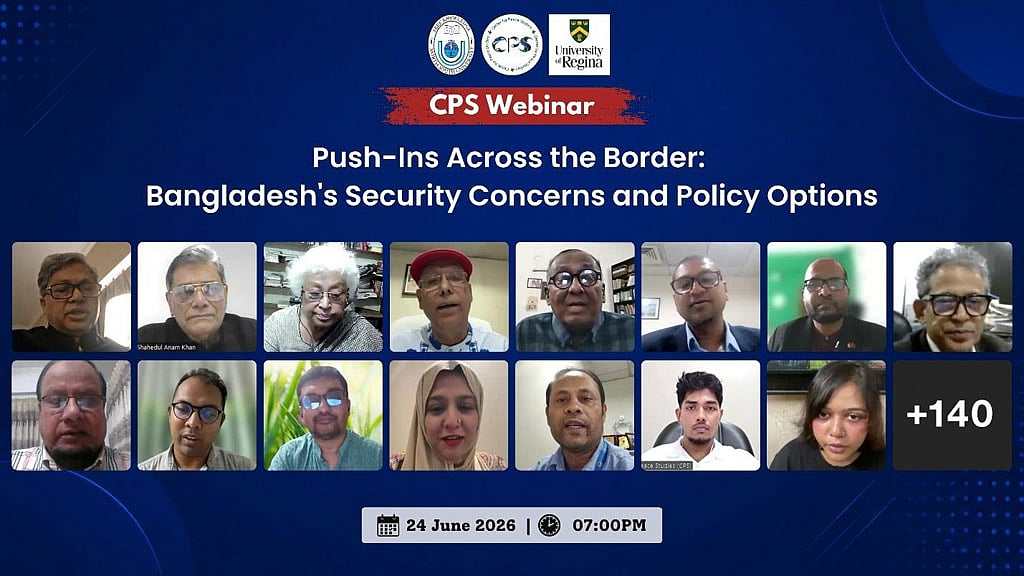
The observations came at a webinar titled “Push-Ins Across the Border: Bangladesh’s Security Concerns and Policy Options”, organised by the Centre for Peace Studies (CPS) at North South University in collaboration with the University of Regina, Canada, on Wednesday.
Moderating the discussion, the CPS Director Prof M Jashim Uddin described “push-ins” and border killings as long-standing threats to Bangladesh’s sovereignty, national stability and the security of border communities, according to a statement.
He said thousands of people had been pushed into Bangladesh since independence and stressed that disputes with India, including push-ins, border killings and water-sharing issues, should be resolved through mutual respect and in line with Bangladesh’s national interests.
Jashim argued that deterrence remained essential for Bangladesh’s national security.
He also noted that while Prime Minister Tarique Rahman was concluding state visits to Malaysia and China under an independent foreign policy, tensions had been observed along the Indian border, including alleged attempts to push Indian Muslims into Bangladesh, border killings and mistreatment of Bengali-speaking Muslims.
Muhammad Asadullah, associate professor of criminology at the University of Regina, focused on anti-Bangladeshi sentiment and the dehumanisation of marginalised border populations.
Recalling a visit to India in 2024, he said his hosts had advised him not to reveal that he was Bangladeshi due to concerns for his safety.
He argued that political rhetoric and social media could deepen hostility while poor and marginalised communities often became victims of state politics.
However, he expressed hope that diplomacy, mutual respect and negotiation could help resolve the issue.
Dhaka University’s former professor of international relations Shahiduzzaman viewed India as a significant factor in Bangladesh’s existential security.
Referring to the concept of Akhand Bharat and writings by some Indian strategists and retired military officers, he warned against ignoring potential threats to Bangladesh’s territorial integrity.
Prof Shahiduzzaman called for modernising the armed forces and strengthening defence capabilities, arguing that Bangladesh would negotiate more effectively with India and Myanmar when backed by military strength.
He also advocated stronger military and strategic ties between Bangladesh, China and Pakistan.
Former Jahangirnagar University teacher, Prof Dilara Choudhury, described Indian policy towards neighbouring countries as hegemonic and said unilateral “push-ins” infringed upon Bangladesh’s sovereignty.
She said Bangladesh should accept individuals conclusively identified as Bangladeshi citizens, but India must provide proper documentation and follow agreed repatriation procedures.
Warning that large-scale “push-ins” could destabilise Bangladesh, she called for a unified national position and direct diplomatic engagement with New Delhi.
Shahedul Anam Khan, executive editor of The Deltagram, rejected suggestions that Bangladesh’s armed forces lacked combat experience or deterrent capacity.
Referring to the 1971 Liberation War and operations in the Chittagong Hill Tracts, the retired brigadier general said the military had demonstrated its capabilities in the past.
He also questioned claims that 20 million Bangladeshis were living illegally in India, saying no verified list had ever been produced.
Anam called for reinforced borders, improved surveillance, stronger diplomacy and greater internal resilience.
He also suggested Bangladesh could use trade, market access, transit and connectivity facilities as strategic assets in negotiations with India.
The Daily Jugantor Editor Abdul Hai Sikder argued that Bangladesh had survived periods of crisis by resisting domination and safeguarding its independence.
Referring to border attacks after 1975, he recalled the role of the “Kaderia Bahini”.
The Kaderia Bahini, led by Kader Siddique, was a guerrilla force that fought alongside the Mukti Bahini against Pakistani forces during the Liberation War, mainly in Tangail and parts of northern Bangladesh.
He said Maulana Abdul Hamid Khan Bhashani had encouraged border communities to remain resilient, while late president Ziaur Rahman established Village Defence Party units to support local security.
He called for rebuilding community preparedness, fencing the border, enhancing defence capabilities and technology, raising border issues at the United Nations and international human rights forums, reforming diplomatic missions, revitalising SAARC and strengthening Bangladesh’s media response.
North South University Vice-Chancellor Prof Abdul Hannan Chowdhury, who chaired the session, described “push-ins” as both a humanitarian and sovereignty issue.
He acknowledged shortcomings in diplomacy, surveillance, intelligence and border preparedness and said Bangladesh must demonstrate strength while maintaining a constructive relationship with India.
He urged the CPS to prepare policy recommendations for the government, foreign ministry and other relevant institutions, saying policy-driven action was urgently needed.
During the question-and-answer session, faculty members and students raised concerns over the absence of national consensus, weak coordination among state institutions and the need for a transparent process to verify nationality before accepting anyone as Bangladeshi.
Participants called for stronger border security, improved documentation and surveillance, firm diplomatic engagement and clearer communication of Bangladesh’s position at home and abroad.