Home
+
Published : 20 Sep 2025, 02:05 AM
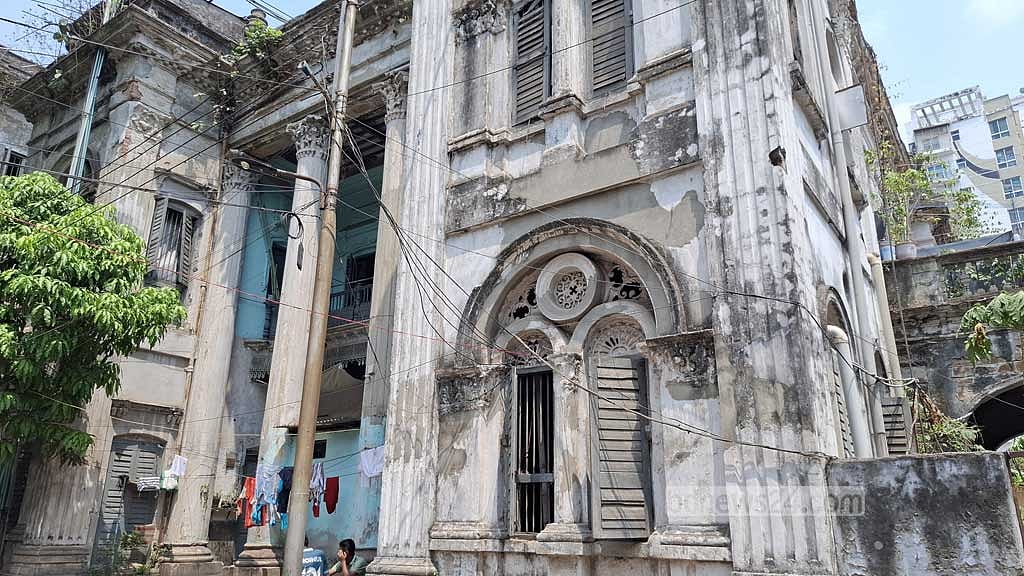
Rickshaws squeezing through narrow lanes between cramped houses, endless traffic jams, noise in every direction, and sheer chaos: that is Old Dhaka. Yet the southern part of the capital still holds within it many traces of the city’s past. Some of these old structures have already vanished completely, others are occupied and falling apart, some are being demolished.
Although calls to preserve these historically valuable structures have come from various quarters at various times, bringing them under government control is no small challenge.
The Rajdhani Unnayan Katrtripakkha (RAJUK), Dhaka city's development authority, says the responsibility for preserving historic buildings lies with the Department of Archaeology, but it will assist if requested.
Organisations working on heritage argue that the Department of Archaeology could preserve buildings through transfer of title. These sites could then be developed as tourist destinations, generating revenue for the government.
Sajjadur Rashid, director of Save the Heritages of Bangladesh, believes the initiative for preservation must be taken by the government.
Suggesting that 8–10 old structures on BK Das Road could be preserved and turned into a tourist hub, he told bdnews24.com: “If they (the residents) can be resettled in some way, if new homes are built for them, the government could acquire the site and preserve it.
“Since we are calling it heritage, it is naturally the government’s duty to relocate people elsewhere and then conserve the site. If it becomes a tourist destination, the government will earn revenue. We’re not calling every building ‘heritage’. These buildings have architectural value.”
Taimur Islam, chief executive of the Urban Study Group, which has long worked on Old Dhaka’s heritage, says not only buildings but whole areas must be conserved.
“Heritage structures must be preserved. If there are documents, then acquire them. If not, take legal steps. Where the army resides (Ruplal House) is not vested property. There have been all sorts of fraud, and we keep hearing it’s under occupation. If nothing is done now, it will not be possible to keep it,” Taimur said.
He proposes relocating Old Dhaka’s businesses to one side and restoring its cultural heritage there.
However, Afroza Khan Mita, regional director for the Dhaka division at the Department of Archaeology, told bdnews24.com: “Just because a site is on the archaeological list does not automatically ensure its control by the state.
“So many different professions use these places, people live there. The work would require resettling everyone or moving them out. That is a major challenge.”
From 2017 to 2024 they inspected more than 2,000 houses in Old Dhaka. Of these, they have submitted a list of five to six hundred properties to the court and say the remainder will be submitted within the next couple of years.
Afroza said, “If instructions then come, we will first include the sites on the preservation list and thereafter begin work from our annual allocation.
“A very large budget will be needed; gathering documents, determining ownership in light of those papers, entering into agreements with owners. We will work on all that in future.”
RAJUK’s Chief Town Planner Ashraful Islam told bdnews24.com they would intervene if they became aware of changes being made to historic buildings. Although the Department of Archaeology has compiled a list, none have been preserved in any meaningful way.
“They may have manpower or budget constraints. The entire building needs monitoring. Whether they take a budget from the government or sit down with RAJUK and the Dhaka City Corporation and say ‘please look after these’, then the work could be done under a project. Either with their own funds or government funds.”
WHAT CONDITION ARE THE HISTORIC BUILDINGS IN?
Heritage groups say at least 2,200 buildings in Old Dhaka are worthy of being preserved as heritage. Up to August 2024, the Department of Archaeology had managed to list only 35 protected antiquities in Dhaka district.
These include Ruplal House in Farashganj in Old Dhaka, and the Sutrapur Zamindar House. Both buildings were gazetted as archaeological properties in 1989.
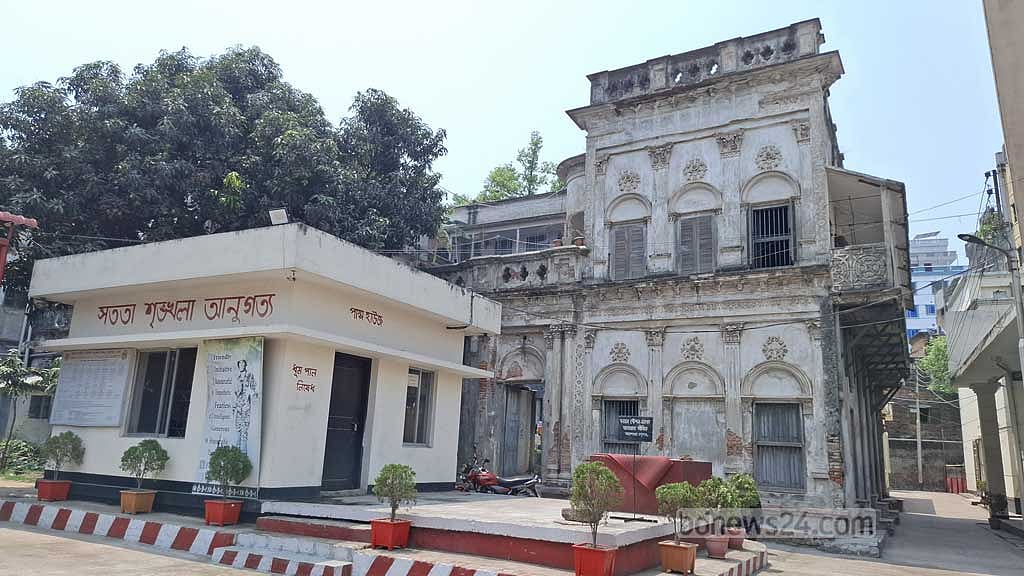
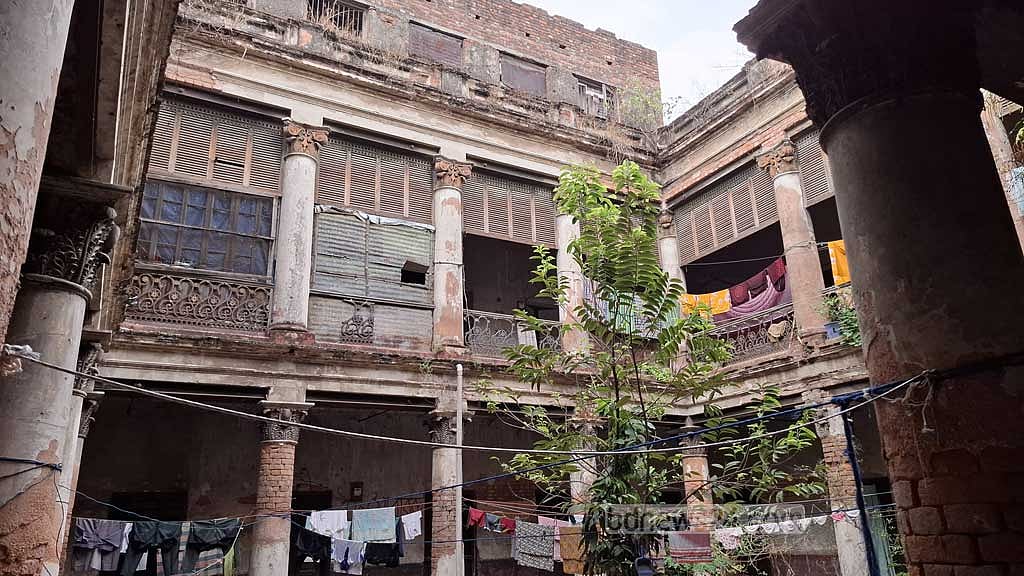
The listing describes the Sutrapur Zamindar House as follows: built on one acre of land, the house has two storeys. The façade has Corinthian columns and a veranda. Inside are 35 rooms of various shapes and a square open courtyard surrounded on three sides by ranges of buildings adorned with ornamentation.
The house was constructed in the early 20th century by a prominent figure named Reboti Mohan Das.
Ruplal House is described as follows: the two-storey building is divided into two sections and extends east–west. Atop the roof sits a large triangular pediment. The entrance is in the central section. Built of brick, lime and surki, the building features wooden Venetian grilles on its doors and windows, decorative cast-iron on the stairs, and coloured glass in the arches.
Popular belief holds that in the early 19h century the western part was built by Dhaka’s eminent businessman Ruplal Das, and the eastern expansion was undertaken by his younger brother Raghunath Das.
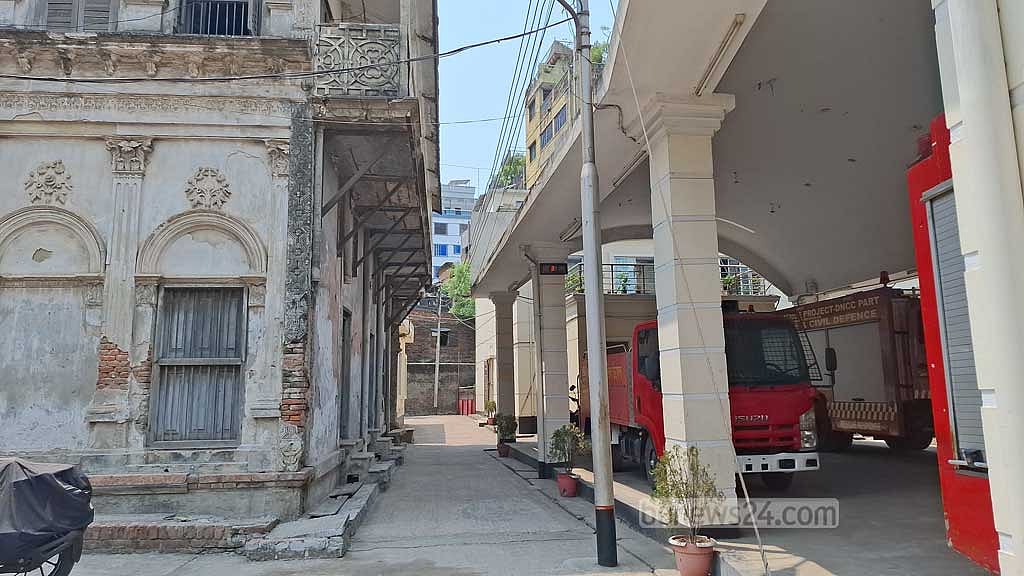
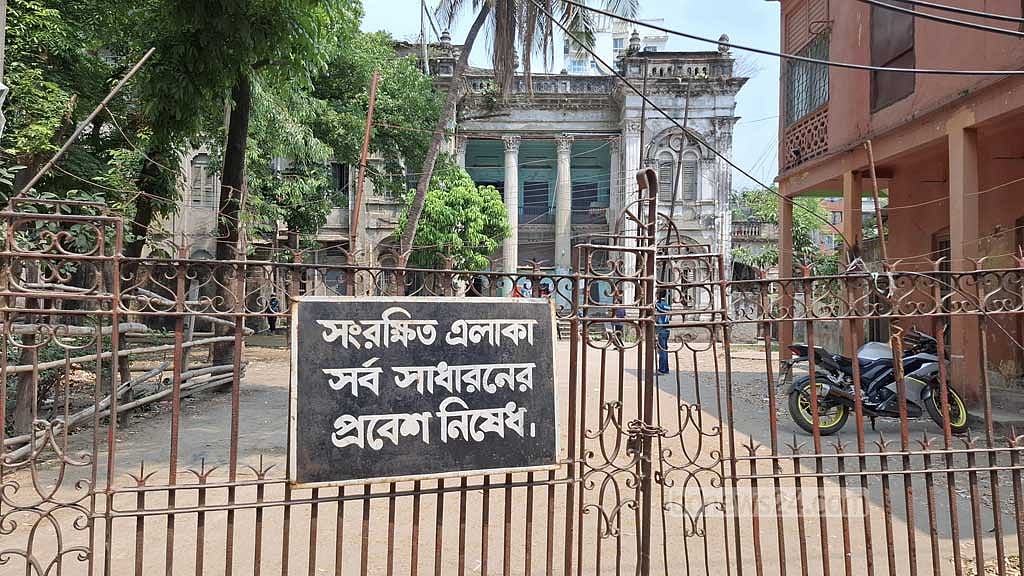
A recent visit to the Sutrapur Zamindar House found a sign on the main gate reading “Protected Area, Entry Prohibited to the General Public.” Plaster is falling off the building, windows are cracked, ornamentation has broken away. Water tanks and electricity meters have been installed, tiles, basins and bathrooms have been added inside the rooms. Within the boundary wall, two new buildings have been constructed on one side to house the Sutrapur Fire Station and its barracks.
Yet the law on antiquities states that there are restrictions on destroying, removing, altering or deforming ancient objects, and on construction near such sites.
A firefighter named Rashid said the fire station was inaugurated six years ago.
“Staff of the Fire Service live with their families in the old building. They pay rent to the government. The rent is a little lower. Water and electricity are all available. I live in the barracks.”
In the old building we met a woman named Sadhika, whose husband works in the Fire Service. She said 70 families live in the building. They too are living there with their family.
RAJUK’s lack of oversight of this old architecture is evident from the remarks of Ashraful, the authority’s chief town planner.
He said, “If changes have been made without permission, that was not right. These changes did not come to our notice, so we could not take action.”
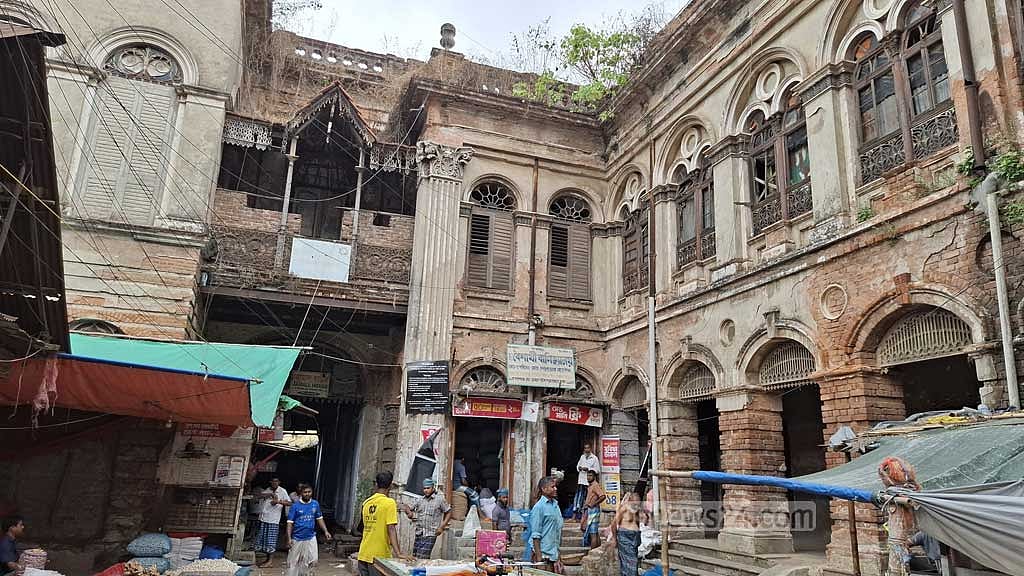
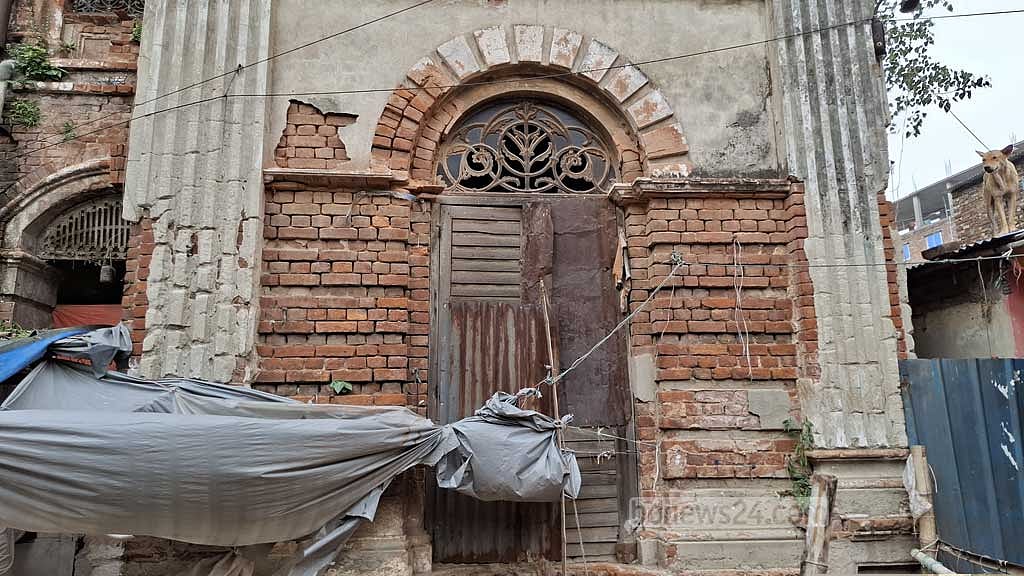
At Ruplal House, spice and betel wholesale businesses occupy the ground floor of the exterior section; inside, families of army officers reside. Outside the building are signs reading “Jamal House” and “Ruplal House Residential Area, Bangladesh Army”. Plaster is falling from various parts of the building, ornamentation has been damaged, some collapsed areas have been patched with corrugated sheets.
Those running the wholesale businesses in the building declined to speak. But Abdur Razzak of Boishakhi Banijyaloy said the shop owner leased the premises from the government in 1972. Although the shop sign bears the name Delwar Hossain, he said the owner’s name is Haji Jewel Akhtar.
Upon entering the compound, one immediately sees a sign in red letters: “Area Under the Custody of the Bangladesh Army, Entry Prohibited to the General Public.” Local residents say, as a result, they have long been blocked from entering the interior.
Rita, who gave a single name and identified herself as the wife of an army officer living there, said: “This is quarters under the army. Families of those who work on ships live here. To get a flat you have to apply to the office, then it’s allotted. We don’t have to pay rent here; electricity, water — all facilities are available. No outsiders live here.”
Regarding the two houses, Afroza of the Department of Archaeology’s Dhaka division said although initiatives had been taken in the past to bring them under government possession, no steps have been taken in the last two to two and a half years.
“To remove the occupants, various measures would be required, and that will need funds. If we have to buy it, those now there have their business and livelihood on the premises… You can’t do this in a hurry. It’s a long-term planning matter. We are considering what can be done.”
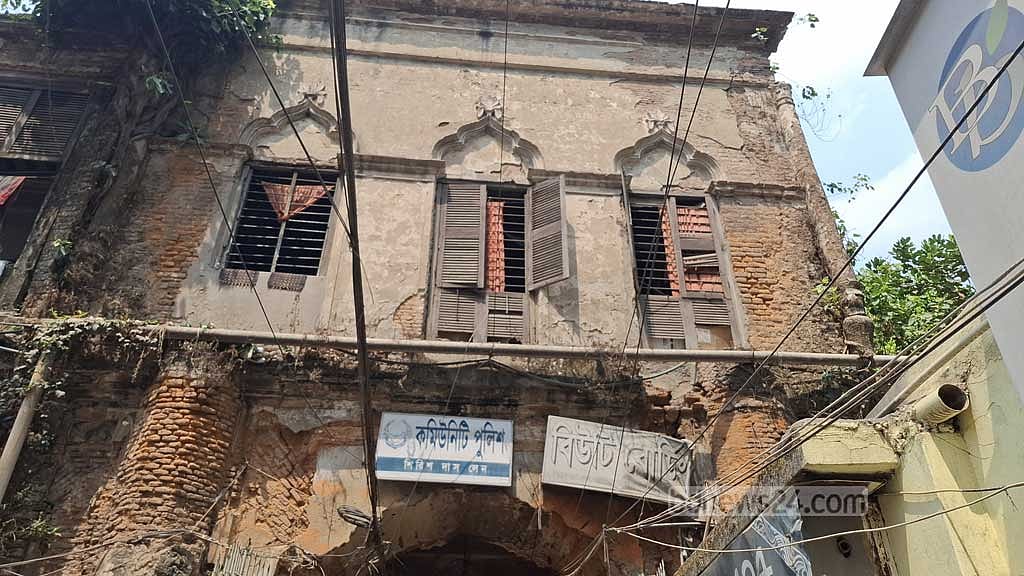
Another heritage structure of Old Dhaka — the zamindar house beside “Beauty Boarding” — is covered by the roots of a banyan tree, and parts of its walls have been damaged. Shops and a barber’s have been set up on the outside, while a family lives on the inner ground floor. On the upper floor, one side houses a police outpost and the other is used as police accommodation. Signs on the walls read “Beauty Boarding” and “Community Police Office”.
Several women were found on the ground floor. One elderly woman admitted she lived there but did not answer how.
A Constable Kawsar at the police outpost said, “Downstairs, the public have occupied the place and are living there. The police outpost has been here a long time; we’re new, so we can’t say how long.”
A local resident, requesting anonymity, said: “People used to come here to worship at the temple. Later it was taken over. They’ve been living here for 20 to 25 years.”
“Ratan” of Ratan Salon said the ground-floor shopkeepers pay rent monthly to Beauty Boarding; he himself pays Tk 1,500–2,000.
“I don’t know who the owner is. Those who live inside, they live rent-free.”
Asked whether the shops were let out by them, Samar Saha, the person overseeing Beauty Boarding, said: “If it’s outside the building, those aren’t ours. We have nothing beyond our own complex. Those belong to others.”
The “Mangalalay” house in Farashganj is being used as a spice wholesale depot, and workers from the depots live inside the house. Posters of Jatiya Party leader Saifuddin Milon are pasted on the exterior.
Saidur Rahman of Rifat Banijyaloy, a spices wholesaler, claims he pays Saifuddin Milon Tk 55,000 a month for the shop and warehouse.
Saifuddin Milon claims to be the owner of the house.
He told bdnews24.com that he bought the house in 2010/11 from “a Hindu man” who later moved to India. He does not plan to preserve the house; instead he intends to build a high-rise. The building has been resurfaced two or three times.
“This is Hindu property, just normal Hindus. It’s not some zamindar’s estate. When I bought it, at that time I could have demolished it. Then there was a problem because under the DAP law half my house fell within the area. RAJUK told me 'Don’t demolish it, the DAP law is being amended. Then you can work on the whole property.’ That’s why I didn’t demolish it. This is not the sort of house that should go to Archaeology.”
On the outer wall of Hrishikesh Babu’s house a sign reads, “Owner of this house: Alhaj Ghulam Maula Mallik”. The inner walls have been freshly painted, but the gate was locked so it was not possible to enter.
A local resident, requesting anonymity, said the family has been living there for some 50 years. Their warehouse employees also live there.
Heir to the property Sani Mallik said: “It is our house. My grandfather bought it from Mr Hrishikesh.”
During the Eid-ul-Azha holidays in June, an attempt was made to demolish the “Mohammad Nasiruddin Memorial Building” in Narinda, Old Dhaka. Another historic building, the century-old Narinda Sewerage Pumping Station, Dhaka WASA’s first sewerage pumping station, was completely torn down.
The Nasiruddin Memorial Building on Sharatgupta Road is associated with the memories of Mohammad Nasiruddin, editor of Saogat Magazine; Nurjahan Begum, editor of Begum magazine; and the writer Rokonuzzaman Khan “Dada Bhai”.
Demolition work on the building began during the Eid holidays. On learning of the matter, the Urban Study Group lodged a complaint in the form of a general diary (GD) with Gendaria Police Station on Jun 14. The Department of Archaeology also filed a GD. Police then halted the demolition.
These acts of demolition have occurred sometimes at privately owned buildings, sometimes at those under government ownership or management. The Urban Study Group claimed in a statement that structures have been demolished even in defiance of court injunctions.
WHAT DOES THE LAW SAY?
The Antiquities Act states that if the government has reasonable grounds to believe that any land contains antiquities, it may acquire that land or part of it. By notification in the official Gazette, the government may declare any ancient object to be a protected antiquity.
There will be restrictions on an owner’s rights regarding the destruction, removal, alteration or deformation of ancient objects, or the construction at or near a site of antiquity. Provision must be made for public access; and where transfer of title causes loss to the owner, occupier or any other person, appropriate compensation will be paid.
If the owner of antiquities cannot be traced, the Department of Archaeology, with government approval, may take necessary measures for preservation and protection until the owner is found.
If the government apprehends that any antiquity is at risk of destruction or deterioration, it may, after consulting the Advisory Committee, acquire that antiquity or any part of it for the public.
Any antiquity over which the government has acquired rights must not be destroyed, broken, damaged, altered or deformed; nor may anything be written, carved or signed upon it.
Anyone who violates these provisions will be liable to imprisonment for up to one year, or a fine, or both.
The National Building Code 2020 states that historically or architecturally valuable buildings listed by the Department of Archaeology may undergo necessary repairs, alterations and additions for conservation and restoration, but such work must be approved by the Department of Archaeology. Where repairs are needed, the original features must be preserved.
In RAJUK’s Detailed Area Plan (DAP), a large part of Old Dhaka has been marked as a heritage zone.
It states: “Considering the historical, aesthetic, scientific, social/religious significance of areas within the Capital Development Authority’s master-planned jurisdiction, 74 structures/buildings/areas have been listed for preservation as special heritage buildings/structures/areas. Without the approval of the Urban Development Committee, partial or full removal/reconstruction/alteration/extension/modification/addition is prohibited. The area within a 250-metre radius from the boundary wall of a heritage site will be considered a protected area.”
Anyone seeking to construct within a protected area must meet the conditions prescribed in the plan and obtain building permission subject to approval by the Special Project Committee.
A clear setback of up to 20 metres from the boundary wall of a listed building/structure must be maintained. No construction or development may take place within this distance. For the next 25 metres, the building height shall be restricted to a maximum of 10 metres. In the remaining portion (within the 250-metre protected zone), building height shall be restricted to a maximum of 15 metres.
If any structures/buildings have already been constructed within the protected area unlawfully/without approval/in contravention of approval, the competent authority shall take necessary legal measures, including eviction, in accordance with the Building Construction Act and relevant laws and rules.
Sajjadur of Save the Heritage says that if heritage is pushed towards destruction instead of preservation, "we will raise a generation without roots".
“Those who live there are dismantling many parts of the buildings. If one can deliberately show that a building has been destroyed or is going to be destroyed, then they will be able to tear it down and build anew. How are these documents being produced? How authentic are they?”
Architectural conservation expert Abu Sayeed M Ahmed believes that without financial compensation from the government, it will not be possible to protect historic structures.
He said, “Many structures are privately owned. Given market demand, many are demolishing them. There is even a law stating that no other structures may be built where archaeological sites exist. So some are demolishing them under cover of darkness.
“Laws alone will not do. These structures are privately owned property; of course the owners will seek to build anew. The government must now offer incentives and be strict about evicting illegal occupants.”
Taimur of the Urban Study Group said there are only three or four old buildings left on Paridas Road, and a section of Hemendra Das Road has been cleared out.
“Slowly a time will come when the old neighbourhoods can no longer be found. As the high-rises go up… who knows what the Department of Archaeology is doing. Local politics and business are involved; landowners have their interests. No one has any real intention of saving heritage.”