Published : 29 Mar 2026, 07:43 AM
Updated : 28 Aug 2026, 01:33 AM


The largest infrastructure project aimed at mitigating Chattogram's chronic waterlogging is nearing completion, but concerns are mounting over the long-term maintenance of the system and the city’s mounting waste management crisis.
While approximately 95 percent of the primary mitigation project is finished, the sustainability of these gains remains under threat.
Residents note that while the duration and extent of flooding have decreased significantly compared with previous years, the sustainability of these gains remains under threat.
Upon completion, the Chattogram City Corporation (CCC) is slated to take over the management of 36 canals, along with sluice gates and other vital infrastructure.
However, the corporation currently lacks the necessary budget and skilled manpower to operate these facilities effectively.
Experts and stakeholders suggest that for a long-term solution, the city must address the remaining 21 canals through new projects, initiate dredging of the Karnaphuli River, excavate ponds to serve as reservoirs, and implement modern waste treatment plants.
Chattogram City Mayor Shahadat Hossain told bdnews24.com that coordination between agencies is the key to a flood-free city.
"We are preparing a Development Project Proposal (DPP) for the restoration of the remaining 21 canals," he said.
The mayor also revealed that feasibility studies are under way for multiple waste-to-energy projects.
"We are collaborating with several firms from South Korea, Japan, and the UK to transform waste into fuel," he added, highlighting a shift toward international technical partnerships to solve the city’s environmental bottlenecks.
95 percent of Flood Mitigation Work Complete
Among the city’s 57 canals, 36 were included in a mega flood mitigation project approved by the Executive Committee of the National Economic Council in August 2017.
The Chattogram Development Authority (CDA) launched the initiative in April 2018, with the 34 Engineer Construction Brigade of the Bangladesh Army executing the civil works.
The project’s initial budget of Tk 56.16 billion was revised in November 2023 to Tk 86.26 billion, extending the deadline to June 2026.
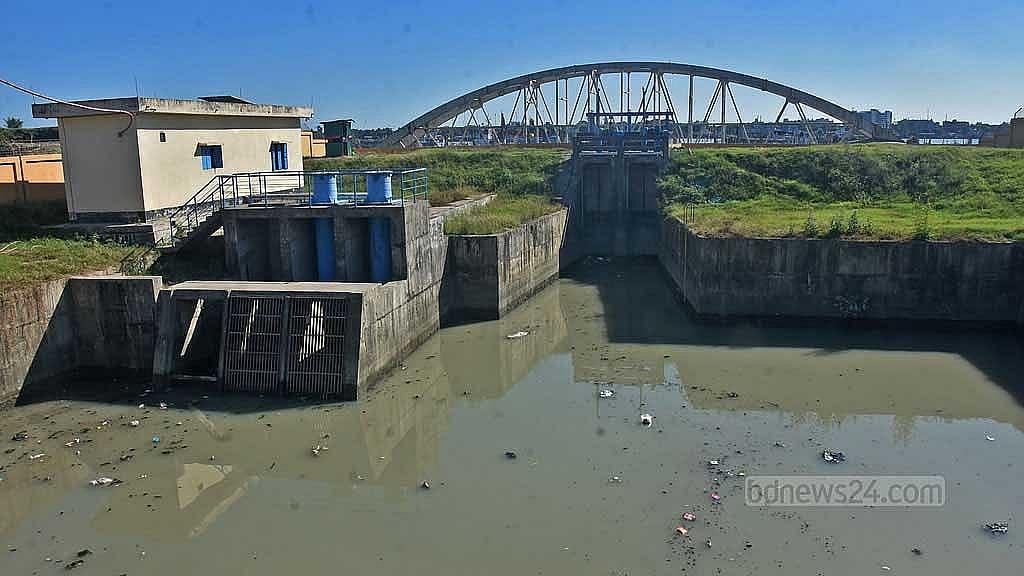
Key features include 163km of retaining walls, 115 bridges and culverts, 27 silt traps, six regulators, and 36.87km of roads alongside the canals.
As of early March, overall progress stands at 95 percent.
Work on 26 canals is fully finished, while seven others are 87–97 percent complete.
The Rampur canal, one of the remaining three, is 75 percent done.
Canal Conditions
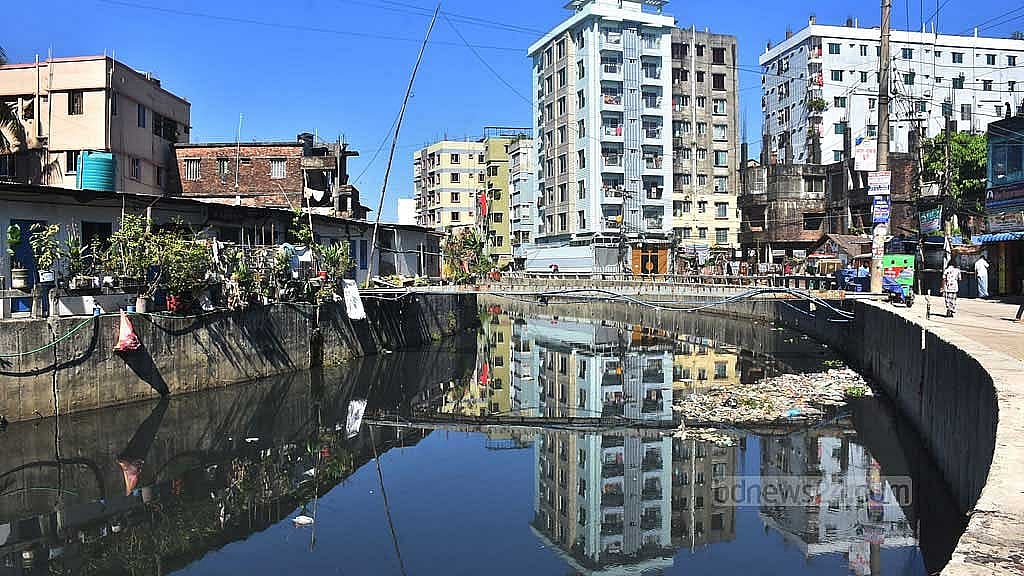
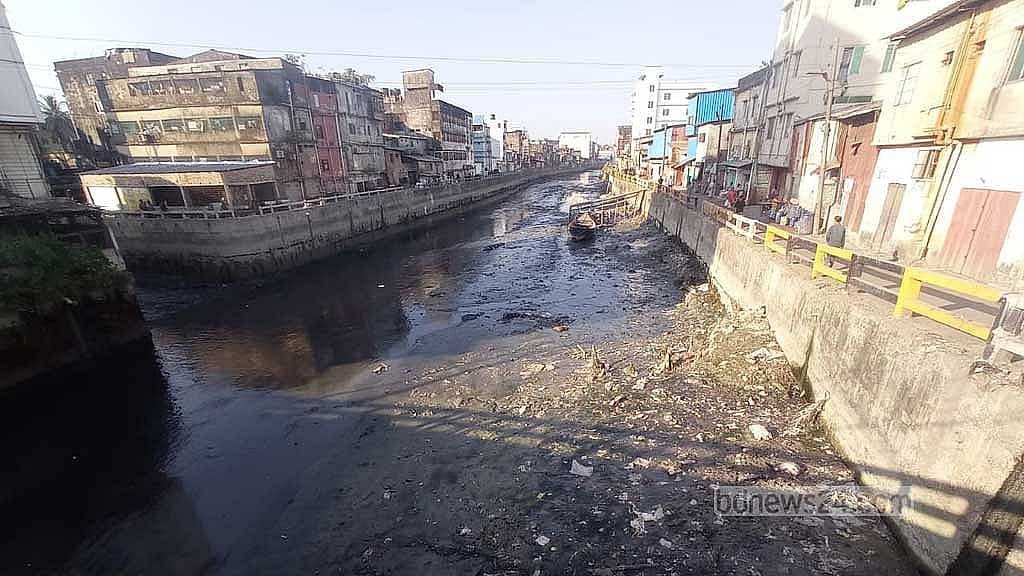
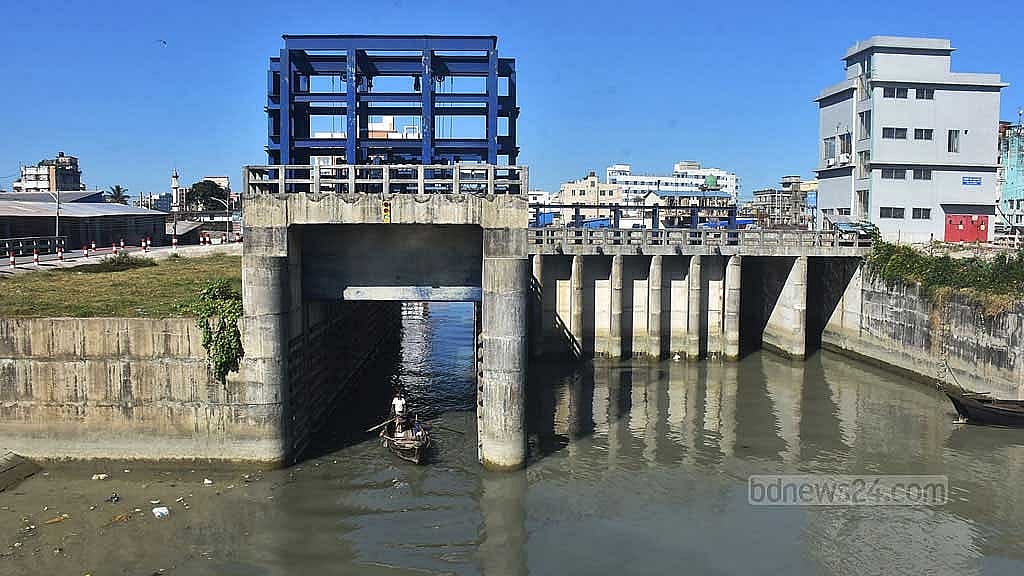
Chaktai Canal, a historic 6km commercial artery, shows a return to natural flow during high tide, with small boats operating near the Karnaphuli confluence.
However, low tide reveals significant siltation, and residents continue to dump refuse into the water.
"In 2024 and 2025, the Chaktai-Khatunganj-Asadganj belt escaped major flooding," said Md Idris, secretary of the Khatunganj Hamidullah Mia Market Traders’ Welfare Association.
"There was slight inundation on a few days when sluice gates weren't closed on time, but trade was unaffected,” he said.
“Large cargo boats stopped entering years ago after the canal bed was paved; now, even smaller vessels struggle due to the new sluice gates," he added.
In the Patharghata area, while new roads have been built alongside the Kalabagicha Canal, they are often obstructed by shop inventory and rickshaw vans.
Upstream, domestic liquid waste flows directly into the water.
"The canal mouths are clear, but the inner sections remain narrow," noted Md Belal, a local resident.
"Household waste just shifts back and forth with the tide, it never actually leaves the canal,” he said.
Conversely, the Manoharikhali and Tekpara canals near Mariners’ Road appear clear, with steady water flow maintained at their entrances.
2 Canals Lag Behind
Of the 36 canals under the project, only Hijra Canal saw significant delays due to land acquisition hurdles and illegal encroachments.
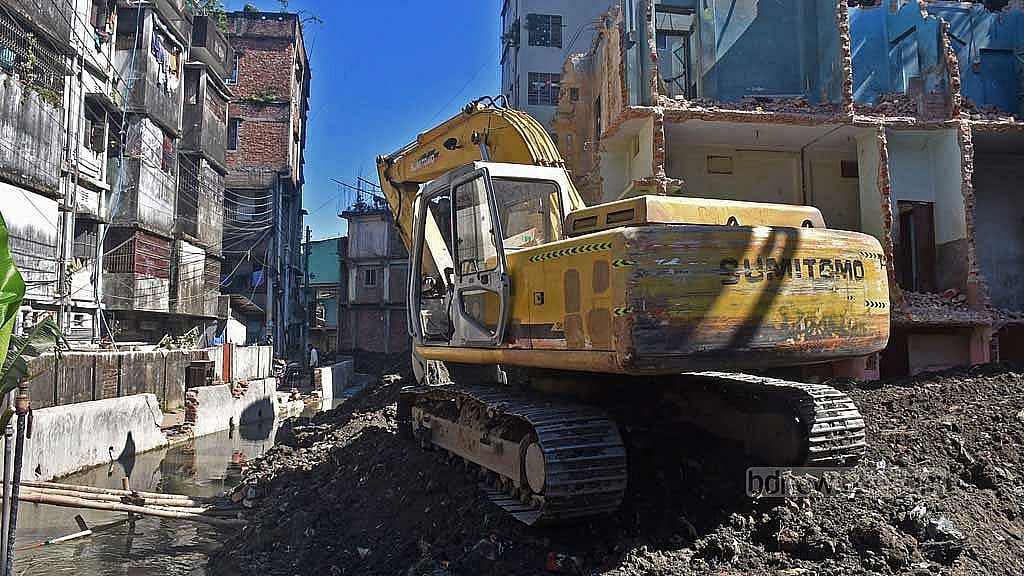
Restoration finally commenced in late 2025 for this vital waterway, which stretches from Lalkhan Bazar through GEC, Prabartak, and Chawkbazar to the Chaktai Canal.
"Work is now under way on the Hijra Canal, where large permanent structures on occupied government land are being dismantled," said Kazi Hasan Bin Shams, the recently departed chief engineer of the CDA.
However, he warned that funding shortages and the scale of demolition mean the canal will not be ready by the June deadline.
Currently, progress stands at just 32 percent.
Meanwhile, work on the Jamalkhan Canal is 58 percent complete, with active construction observed across the Rahmatganj and Hemsen Lane sections.
The current Chief Engineer Ahmed Anwarul Nazrul noted that while canal works are ongoing, securing government fund allocations remains a time-consuming process.
Management Dilemma
A significant challenge looms over who will manage the infrastructure once the CDA and Water Development Board projects conclude.
Sheikh Muhammad Tauhidul Islam, the former CCC chief executive officer, admitted the corporation lacks the financial capacity, manpower, and technical readiness to maintain the sluice gates and canals.
"Chattogram urgently needs a smart solid waste management system," he added.
To bridge this gap, the CDA plans to train CCC staff on operating the new infrastructure over the next year.
However, the recurring costs for salaries, electricity, and waste recycling will require a dedicated operational budget that the CCC has yet to secure.
CDA Chairman Engineer Md Nurul Karim emphasised the need for a clear transition framework.
"A coordinated plan led by the city corporation, involving all relevant agencies, is essential to ensure the long-term benefits of this mega-project," he said.
Future Strategy: Beyond Infrastructure
Shahriar Khaled, an advisor to the city mayor on waterlogging and a long-time advocate for urban canal protection, believes that while the current mega-project is a vital step, long-term success requires a shift in strategy.
"Once these works are finished, the immediate crisis will subside, but we must now plan for a future that remains flood-free," he said.

His recommendations include:
Water retention ponds: Essential for storing runoff during heavy monsoon rains when sluice gates must remain closed to block high tides.
Canal restoration: A new project to recover the city’s remaining 21 canals currently outside the scope of the mega-project.
Year-round maintenance: Moving away from seasonal fixes to a scheduled, year-round maintenance cycle.
Khaled also highlighted structural concerns, noting that some canals, including the Krishnakhali, lack navigation routes at their sluice gates.
In certain areas, canal-side roads are narrower than 15 feet, preventing long-boom excavators from clearing waste.
He also pointed out deteriorating retaining walls at specific points along the Chaktai Canal and noted that many homes remain lower than the newly raised roads, leading to persistent seepage.
Environmental Concerns
Syed Muhammad Atiqur Rahman, general secretary of the environmental group People’s Voice, acknowledged that while the severity of flooding has decreased as the project progresses, extreme rainfall still triggers inundation.
"We must protect our remaining open wetlands and ponds to maintain natural drainage," he warned. "If we cannot stop illegal hill cutting, the canals will simply fill with silt again."
He also emphasised the urgency of a modern waste collection system to prevent refuse from clogging the waterways.
River Connection
The drainage of the city is also inextricably linked to the health of the Karnaphuli River.
CDA’s former chief engineer Shams warned that the stretch of the river from the Shah Amanat Bridge to Madunaghat has not been dredged, leading to significant siltation.
"Unless the river’s depth is restored, we cannot effectively prevent tidal surges from entering and stalling the city's drainage systems," he said.