Home
+
Published : 21 Jun 2026, 05:18 PM
Where does one go first? It has always been an important decision for any new prime minister taking the reins in Bangladesh. It is also -- amid the ever-changing nuances of international diplomacy -- a consequential one.
How about neighbouring India? Emerging superpower China? Or perhaps the more neutral New York, which hosts the UN’s headquarters.
Sometimes the heads of government have opted for Saudi Arabia -- a perfect destination for more than just political or diplomatic reasons. The religious pilgrimage comes as a bonus.
Just as party leaders kick off election campaigns with visits to the shrine of Hazrat Shahjalal (RA) in Sylhet, the decision carries a symbolic meaning.
Why, then, has Tarique Rahman chosen Malaysia?
Our Special Correspondent Sumon Mahmud, currently in Kuala Lumpur to cover the prime minister’s tour abroad, has sought to answer that question.
The first visit sends a message about the new government’s stance on foreign policy.
Analysts say the choice reveals its geopolitical priorities, reassures partner countries, and strengthens their strategic hand.
India and China have always been two key pillars of Bangladesh's diplomacy. Under the Awami League, the relationship with India grew in prominence.
However, in the last years of her regime, Sheikh Hasina tried to balance that growing closeness with more outreach to China.
After the fall of the Hasina-led government in the 2024 July Uprising, Bangladesh’s relations with India hit a nadir under the interim government of Muhammad Yunus.
China, on the other hand, bolstered relations with both the interim government as well as BNP and Jamaat-e-Islami.
Near the end of the interim government’s term, as BNP’s chances of winning the elections looked strong, India expressed its interest in working with the next elected government of Bangladesh.
After the death of former prime minister Khaleda Zia in December 2025, Indian Foreign Minister S Jaishankar came to Dhaka to pay his last respects. Indian Prime Minister Narendra Modi sent a condolence message to Khaleda’s son Tarique, expressing his support.
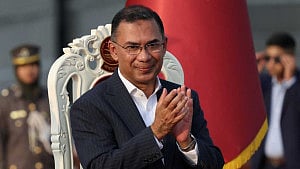
When the BNP won the election and formed the government on Feb 17, Indian Speaker Om Birla attended Tarique's inauguration ceremony. With him he carried an invitation from Modi to the new prime minister to “visit India at a time of his convenience”.
The Indian government’s efforts sparked talk of where the premier would go on his first state visit abroad. Alongside India and China, South Asian neighbours Bhutan and Nepal seemed in contention.
On Feb 24, Chinese Ambassador to Bangladesh Yao Wen met Tarique and formally invited him to visit China.
This strengthened the case for China. In May, when the Chinese prime minister sent a letter inviting his counterpart to visit Beijing, it added to the speculation.
But there was also the case of Malaysia. Anwar Ibrahim, the Malaysian prime minister, was one of the first world leaders to congratulate Tarique after his swearing-in. It was during that call that he also invited him to visit Malaysia.
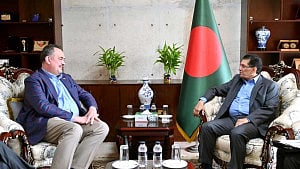
On Apr 9, when Bangladesh's Expatriates' Welfare and Overseas Employment Minister Ariful Haque Choudhury met the Malaysian prime minister at his office in Putrajaya, Ibrahim formally reiterated the invitation.
After that, Malaysia was finalised as the destination for Tarique’s first overseas visit.
Analysts say the new prime minister had to choose a third country for his opening trip in order to avoid stepping into the India-China rivalry.
Since the time of the interim government, anti-India sentiment has been strong among a section of Bangladeshi society. If Tarique had chosen India for his first visit, critics could have portrayed it as a signal towards a “Delhi-oriented foreign policy”.
A visit to China would have sparked concerns about an attachment towards Beijing, potentially straining the fragile relationship with India.
Instead, Tarique has avoided unnecessary controversy by picking Malaysia, which gives him the opportunity to dismiss concerns of bias towards any major power while maintaining the government’s commitment to balanced foreign relations.
But an aversion to fuelling the Delhi-Beijing rivalry is not the only reason for the decision.
Malaysia allows the BNP to set out a distinctive position in international diplomacy by strengthening friendships with advanced countries in the Muslim world, especially those with a more moderate bent.
For this, Tarique can look to his father, the late president Ziaur Rahman, as an example. Under his tenure, Bangladesh and the Organization of Islamic Cooperation (OIC) developed deep and brotherly relations.
He took different steps to improve relations with the Muslim world and his efforts at creating employment opportunities for Bangladeshi workers in West Asian countries has drawn persistent praise.
Bangladeshis living abroad have long played a major role in keeping the wheels of the country’s economy spinning. But the path to Malaysia, one of Bangladesh's largest labour markets, has been closed for several years.
In addition to opening that door, a new agreement between the two countries is needed to clear a path for Bangladeshis who have overstayed their visas to continue living in the country legally.
The issues of recruiting new workers, facilitating visas, protecting workers' rights, and creating employment in new sectors will be important points of discussion during the prime minister's visit.
Bangladesh is one of Malaysia's most important trading partners in Asia, but the Southeast Asian country is far ahead in bilateral trade.
Analysts believe that Bangladesh will benefit if trade cooperation between the two countries is increased.
Discussions have been going on for several years about the possibility of a free trade agreement with Malaysia.
Tarique's visit may bolster the likelihood of such an agreement, while also being aimed at attracting Malaysian investment, increasing cooperation in the industrial, infrastructure, and technology sectors, and creating new economic opportunities.
Malaysia is also an influential member of the Southeast Asian regional alliance ASEAN. Bangladesh has been trying to increase its economic and strategic relations with ASEAN for a long time, particularly in becoming a member or a “sectoral dialogue partner” of ASEAN.
Several government officials have said that if Bangladesh joins ASEAN, it is possible to expand its economy, increase trade and commerce and build a bridge between the countries in South and Southeast Asia. Malaysia can play an important role in this effort.
Foreign Secretary Asad Alam Siam has already said that the high-level meeting led by the heads of government of the two countries will touch on issues such as trade, investment expansion, energy cooperation, the Halal economy, the semiconductor industry and agriculture, and education and public relations.
Discussions will be held on establishing greater cooperation between the two countries in these areas.
However, the main topic of discussion will be increasing opportunities for Bangladeshis in the Malaysian labour market.
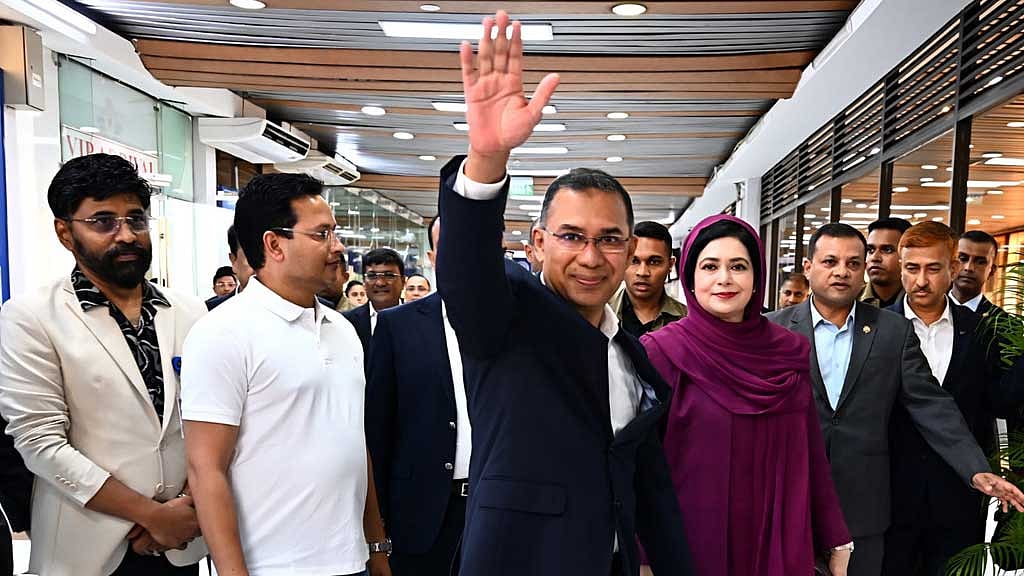
Tarique will arrive in the Malaysian capital Kuala Lumpur with his wife Zubaida Rahman at 9:30pm local time on Sunday.
Two memoranda of understanding (MoUs) and two “notes of exchange” are likely to be signed with Malaysia during his visit.
However, Malaysia is not the end of the trip. The prime minister is scheduled to travel to China directly afterwards.
Fifteen to 17 agreements and MoUs are slated to be signed in Tarique’s presence there.
Bangladesh's Teesta project, military cooperation and joining China's four global initiatives will be on the agenda during his talks with Chinese President Xi Jinping and Prime Minister Li Keqiang.
Diplomatic analysts believe that the prime minister's visit is important in determining the future course of Dhaka-Beijing relations.
A Personal Interest
Prime Minister Tarique is also interested in Malaysia, especially the country's history of economic progress.
This interest of his is quite old, with the topic coming up in an interview two decades ago.
When Manabzamin editor Matiur Rahman Chowdhury conducted Tarique's first television interview for Channel I on Dec 28, 2003, the BNP was in power. Channel I broadcast the interview on Jan 1, 2004.
Matiur asked Tarique what kind of Bangladesh he wanted to see.
In response, the BNP leader said: “If you ask me, after Bangladesh, which country -- I mean, many times people ask what country you like; many people like different countries. I like one country very much, and that is Malaysia.
“Whenever I get the opportunity, I go to Malaysia; I visit different places in Malaysia. Because I have heard, read, been told by many people that once upon a time, about 20 years ago, that country was like ours. But, in the last 15-20 years, that country has developed a lot.
“Still, they have many things in common with us, let’s say socially, or from a religious perspective. They say that several things are more or less similar to Bangladesh.
“That is why I like to see that country -- see how they changed, where they changed, what they changed. I am interested in that kind of country where yes, the country is moving, it is changing, and it is progressing.”
Tarique also has another personal tie to Malaysia. His younger brother, Arafat Rahman Koko, died in the country in 2015. Tarique was living in exile in London at the time. He did not have the opportunity to visit Malaysia or return home to Bangladesh to see his younger brother for the last time.