Published : 09 Dec 2025, 07:29 PM
Updated : 28 Aug 2026, 01:30 AM


Chief Advisor Muhammad Yunus has said Bangladesh has yet to see a figure match the stature of Begum Rokeya, the trailblazing champion of women’s rights in Bengal, even as nearly a century has passed since her death.
Speaking at the Rokeya Day programme on Tuesday, he said: “We have not been able to create another Rokeya even after 100 years. This is our misfortune. We have not been able to implement the directions she gave, the dreams she showed. We have talked about them, but we have not moved forward.”
He said the event was not only to honour her memory but also to confront the nation’s shortcomings.
“Why have we failed? Why haven’t more Begum Rokeyas developed among us in these 100 years? Who would show us the way, push us forward, remind us of the path? What has happened in these 100 years? How far have we progressed?”
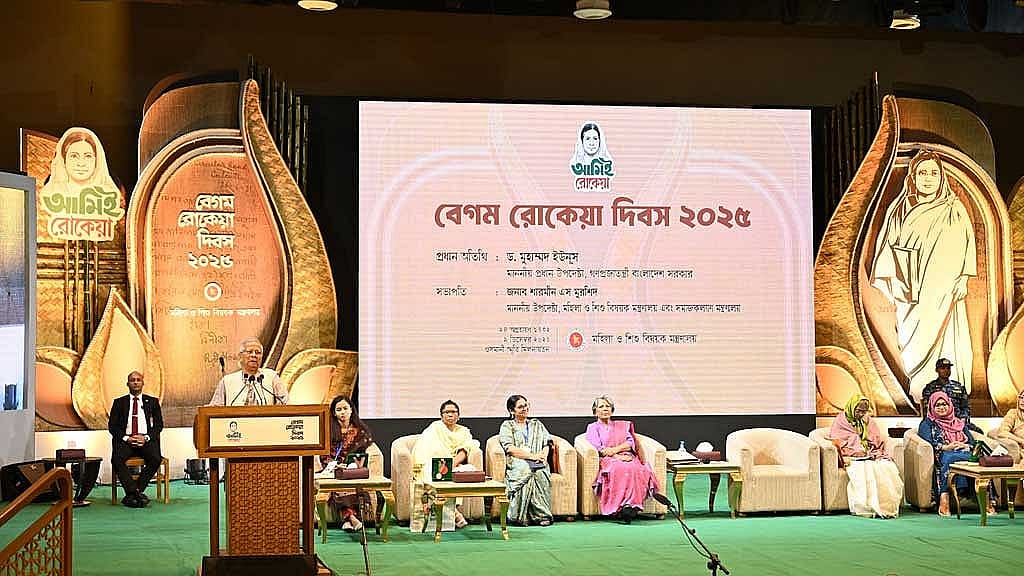
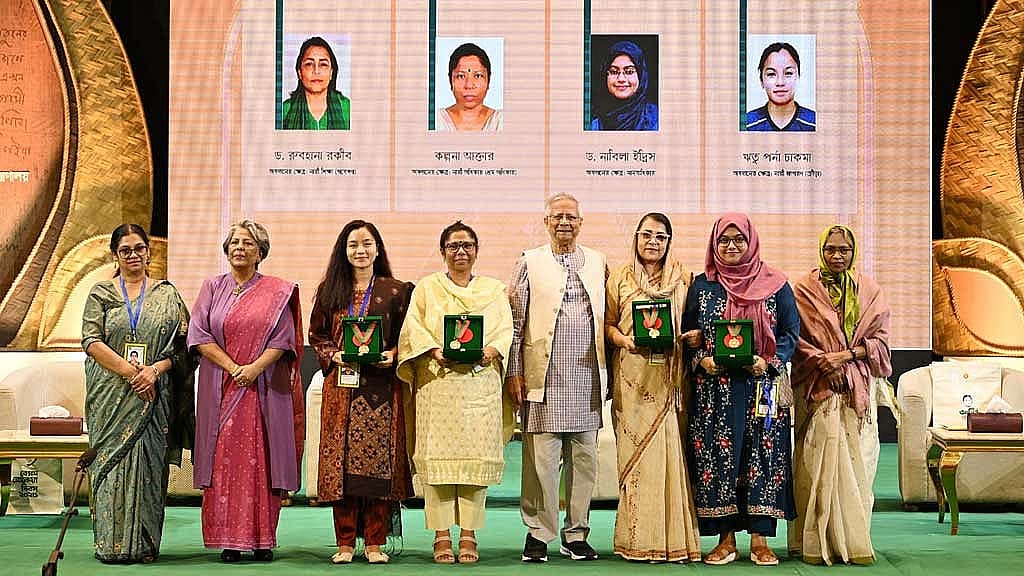
At the event, held at the Osmani Memorial Auditorium and organised by the Ministry of Women and Children Affairs, Yunus presented the Begum Rokeya Padak to four women -- Rubhana Raqib in the Women’s Education (Research) category, Kalpana Akhtar in Women’s Rights (Labour Rights), Nabila Idris in Human Rights, and Ritu Porna Chakma in Women’s Awakening (Sports).
Yunus said the spirit of Begum Rokeya would find peace in seeing the awardees’ contributions.
“The society she imagined, the society she envisioned -- those who received the award today are showing us the path to building that society.
“We, the entire nation, must learn from their example. The ideals that Begum Rokeya expressed so clearly in her speeches and writings -- these four women have carried our nation forward along that path. We are lucky.”
The government awards the Rokeya Medal every year on the birth and death anniversary of the leading figure in Bengali feminism.
Born on Dec 9, 1880 in Pairaband of Rangpur’s Mithapukur Upazila, Begum Rokeya died on the same date in 1932 in Sodepur, Kolkata.
Throughout her life, she fought for equal rights for women.
She stood against child marriage, dowry, social prejudices and the misuse of religion.
In her influential works – “Motichur”, “Sultana’s Dream”, “Abarodh Basini” -- she exposed bigotry, social stagnation and the structures that kept women confined.
Highlighting how Rokeya shattered the constraints of her time, Yunus said: “Rokeya dreamt a dream. A awe-inspiring dream. It is unbelievable that people could dream such things in that era. Today it may sound beautiful, but these were revolutionary ideas.
“She shook our entire society, but no one came forward to carry on that push. This is unfortunate; this is our misfortune.”
Reflecting on her call for women’s self-reliance, he said: “She taught women to stand on their own feet. She could have been busy with her own life. She had much to do. But she never separated her work from society.”
Yunus added that the awardees had elevated Bangladesh internationally.
“These are not just daughters of Bangladesh; these are women who will lead the world. Honouring them today is only the first step.”
He also drew attention to the recent decision to rename the Ministry of Women and Children Affairs, noting that the new name was missing from the event’s banner.