Published : 01 Feb 2026, 01:23 AM
Updated : 21 Aug 2026, 03:05 PM


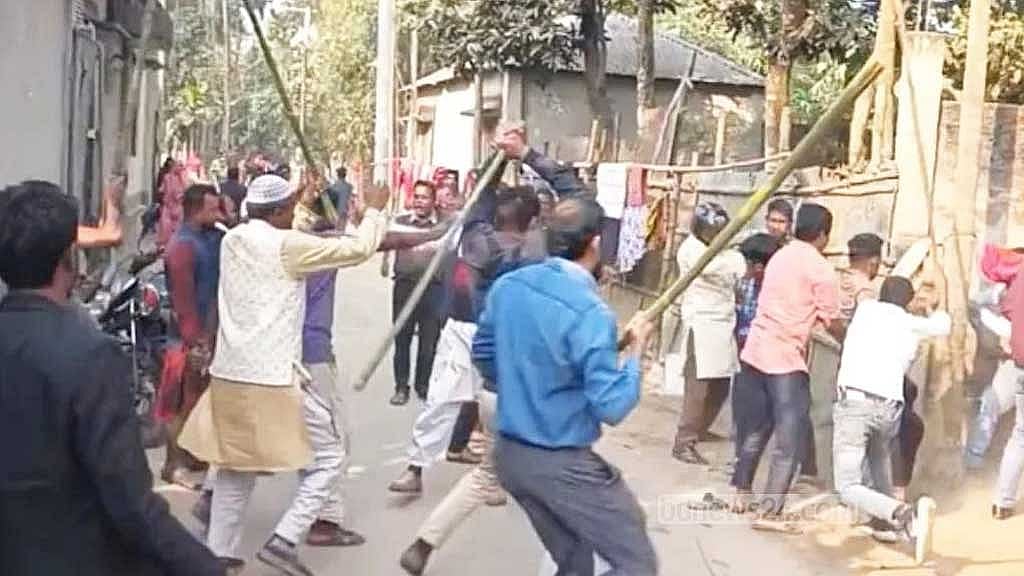
At least four people have been killed and 509 others injured in 64 incidents of election-related violence across Bangladesh in January, according to rights group Manabadhikar Shongskriti Foundation (MSF).
The figures come amid reports of clashes between activists of the BNP and Jamaat-e-Islami in different parts of the country as the election approaches.
In December, MSF recorded seven election-related violent incidents nationwide, which left one person dead and 27 injured.
In its monthly human rights situation monitoring report sent to the media on Saturday, the last day of January, MSF said election violence emerged as one of the “most severe” human rights crises during the month.
Beyond election-related clashes, the organisation reported 24 incidents of political violence in January, in which 215 people were injured. Six people were killed in attacks carried out by assailants during these incidents.
In comparison, December saw 16 incidents of political violence, leaving 124 people injured and four killed.
In an analysis, MSF said, the data “demonstrates that the election process in January is effectively moving towards deadly violence”.
According to the report, Nazrul Islam, a supporter of independent candidate Salman Omar Rubel, was killed in election-related violence at Ershad Bazar in Mymensingh’s Dhobaura.
In Sherpur’s Sreebardi Upazila, Jamaat Secretary Rezaul Karim was brutally beaten to death with bricks.
Two more people were killed in separate incidents: former BNP president of Achmita Union and former UP member Mohammad Kamal Uddin in Kishoreganj-2 constituency’s Katiadi Upazila, and Md Azhar, a Jubo Dal leader, in Kanchan of Narayanganj’s Rupganj.
According to MSF, 33 of the 64 election violence incidents involved clashes between BNP and Jamaat activists.
Thirteen stemmed from internal BNP rivalries, nine involved BNP and independent candidates, while one incident each involved Gono Odhikar Parishad versus an independent candidate and BNP versus NCP.
Of the 24 political violence incidents, 16 involved internal BNP conflicts, five BNP–Jamaat clashes and two BNP–Awami League confrontations.
Six people were killed in these incidents, all of whom were BNP activists or supporters.
The report also documented 10 unnatural deaths during the month.
Of them, four were BNP activists, two Jamaat supporters, two members of the banned student organisation Chhatra League, one adolescent and one elderly woman, who was burnt to death amid political unrest.
15 DEATHS IN JAIL CUSTODY
MSF said 15 inmates died in jail custody in January, up from nine deaths in December.
Among the dead were four convicted prisoners and 11 undertrial detainees. Of the 11 undertrial detainees, five were leaders or activists of the banned Awami League.
Two inmates died at Dhaka Central Jail in Keraniganj, one at Kashimpur Central Jail in Gazipur, and one at Jamalpur District Jail.
Among undertrial detainees, two died at Dhaka Central Jail, while one death each was reported from Narsingdi, Lakshmipur, Narayanganj, Pabna, Patuakhali, Brahmanbaria, Meherpur, Naogaon district jails and Rangpur Central Jail.
MSF said all deaths occurred at hospitals outside the prisons.
The report also highlighted allegations that a prisoner named “Nayan” was repeatedly beaten with his eyes blindfolded at Meherpur Jail by three warders -- Mishu, Hazrat and Habib, all known by single names.
MSF said there is no legal provision allowing physical torture of inmates, and multiple recently released prisoners alleged that Nayan was severely tortured.
MOB LYNCHING DEATHS RISE
MSF recorded 29 incidents of mob lynching in January, in which 21 people were killed and 26 others seriously injured. 17 victims were handed over to police while injured.
Among those killed, one was accused of mugging, 10 of theft, two of murder, one of robbery, one of extramarital affairs, four following altercations, one over alleged drug dealing and one over alleged extortion.
Meanwhile, eight people were seriously injured over robbery allegations, three over alleged theft, two over extramarital affairs, one over an attempted rape allegation, three over accusations of being Awami League activists, and nine over disputes involving abuse, fraud or romantic relationships.
57 UNIDENTIFIED BODIES RECOVERED
MSF said 57 unidentified bodies, including nine women and 48 men, were recovered from different parts of the country in January.
In December, 48 unidentified bodies were recovered.
MSF noted that except for a few cases, most bodies remained unidentified.
The bodies were mostly found floating in rivers or ponds, by highways or roadsides, under bridges, near railway tracks, in agricultural fields and in abandoned locations.
The organisation also reported that one individual was killed by gunfire during a Coast Guard operation on Jan 9.
Additionally, media reports documented two deaths in police and Army custody in January, with families alleging torture by law-enforcing agencies in both cases.
On Jan 22, truck driver Mukul Mia from Dhap Chikli Bhata area in Rangpur city was detained by a five-member police team led by Kotwali Police’s Sub-Inspector Monirul Islam.
Shortly afterwards, the family was informed by Rangpur Medical College Hospital that he had died.
On Jan 12, Shamsuzzaman Dablu, general secretary of Jiban Nagar municipal BNP in Chuadanga, was picked up by an Army team.
He fell ill during interrogation and was taken to Jiban Nagar Upazila Health Complex, where doctors declared him dead.
MSF also reported two more deaths due to alleged torture by law-enforcing agencies.
On Jan 21, BNP activist Abul Bashar was taken from Lakshmipur District Jail to the sadar hospital in critical condition, where doctors pronounced him dead.
On Jan 29, MSF said Ismail Hossain died after being beaten by an Army patrol in Ashashuni, Satkhira.
According to the report, he and two friends were travelling on a motorcycle without helmets when the patrol stopped them and assaulted Ismail, causing his death on the spot.
Overall, MSF said Bangladesh’s human rights situation deteriorated both “qualitatively and quantitatively” in January compared with the previous month.