Published : 28 Sep 2024, 08:16 AM
Updated : 28 Aug 2026, 01:12 AM


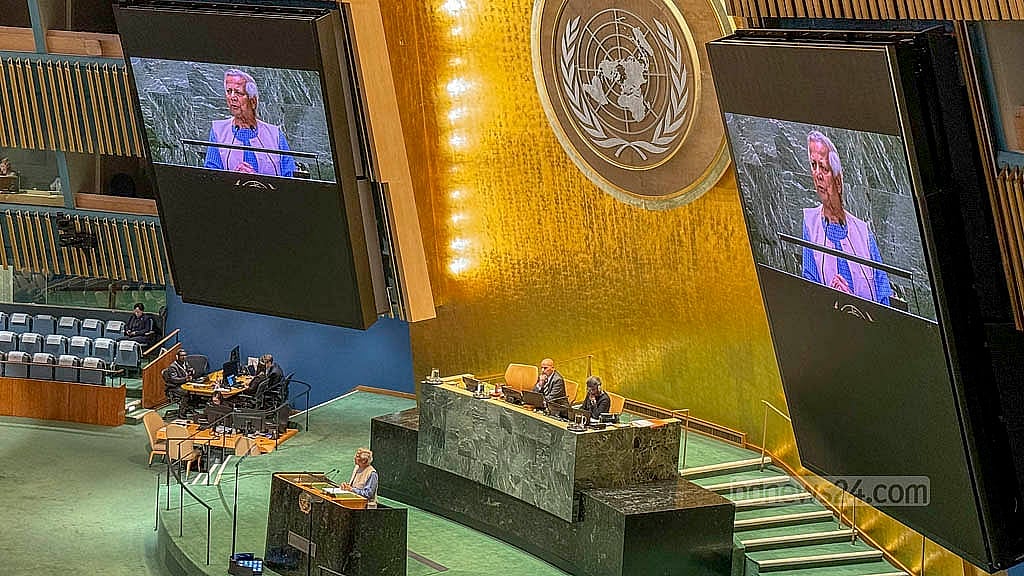
Chief Advisor Muhammad Yunus has urged global leaders to engage with the emerging ‘new Bangladesh’ with a “fresh approach”.
Standing before the United Nations as a leader of Bangladesh's 170 million people, Yunus said: “I call upon the international community to continue and deepen engagements with Bangladesh in meeting our people’s quest for democracy, the rule of law, equality, prosperity, so that we can emerge as a just and inclusive democratic society.”
The movement demanding the reform of quotas in government jobs, which began in July, eventually morphed into a large-scale anti-government uprising. On Aug 5, Sheikh Hasina fled to India, marking the end of the Awami League’s 15-year rule.
This uprising, the bloodiest in independent Bangladesh’s history, has seen the deaths of over 800 people and written a new chapter in the country’s history.
Under the leadership of Nobel laureate Yunus, an interim government has taken charge, initiating various reform programmes in line with the protesters' expectations.
Speaking for the first time as Bangladesh's head of government at the UN General Assembly on Friday, Yunus urged world leaders: “I would call upon the international community to engage with ‘new Bangladesh’anew that aims to realise freedom and democracy, beyond letters, for everyone.”
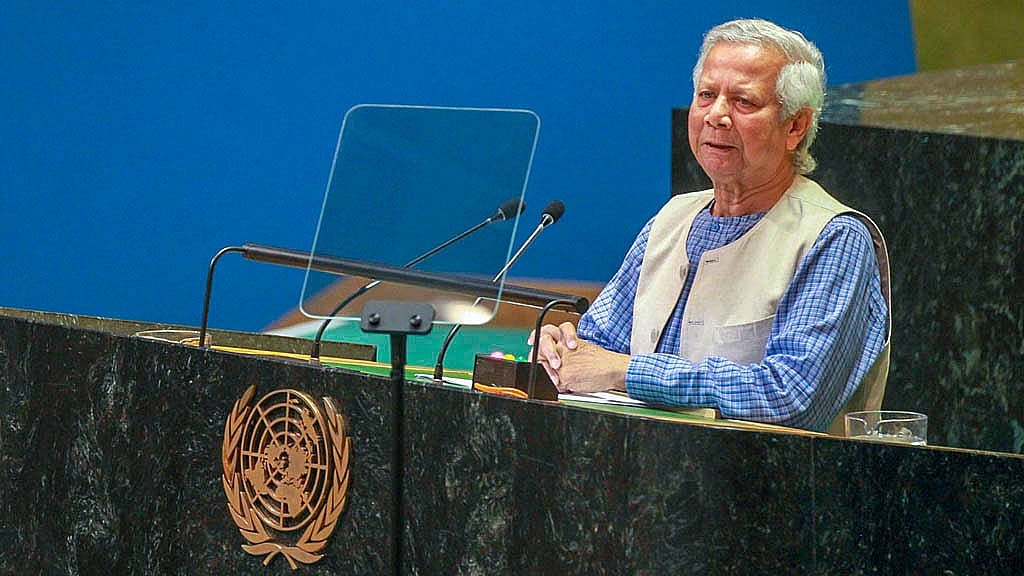
Maintaining traditions, the chief advisor delivered his speech in Bengali at this global forum, wearing his trademark Grameen check Fatua and Koti.
Early in his address, he highlighted the context of Bangladesh’s Anti-discrimination Student Movement and the transformative changes it has brought about.
Yunus expressed hope that “the revolution’ that the world witnessed in Bangladesh in the span of few weeks, may inspire many across communities and countries, to stand for freedom and justice.”
He highlighted how the previous Awami League government had turned Bangladesh's democratic system into 'ruins' and outlined the reform initiatives taken by the caretaker administration.
Yunus said, “We aim to establish effective safeguard mechanisms to ensure the sustainability of these reforms and create an enabling environment towards conduct of free, fair and participatory elections.
Yunus presented the new government's foreign policy to world leaders and said Bangladesh is eager to build and maintain friendly relations with all nations based on mutual respect, dignity, and shared interests.
He emphasised that Bangladesh will continuously strengthen its role in promoting peace, prosperity and justice globally.
‘GENERATION Z REDEFINES LIBERATION WAR VALUES’
In his opening remarks, the chief advisor presented the context of assuming the role of head of Bangladesh’s interim government following a mass uprising.
Yunus said, “I stand in this parliament of nations thanks to an epochal transformation that Bangladesh witnessed this July and August. The uprising led by the students and youth was initially aimed at ending discrimination. Progressively the movement evolved into a people’s movement.”
He continued, “The world eventually saw how people at large stood against autocracy, oppression, discrimination, injustice and corruption, both on the streets and online.”
“Our people, particularly youth, gained us independence from an autocratic and undemocratic regime with their exceptional resolve and capability. That collective resolve should define Bangladesh of the future and place our nation as a responsive and responsible State in the comity of nations,” he added.
The chief advisor said the people of Bangladesh sought inclusive participation in development efforts through their movement.
“The people aspired for a just, inclusive and functioning democracy for which our new generations made supreme sacrifice. We were moved by the wisdom, courage and conviction our youth showed. Even braving bullets, bare chest,” he said.
“Young girls were fiercely vocal against the illegitimate State power. School-going teenagers laid down their lives. Hundreds lost their eyes, forever. Mothers, day labourers and scores of people across cities lent their shoulders, for ‘their children’,” he added.
Drawing a connection between the current movement and the bloody nine-month Liberation War 53 years ago, said: “Bangladesh was born because of her people’s profound belief in liberalism, pluralism, secularism. Decades later, our ‘Generation Z’ is making us re-visit and re-imagine the very values that our people in Bangladesh stood for back in 1971. As our people also did in 1952, to defend our mother language, Bangla.”
REFORMS UNDER WAY, FOCUS ON ELECTIONS
In his speech, Yunus highlighted that many pillars of the governance structure became ‘ineffective’ during the previous government.
He said the interim government would address these issues to pave the way for elections.
The chief advisor said, “As we took to the office, to our utter shock and dismay, we discovered how endemic corruption a ‘functioning democracy’ was brought to farce, how key institutions were ruthlessly politicised, how public coffers were reduced to rubble, how oligarchs took over business, how ‘chosen few’ concentrated wealth in their hands and amassed and laundered wealth out of Bangladesh. In all, justice, ethics and morality, almost at every level, reached a low. “
He continued, “Under such circumstances, we were asked to rebuild Bangladesh and give back the country to the people. Our primary goal is to correct the ills of the past while building a competitive and resilient economy along with a just society.”
The chief advisor said all political parties can now express their opinions 'freely' in the current transformed environment.
He mentioned that ensuring accountability for every individual or institution involved in state activities and decision-making processes is a priority for the caretaker administration.
“We are committed to promoting and protecting the fundamental rights – for people to speak in freedom, to assemble without fear or inhibition, to vote whosoever they choose, to uphold the independence of the judiciary and freedom of the press, including in the cyber domain. “
Yunus said, “To ensure that the child of a farmer or worker can scale the highest in the society, we prioritise allocation in education and health sectors over grandiose infrastructure development.”
Addressing world leaders, the chief adviser said: “Bangladesh is open to nurture friendly relations with all countries based on mutual respect, upholding our dignity and pride and shared interests.”
He said the interim government is working towards organising national elections after essential reforms, with a focus on restoring public trust and confidence in the electoral system, judiciary, and media.
“We launched independent Commissions to reform the electoral system, constitution, judicial system, civil administration, and law and order. A few more Commissions are on the cards to reform other sectors, including press and media,” he added.
IMPLEMENTATION OF CLIMATE COMMITMENTS URGED
Yunus highlighted the severe threats posed by climate change, urging for the fulfilment of international commitments to protect vulnerable populations.
He pointed out that the record-breaking heatwaves experienced this summer serve as a stark reminder of the urgent need for climate justice.
Yunus said, “We need accountability for those responsible for reckless decisions and indifferent behaviours that contribute to climate damage.”
Yunus called attention to UN Secretary-General António Guterres’ warnings about the trajectory of global temperature rise, stressing that without immediate action, the world could face a temperature increase of 2. 7°C.
“I would hence urge for channelling robust resources for climate adaptation in the climate-vulnerable countries like Bangladesh. It is moreover crucial to operationlise Loss and Damage Fund by leveraging innovative solutions and additional finance,” he added.
‘THREE ZEROES’ CONCEPT
Yunus presented his ‘Three Zeroes’ concept, while also discussing his vision of creating a prosperous world through the global spread of his social business model.
He said, “I believe, the world needs to engage on a shared vision of ‘three zeroes’ that we can materialize together, targeting zero poverty, zero unemployment, and, zero net carbon emissions. Where a young person anywhere in the world will have opportunities to grow not as a job seeker but as an entrepreneur.”
He envisions a scenario where, despite limited resources, individuals can cultivate their creativity. Businesses can focus on achieving a harmonious balance among social benefits, economic profits, and environmental responsibilities.
He highlighted that through social business, anyone can transcend beyond consumerism and can ultimately catalyse social and economic transformation.
To achieve this vision, the interim prime minister said that both developed and developing countries, along with their partners, need a “new perspective, new values, and new unity.”
“If we are to realise such course correction, in full, the United Nations system, national and sub-national governments, non-governmental organisations, businesses, and philanthropies have to walk together. If we accept and accommodate ‘social business’ within existing economic structures, we can bring meaningful changes in the lives of the bottom half of the population, in every society.
“If we can realistically position social business, we can stem much of climate-insensitive distortions within the existing market economy. I would like to invite the attention of Secretary General, Antonio Guterres, on that score,” he added.
CALL FOR AN END TO WAR
The Nobel Peace laureate urged global leaders to take effective action to stop the ongoing war in Ukraine and the genocide in Palestine.
He said, “The genocide in Gaza continues unabated despite global concerns and condemnation. The situation in Palestine just does not concern the Arabs or Muslims at large but rather the entire humanity. Palestinians are no expendable people. All those responsible for the crimes against humanity against the Palestinian people must be held accountable.”
He continued, “Bangladesh calls for an immediate and complete ceasefire to protect the Palestinian people from the brutalities, particularly against the children and women. The international community, including the UN, needs to act in earnest to implement the two-state solution that remains the only path to bring lasting peace in the Middle East.”
The chief advisor said two-and-a-half-year-long war in Ukraine has claimed far too many lives. The war has impacted far and wide, even lending deeper economic implications in Bangladesh.
“We would urge both sides to pursue dialogue to resolve the differences and end the war,” he added.
SAFE RETURN FOR ROHINGYA
Yunus called on the global community to take a united stance for the sustainable and peaceful repatriation of the Rohingya currently sheltered in Bangladesh.
He said Bangladesh has been hosting over 1.2 million Rohingya for the past seven years, driven by humanitarian reasons.
“As a result, we are facing significant socio-economic and environmental damage. The protracted crisis in Myanmar also pose growing risks with national and regional security implications for Bangladesh, both traditional and non-traditional security challenges,” he added.
Yunus further urged world leaders, “We need continued support of the international community towards the Rohingya in carrying out the humanitarian operations and their sustainable repatriation.
Yunus said, “Ensuring justice through ongoing proceedings at the ICJ [International Court of Justice] and the ICC [International Criminal Court] for the widespread human rights violations against the Rohingya is equally important.”
Yunus praised the continuous efforts of the United Nations and other international organisations in creating a conducive environment for Rohingyas to live freely and with dignity in their homeland.
“It is crucial to pave the way for the Rohingya to return to Rakhine with adequate security and rights,”he added.
MIGRATION, LABOUR MARKET, AI
Highlighting the presence of over 15 million Bangladeshi expatriates, Yunus stressed the need for dignified migration processes.
“For migration to be beneficial for all, we have to create pathways for safe, orderly, regular, and responsible migration and mobility of people. The international community has to ensure full respect for human rights and the humane treatment of migrants, regardless of their migration status,” said Yunus.
He added, “While Bangladesh remains committed to the full implementation of the Global Compact on Migration, our government is also committed to curve unsafe migration.”
He mentioned that around 2.5 million young people enter Bangladesh's labour market each year, with nearly two-thirds of the country's vast workforce being youth. Yunus described preparing this workforce for the future as a challenge for Bangladesh.
The chief advisor said, “Yet, we see the world of work is changing where a younger person has to adapt constantly, re-skill, adopt newer attitudes. As Bangladesh is set to graduate as a Middle Income Country, we reckon the vital need to secure ourselves in terms of ‘learning’ and ‘technology’.”
Speaking on the remarkable development of artificial intelligence, Yunus highlighted the interest of Bangladesh's youth in AI and also warned world leaders about its potential risks.
Yunus said, “Our youth are excited with the prospect of fast unfolding generative AI. They aspire to walk and work as global citizens. The world needs to ensure that no youth in countries like Bangladesh get left behind in meaningfully reaping benefits of the AI-led transformation.”
“The world simultaneously needs to ensure that the development of artificial intelligence does not diminish the scope or demand for human labour,” he added.
He continued, “As the scientific community and the world of technology keeps moving on developing ‘autonomous intelligence’ – artificial intelligence that propagates on its own without any human intervention – we all need to be cautious of the possible impact on every human person or our societies, today and beyond.”
“Many have reasons to believe that unless autonomous intelligence develops in a responsible manner, it can pose existential threats to human existence,” he added.
THE PROMISE OF A NEW BANGLADESH
Yunus emphasised the importance of uniting efforts, capabilities, and resources to harness everyone's potential, innovation, and prosperity in addressing the various global crises.
He said, “The challenges we face – in economic development, climate resilience, or social development – have to be addressed with common endeavours.”
Yunus highlighted that South-South and triangular cooperation could play a pivotal role, especially considering the unique economic and social contexts of countries in the global South.
“It is also a growing necessity for the global South to make our voices heard. In shaping and steering the global agenda, the global South merits equal space and focus,” he said.
The chief advisor said, “This year, we celebrate the golden jubilee of Bangladesh’s partnership with the United Nations. It has been a shared journey, of mutual learning. In our modest ways, Bangladesh contributed towards promoting global peace and security, justice, equality, human rights, social progress and prosperity. And, indeed in building a rules-based international order.”
Yunus also urged world leaders to reflect deeply on how to ensure equal opportunities for men and women to become empowered entrepreneurs in today's world.
He said, “In this assembly, echoing the calls for peace, security, justice, and equitable distribution of resources, we must all understand how to create equal opportunities for all, ensuring their empowerment.”
Referring to Bangladesh’s revolution, Yunus praised the youth. “The youth in Bangladesh have shown that upholding freedom, dignity and rights of people regardless of distinction and status cannot just remain aspirational. It is just what everyone deserves.”
He concluded, “Bangladesh would assure that we would and continue to deliver our bit, at international, regional and national levels, in securing peace, prosperity and justice, for everyone.”