Published : 05 May 2026, 04:09 AM
Updated : 21 Aug 2026, 03:41 PM


A sense of profound despair has gripped the Haor regions of Sunamganj as relentless rains have submerged vast tracts of paddy, leaving farmers to watch their only means of survival rot and sprout in the rising water.
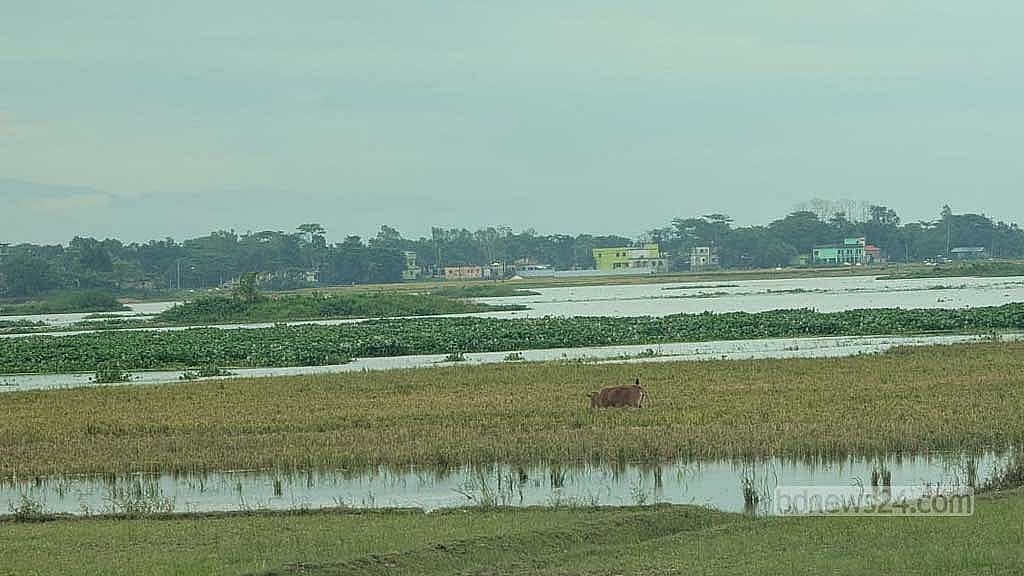
A visit to the Jhauar section of Dekhar Haor on Monday morning showed more than half of the area under water, submerging both ripe and unripe paddy.
As water levels rise, water hyacinths drifting in from nearby wetlands have spread across the fields, covering vast stretches of the Haor.
The scene makes it nearly impossible to distinguish farmland from open water.
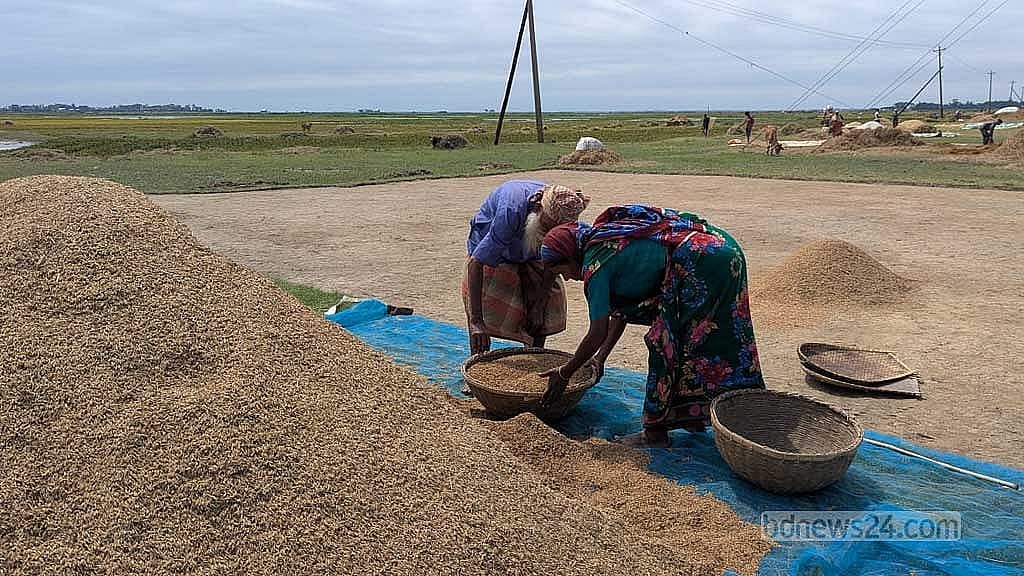
Even the paddy that farmers managed to harvest in haste has begun to sprout -- a process known locally as Gera -- rendering the grain nearly useless.
The volatile weather, shifting between sudden rain and brief sun, has made it impossible for farmers to dry their grain or the straw needed to feed their cattle.
"I cultivated eight keyars (approx. 33 decimals each) of land," said Chad Mia, a farmer from Hasnabasot village, his face etched with worry.
"The water took half before the ears could even ripen. I cut the rest, but most of it has sprouted and spoiled. How will I feed my family of eight now?"
Nearby, his wife Jamila Khatun was sorting sprouted grains from a pile of harvested paddy.
Pointing to rotting straw, she cried: "The rice is gone and so is the fodder. How am I supposed to keep my four cows alive?"
Labourers Retreat as Harvest Becomes Risky
Around 9:30am on Monday, a bleak picture emerged in the same Haor.
A group of harvest workers led by Nazrul Islam from Achinpur village had set out to cut paddy in the fields of Aslam Mia.
They had agreed to harvest at a rate of Tk 800 per day.
But within 20 minutes, they returned without starting work.
The fields were fully submerged, forcing workers to wade into waist-deep water -- posing serious health risks.
“The fields are frightening. We would have to work in deep water and risk illness. No one wants to cut paddy in such conditions,” Nazrul said.
Farmers say even plots near the banks that had remained partially above water are now submerged, making harvesting impossible.
Sadikur Rahman, a marginal farmer from Kalipur village, said he had cultivated two-and-a-half Keyars of land by taking loans after undergoing gallbladder surgery.
“Two Keyars are already under water. Even the half Keyars I harvested are now sprouting. There’s no way to recover submerged crops. Labourers come and go back -- they refuse to work in deep water,” he said.
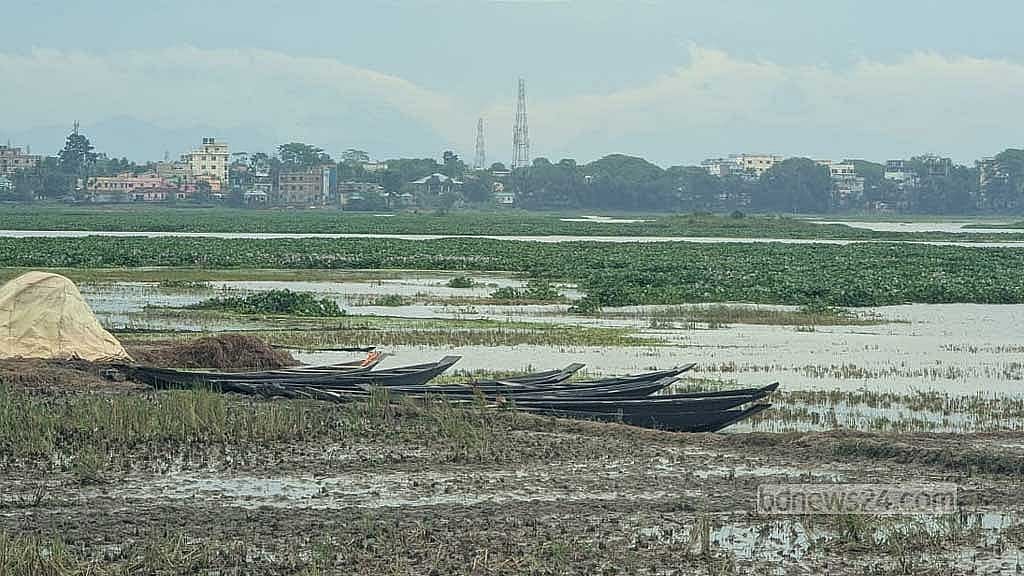
Meanwhile, the Bangladesh Water Development Board reported the Surma River rose by 12 centimetres between Sunday evening and Monday morning.
At Sunamganj point, the river was flowing at a level of 4.87 metres on Monday morning.
With the waters still rising, the hope of the Haor farmers is rapidly washing away.
Threshing Machinery Owners Face Heavy Losses
The devastation in the Haors has extended beyond the farmers to the owners and operators of threshing machines, locally known as “Boma machines”.
Many owners invested Tk 15,000 - 20,000 each to repair and ready their equipment for the Baisakhi harvest, but the submerged fields have rendered the machinery idle.
While these machines typically collect at least 100 maunds of paddy as payment during a standard season, most owners have failed to gather even 20 to 30 maunds this year.
"In a good year, we earn 80 to 100 maunds of paddy. I spent Tk 20,000 to fix my machine, but I haven't even collected 30 maunds yet," said Siraj Mia, a machine owner from Kalipur village.
"If the farmers can't save their crops, how are we supposed to earn?"
Chan Mia, a machine operator, highlighted the rising labour costs.
"It takes at least three people to run a machine, and more if the roads are bad and it needs pushing. Usually, each worker earns about 15 maunds of paddy, but this time we haven't even reached that. The whole Haor is underwater."
Discrepancy Over Damage Assessments
Conflicting reports have emerged regarding the extent of the agricultural damage, with activists accusing the government of underreporting the crisis.
Bijon Sen Roy, general secretary of the Haor Bachao Andolan (Save Haor Movement), claimed that roughly 60 percent of the crops have been lost.
"Even half of the harvested paddy has been ruined. The Department of Agricultural Extension (DAE) is hiding the true extent of the damage. By downplaying the losses, they are depriving farmers of much-needed incentives," he said.
However, the DAE maintains that the majority of the harvest is already secure.
Mohammad Omar Faruk, deputy director of the Sunamganj DAE, said 77 percent of Haor paddy has already been harvested.
"Of the 165,000 hectares cultivated in the Haors, 127,000 hectares have been cut," Faruk said.
He noted that across both Haor and non-Haor areas, 65.9 percent of the total 223,511 hectares has been harvested.
While the department currently estimates that 20,160 hectares of crops have been destroyed, Faruk admitted that "the damage figures may rise".