Published : 25 Nov 2025, 08:29 AM
Updated : 21 Aug 2026, 02:47 PM


From the bustling streets of Dhaka to the quiet fields of Narsingdi, Friday’s 5.7-magnitude earthquake sent shockwaves through Bangladesh in more ways than one.
Across the nation, instinctive panic eclipsed preparation. In the stampede to get out -- down stairwells, off balconies, and in some cases by leaping from upper floors -- hundreds were injured, several of them gravely, exposing a stark truth: the country remains unready for seismic disasters.
For years, repeated warnings from geologists and disaster experts have collided with government assurances of “initiatives” and “programmes” designed to educate and protect the public. Yet when the earth trembled violently, these promises proved largely symbolic.
In less than a day, a series of smaller aftershocks compounded the fear, revealing not only gaps in emergency messaging but also the fragile state of public awareness at every level of society.
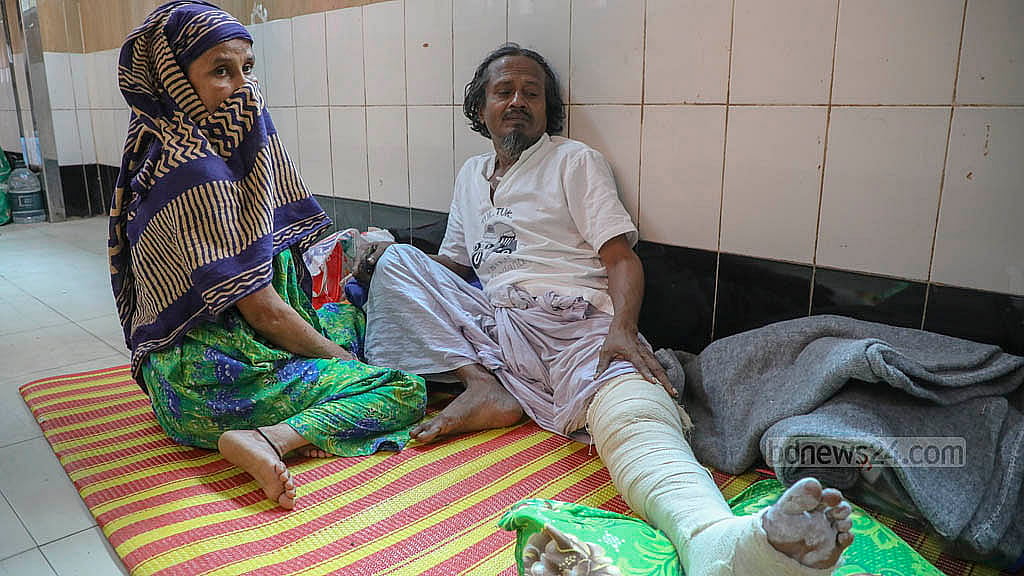
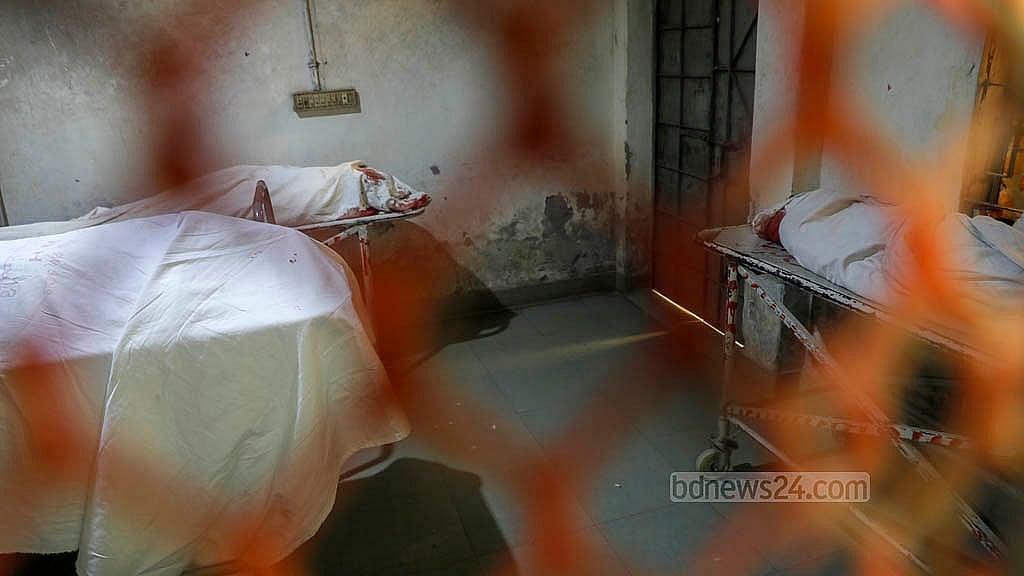
At least 600 people were hurt on Friday alone, while dozens remain in critical condition.
A parallel controversy erupted on Saturday after the Earthquake Observation and Research Centre wrongly identified the epicentre of the day’s successive quakes.
The centre blamed the mix-up on “an unintentional human error”, insisting that it did not reflect any fundamental weakness in its technical capacity. Its officials argued that earthquake data are frequently revised in countries around the world.
At Dhaka University, students were admitted to the hospital after misjudging the safest escape routes, while elsewhere, injuries ranged from fractured limbs to severe trauma.
In the countryside, 65-year-old Nasir Uddin collapsed and died of cardiac arrest as he ran in panic from his fields, underscoring that fear itself can be lethal when preparedness is absent.
Social media misinterpretations, conflicting official messages, and decades of inadequate awareness campaigns have converged into a perfect storm of confusion, leaving citizens more vulnerable than ever.
The Ministry of Disaster Management and Relief has long maintained that awareness programmes were ongoing. But officials now concede those efforts have been “insufficient”. A high-level meeting chaired by the chief advisor was held on Monday to chart the next steps.
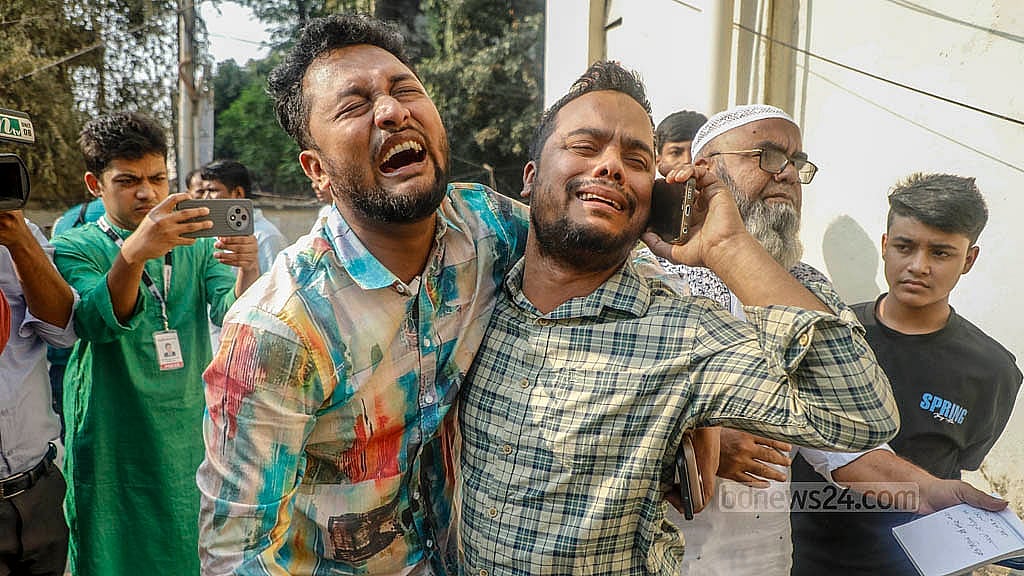
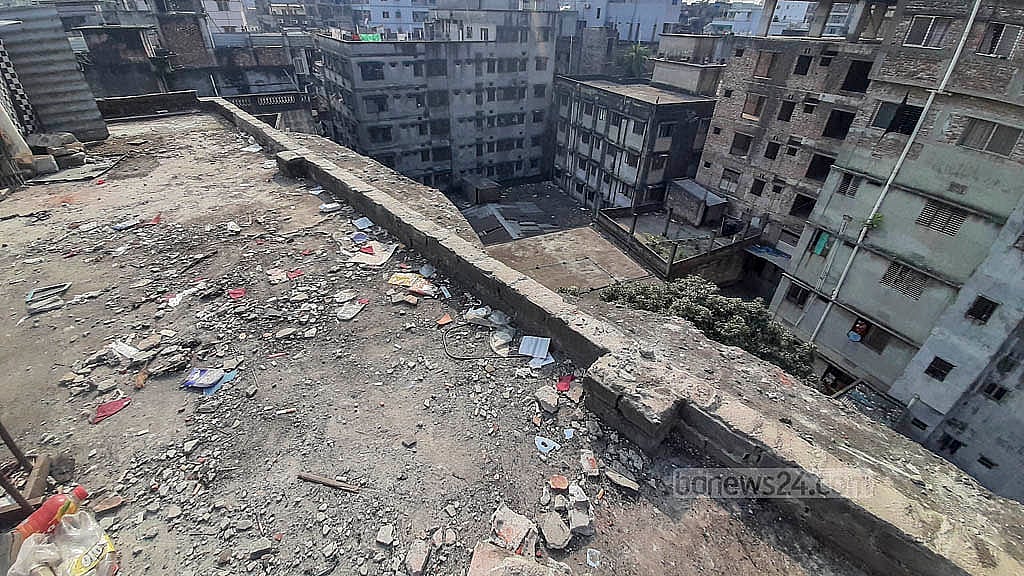
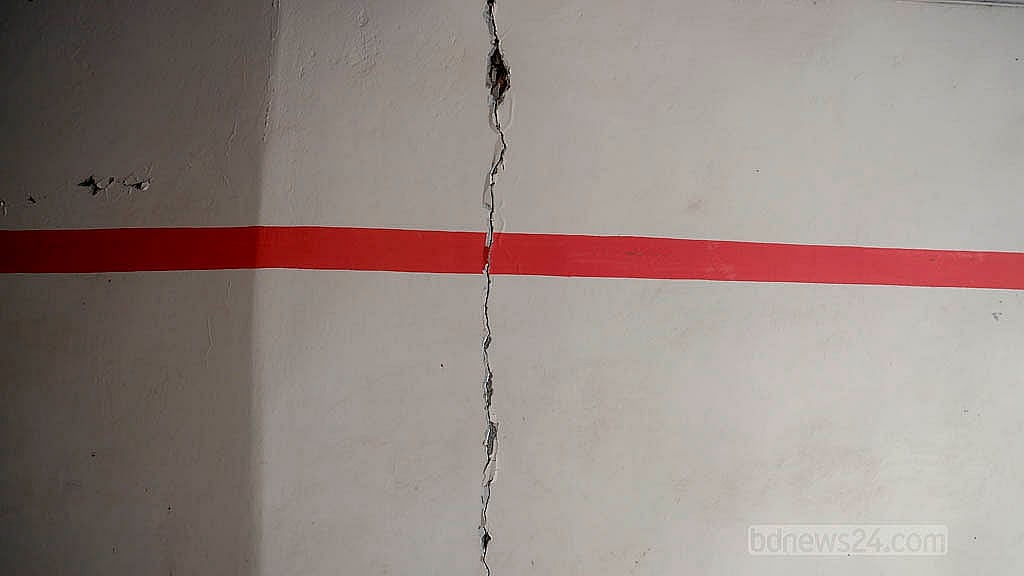
On Friday at 10:38am, Bangladesh was struck by the most lethal earthquake it has faced in two decades. At least 10 people died across three districts. Cracks snaked through dozens of buildings in Dhaka, and several structures were reported to have partially tilted.
According to official measurements, the 5.7-magnitude quake originated in Madhabdi, Narsingdi -- just 13km from Dhaka -- at a depth of 10km.
Prof Mehedi Ahmed Ansary of BUET’s civil engineering department said the country lacked adequate earthquake awareness “at every level”.
“Everyone shares a bit of the negligence,” he said. “People say many things, but no one has actually done the real work.”
He warned that a major earthquake “will occur by 2030”, arguing that awareness must be strengthened now and reinforced by regular drills.
HOW AWARE ARE PEOPLE?
In the two days in which Bangladesh experienced four tremors, Dhaka University logged injuries on both days, largely from students rushing out in fear. Several students jumped from fourth-floor balconies or even rooftops.
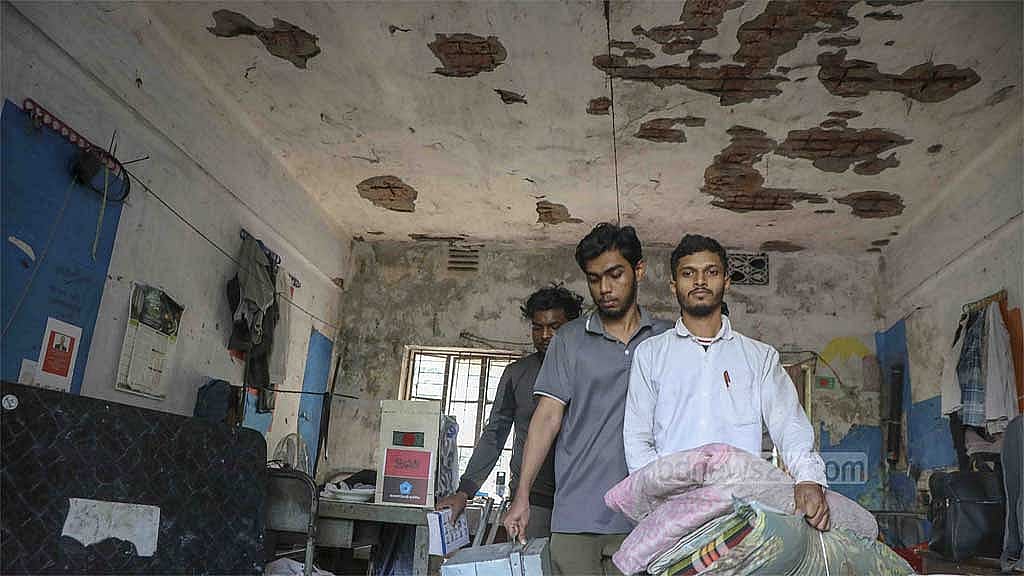
Many of the students themselves now say these incidents reflect a profound gap in awareness.
Mohammad Nazim, a resident student at Haji Muhammad Mohsin Hall, said: “People don’t know what to do when an earthquake hits. We know a few primary things, but we have no practical idea.”
Prova, a law student who gave by a single name, said many DU buildings were either old or structurally weak.
“So everyone thinks that getting out and reaching an open space gives them the best chance to survive. That’s why people rushed, and that’s why so many were injured.”
Journalism student Zeba Tahsin said she “knew almost nothing” before Friday.
“I panicked, rushed down the stairs, and later learned from experts that staircases are actually the most dangerous place.”
Fardeen Rahman, another DU student, said: “The sudden fear makes people feel their buildings won’t withstand the quake. They try to get out immediately, and that’s what causes the accidents.”
On Sunday, after two days of panic and repeated injuries, the university declared a 15-day closure. Students began leaving their residential halls that afternoon.
When asked whether a closure alone was sufficient, as opposed to engineering a plan to increase awareness, Convenor of the Provost Standing Committee Professor Abdullah Al Mamun said: “We trained students on fire drills recently, but not on earthquakes. After the last two days, we have decided that once classes resume, we will train all students on what to do during an earthquake.”
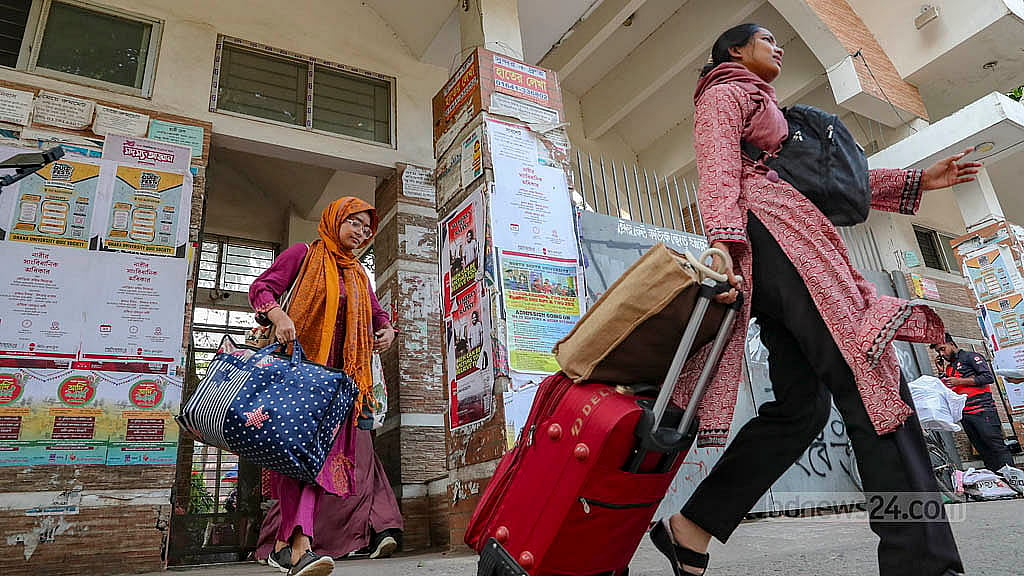
Firoz Ahmed, an officer at a private bank in Dhaka, echoed the same concerns.
“People know a few basic steps, but fear wipes their minds clean. I think this is also a knowledge gap.”
According to him, “No one has a clear idea of what exactly to do. People just run. But in a city like Dhaka, is running downstairs really safe? And people are getting injured while doing that.”
In Narsingdi, Arafat Shah said tiles fell off multiple walls in his four-storey home.
“Everyone is physically fine, but the fear is still there,” he said.
GOVT INITIATIVES TO RAISE AWARENESS?
Netai Chandra Dey Sarker, director of Monitoring and Information Management at the Department of Disaster Management, said the government has long run awareness programmes in Dhaka, Chattogram and other city areas with local stakeholders.
He said documentaries and other “awareness-raising materials” had been produced.
“Dramatised videos show what to do at a personal level during an earthquake. We also distribute leaflets, and these messages are on our website,” he said.
But he acknowledged that training sessions, workshops and other programmes “have not been sufficient”.
Asked whether awareness campaigns would be expanded in future, he had pointed at Chief Advisor Muhammad Yunus’s high-level meeting with specialists on Monday.
“The government has taken this seriously. The next steps will be decided from there.”
The discussion, which lasted for more than two hours, focused on gathering expert opinions present in the meeting.
He asked everyone present to submit written recommendations, based on which a work plan would be finalised within a week, officials said. The aim, he told them, was to shape future strategy from a consolidated set of proposals.
One senior official who attended the meeting and asked not to be named told bdnews24.com: “Experts shared their views on earthquakes. The government listened and asked for more suggestions.
“Only after that will the action plan be fixed. We were told it needs to be done fast, and accordingly, more inputs will be provided.”
BUET civil engineering professor Mehedi Ahmed Ansary, who also participated, said: “A lot was discussed today. They will probably take the feedback and make a summary. They may form a coordination or working committee. We discussed what should be done going forward, including issuing warnings to the public.”
According to him, the government wants written advice from everyone “as soon as possible”, which would then be collated within five to seven days and turned into a plan of action.
Asked whether any decision had already been taken, Ansary said the discussion centred on future strategies.
“A national-level institute is already in the pipeline -- that will hopefully be the focal point, that’s how the discussion went. It may be approved within the next month.
“Under that institution, a lot of work will likely be done. We are preparing a list of tasks. We will all submit them, and the government will coordinate.”
Geoscientist Prof Syed Humayun Akhter believes Bangladesh faces the prospect of a major earthquake, and that the danger has reached a “critical” level because of public ignorance, government inaction, and a chronic lack of preparedness.
In his words, earthquakes cannot be prevented, resisted, or predicted. But their impact can be reduced -- if the right decisions are taken.
“The final point is capacity building, and planning for the short, medium, and long term in earthquake preparedness and disaster management,” he said.
Akhter emphasised awareness campaigns as a short-term priority. “We need a social movement. We need regular earthquake drills.
“Everyone has responsibilities here -- ordinary people, the government, political parties, professional groups. If we can build a social movement and raise awareness, then if such an earthquake happens, the damage to life and property can be reduced to a minimum.”
He also warned that misinformation and misinterpretation on social media were deepening panic and confusion in an already fragile situation.
The retired Dhaka University geology professor said, “Nowadays, everyone claims to be an earthquake expert. As a result, conflicting messages reach the public and policymakers, leaving them confused and misguided.”
FALSE ALARMS
At 10:36am on Saturday, a day after the strongest earthquake in recent national memory, a mild tremor of magnitude 3.3 was recorded in Bangladesh.
Initially, the epicentre was said to be Baipail in Savar. Later, the Earthquake Observation and Research Centre corrected this to Palash in Narsingdi.
At 6:06pm that evening, the centre reported two earthquakes striking Dhaka’s Badda just one second apart. Shortly afterwards, it revised the message: one tremor had originated in Badda, the other in Narsingdi.
Analysts fear that such contradictory messages on a disaster event can alarm the public unnecessarily.
Prof Ansary viewed the episode as an indicator of the centre’s capacity limitations.
“They lack equipment. Some machines are broken; only two are functioning. That’s why they can describe the situation but not isolate the location properly.
“They should have admitted it. One moment they say Baipail, then Narsingdi, and still no acknowledgement. They should say the equipment is faulty and not working. Why give wrong information?”
Rubaiyat Kabir of the Met Office’s Earthquake Observation Centre offered an explanation for the confusion surrounding the three tremors on Saturday morning and evening.
“We have an auto system. Whatever comes into the system first, we release. That’s why we later revised it,” he said.
He added that international geological agencies also revise earthquake magnitude and location.
“In the past, we took more time, waited, then declared. Now we’ve introduced an auto system -- when we receive an alert, it’s pushed out quickly.
“That’s why in the morning, whatever we first received, we released. Later, we revised and fixed the location.”
He said reporting two epicentres at once was a “typing mistake”.
“We have to type the message manually. The person typing got the two messages mixed up and wrote Badda in the wrong place.
“Since it had already gone to the website, I revised it within 10 minutes. It was human error.”
He added that if the organisation had failed to detect the mistake internally, “then there would be grounds for criticism”.
On the question of capacity, Rubaiyat noted: “Our analysis system is semi-automatic. We still have to do some things manually.
“We recently launched an auto system experimentally. We hope it will be fully functional within six months, which should reduce confusion.”
EARLY-WARNING SYSTEMS
In 2022 and 2024, residents in parts of California reported receiving phone alerts seconds before an earthquake struck. Some received warnings at least 30 seconds ahead, bringing renewed debate about the possibility of advance alerts.
Tech giant Google has been working with the US Geological Survey (USGS) and several California universities to develop such technology, which is expected to provide a few seconds’ notice -- enough time for people to move to safer ground.
Beyond Google’s Earthquake Alert System, people worldwide use apps such as My Earthquake Alerts and MyShake.
The issue was raised on Sunday at the weekly core committee meeting of the Ministry of Home Affairs, where officials discussed the different apps used globally for early earthquake alerts.
After the meeting, Home Advisor Jahangir Alam Chowdhury said: “We don’t have any app that provides advance alerts for earthquakes in our country, but we’ve learned that others do. We will see whether we can use such apps. We will consult Met Office experts.”
But Prof Ansary cautioned that earthquake prediction is impossible anywhere in the world. “Prediction is not possible. You can never say it will or won’t happen,” he said.
FIRE SERVICE MESSAGE
A day after tremors were felt for two consecutive days, the Department of Fire Service and Civil Defence on Sunday released a set of instructions on “what to do during an earthquake”.
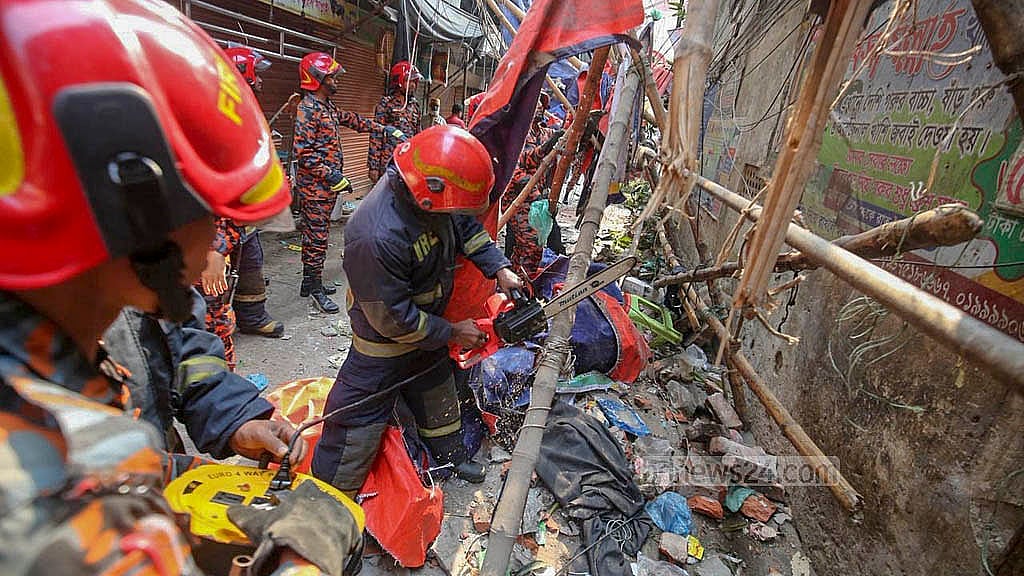
The advisory, circulated as an eight-point notice, urged everyone to stay calm and respond with measured action rather than panic.
The agency’s guidance on earthquake safety is as follows:
• If you feel tremors, do not panic. Remain calm and steady. If you are on the ground floor of a building, exit quickly and take shelter in an open space.
• If in a multi-storey building, follow the “drop–cover–hold” method:
- Drop low, take cover under a sturdy table or desk, and hold on firmly.
- Alternatively, take shelter beside a column or beneath a beam.
- Cover your head with a pillow, cushion, or any similar item if possible.
• Avoid using lifts during an earthquake. As soon as the shaking stops, switch off the electricity and gas connections immediately.
• Stay away from balconies, verandas, windows, bookcases, wardrobes, wooden furniture or any hanging heavy object. Keep a torch, helmet, essential medicines and a whistle within reach so they can be used in an emergency.
• If outside, take shelter in open areas away from trees, tall buildings, and electric poles.
• If inside a vehicle, stop the car away from overbridges, flyovers, trees, and electric poles, stay inside the vehicle until the shaking ends.
• Be aware that aftershocks may follow a main earthquake. Stay away from damaged buildings, bridges, and infrastructure, as they may collapse further in subsequent tremors and cause casualties.
For emergency assistance, the Fire Service and Civil Defence advised the public to contact their hotline at 102.