Published : 15 Mar 2026, 09:39 PM
Updated : 28 Aug 2026, 01:33 AM


Opposition Leader and Jamaat-e-Islami chief Shafiqur Rahman has raised questions in parliament over the failure to convene the first session of the proposed Constitution Reform Council.
In response, Home Minister Salahuddin Ahmed said the Constitution does not recognise such a council, meaning neither can the prime minister advise the president to call its session nor can the president convene it.
Speaker Hafiz Uddin Ahmad did not give an immediate ruling, saying he would respond after receiving a formal notice.
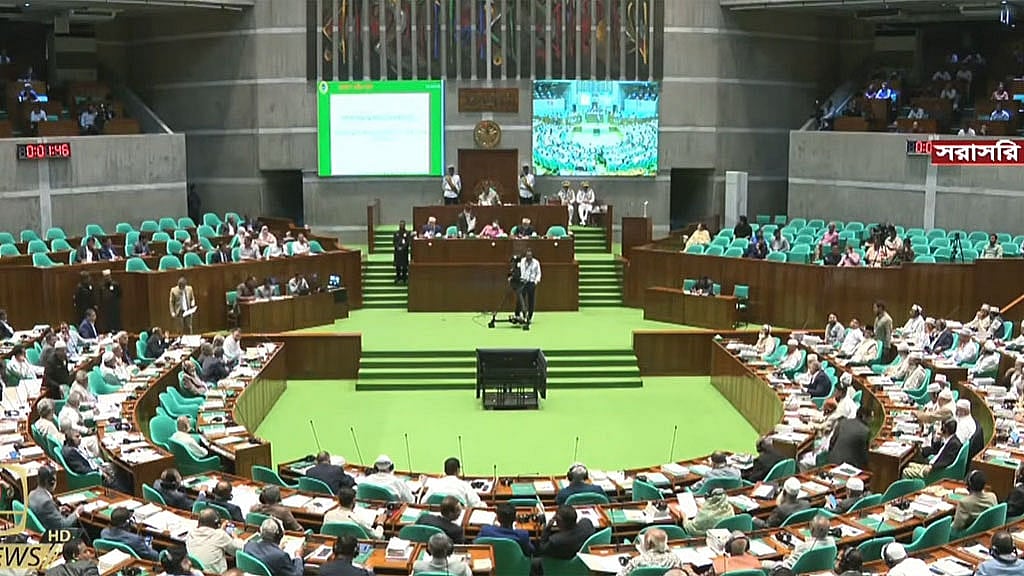
Soon after the House sat at 11am on Sunday, Shafiqur stood up seeking to raise the issue through an unscheduled discussion. When he tried to speak immediately, the speaker asked him to wait until the end of the question-answer session, saying he would be given time later.
When he was finally allowed to speak, the opposition leader said the current parliament, formed in the aftermath of the July Uprising, had not come through a “normal electoral process”.
He said a presidential order issued on Nov 13, 2025 had stipulated that the Constitution Reform Council should be convened within 30 days of the announcement of the parliamentary election results, but that had yet to happen.
Referring to the July National Charter implementation order, Shafiqur said it provided for the formation of a Constitution Reform Council made up of elected representatives if the referendum produced a “Yes” vote.
He said 77 opposition MPs had taken oath as members of the council and wanted to serve simultaneously as lawmakers and as council members.
Replying to the issue, Salahuddin first questioned under which rule the opposition leader had been allowed to raise it, noting that parliamentary rules require separate notices for adjournment motions or brief discussions on urgent matters of public importance.
He then set out the government’s position, saying Article 93 of the Constitution allows the president to promulgate ordinances when parliament is not in session, but constitutional amendments cannot be made through ordinances.
“The July National Charter is neither an ordinance nor a law,” he said, adding that its constitutional position was therefore “questionable”.
Salahuddin said the president had convened parliament under Article 72 of the Constitution and delivered the presidential address accordingly.
But since the Constitution does not contain any provision for a Constitution Reform Council, the prime minister cannot send written advice to the president to summon such a body, and the president also has no authority to call its session, he said.
“The government is not rejecting the referendum verdict,” the minister said.
“But to implement that verdict, the Constitution must first be amended. Only after the matter is incorporated into the Constitution can the question of the council arise in the next step.”
He said the people’s mandate must be respected, but that it had to be implemented through constitutional and legal means.
“There is no place for emotion here. A state does not run on emotion — it runs on the Constitution, on law and legal procedures,” he said.
At the same time, Salahuddin indicated that the government was not stepping away from the July Charter altogether.
He suggested that the parliamentary Business Advisory Committee could discuss when a constitutional amendment bill might be placed before the House.
“The government respects the July National Charter as a document of political consensus and remains committed to implementing it word for word,” he said.
After hearing the statements from both the opposition leader and the home minister, the speaker said the issue raised was “of great public importance”.
But he said no immediate solution could be given on the floor to such an important matter.
He asked Shafiqur to submit a formal notice and said he would give his ruling after receiving it.
Following the Feb 12 election and referendum, newly elected MPs took oath on Feb 17. While BNP lawmakers were sworn in only as members of parliament, MPs from the Jamaat-led alliance took oath both as MPs and as members of the proposed Constitution Reform Council.
On Mar 2, Salahuddin said the formation of such a council would require discussion in parliament and a lengthy process.
He also said then that although the Constitution does not recognise such a body, those who had taken oath under that designation had done so in their personal capacity.
After a meeting of the Business Advisory Committee on Saturday, the government indicated that the matter might be discussed in parliament rather than within the committee.
The issue formally entered parliamentary debate on Sunday when Shafiqur raised it at the start of the sitting.