Published : 05 Feb 2026, 05:59 AM
Updated : 21 Aug 2026, 03:06 PM


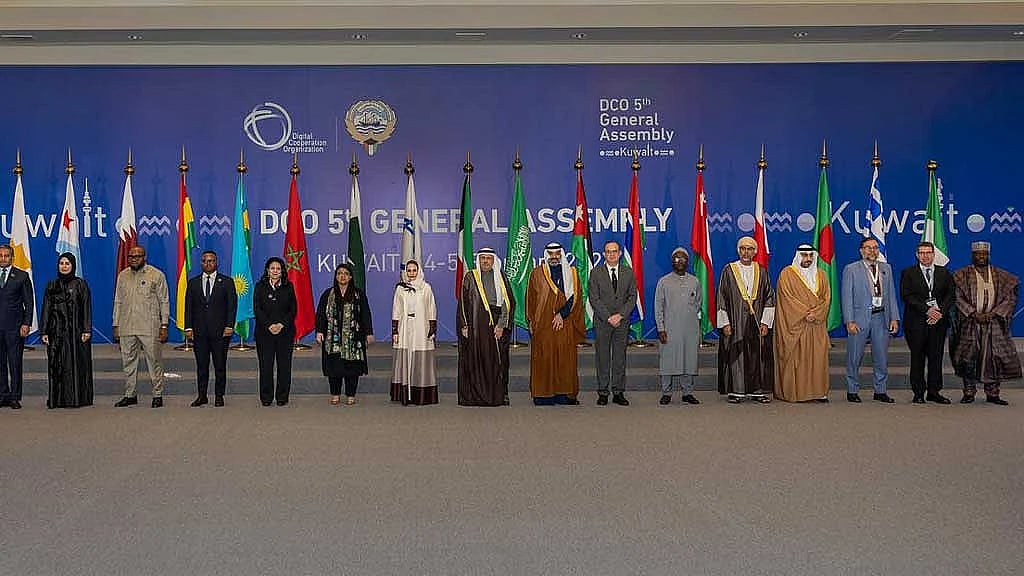
Bangladesh has announced plans to release its maiden artificial intelligence (AI) policy in February at the opening day of the 5th General Assembly of the Digital Cooperation Organisation (DCO) in Kuwait.
“We are working on the AI policy, and hopefully this will be in place within the month of February,” said Shish Haider Chowdhury, secretary of the Information and Communication Technology Division, on Wednesday.
He noted Bangladesh’s progress in AI, saying the country began its digital transformation journey 15 years ago and has already prepared an AI strategy.
The two‑day assembly, hosted by Kuwait, brought together representatives from 16 member states across the Middle East, Africa, Europe and Asia, alongside guest countries.
Participants called for responsible and inclusive adoption of AI to mitigate risks and ensure equal access to benefits.
Discussions covered billion‑dollar investments, regulatory frameworks, AI universities, data centres and ethical concerns.
The participants said AI technology is already shaping economies, societies, and potentially the perceptions of the next generation.
They also highlighted AI’s potential use in social engineering, threatening social and political stability if the technology is not embraced ethically.
Omar Saud Al-Omar, Kuwait’s minister of state for communication affairs, chaired the discussion.
“Digital transformation makes governments responsible for delivering seamless services to citizens, businesses, and companies,” he said.
AI technology will gradually engulf the world, the participating countries noted, calling for mature use of the technology, drawing on experiences of others who employed it in education, agriculture, science, public service, and even government purchases.
DCO Secretary‑General Deemah Al Yahya stressed the need for cross‑border cooperation to counter “real‑time misinformation and disinformation”, warning that failure to act could widen the digital divide.
“The opportunity is clear, but so are the risks. If we fail to act with urgency and coordination, the digital divide will widen,” she added.
The International Digital Cooperation Forum (IDCF), the DCO’s multi-stakeholder platform, also hosted plenary dialogues and side events on artificial intelligence, digital skills mobility, tech safety, and inclusive growth.
RISKS BEYOND BORDERS
Speakers stressed that AI risks transcend borders and that the technology is advancing faster than governments’ collective capacity to regulate it.
United Nations Secretary-General António Guterres, addressing the assembly in a brief recorded video message, said at a time of rising geopolitical fragmentation, evidence-based digital cooperation is more important than ever.
Speakers, however, pointed out that national AI regulatory frameworks, often relying on voluntary commitments, are far from being enough to deal with the issues at hand.
They warned that AI-driven social engineering could undermine democratic institutions and public trust.
FINANCING, TRUST, AND GOVERNANCE
Jordan showcased its national AI ecosystem, noting that over 90 percent of startups in the country specialise in AI, with 27 universities offering AI degrees and more than 11,000 students enrolled by 2025.
The country has established a National Council for Future Technologies, chaired by the prime minister and adopted a national AI code of ethics.
“Trust is at the heart of AI adoption,” said a delegate from Pakistan, which is due to take on the DCO presidency next year.
Saudi Arabia called for frameworks to govern cross-border data flows, while Bahrain and several other member states urged an inclusive international AI treaty.
Azerbaijan highlighted its paperless government system. Initiatives taken by the country have produced more than 1,000 AI engineers and product managers.
Speakers also stressed human-centred AI governance, with pilot projects underway in health, education, and public services.
Morocco boasted a 50 MW data centre, opening a window of tests and trials of AI.
Delegates also highlighted AI’s potential role in climate resilience, calling for international support to deploy AI in environmental monitoring and adaptation.
The assembly concluded with the agreement that while AI is no longer a future technology, governance, trust, and inclusion must advance at the same pace as innovation if the digital economy is to benefit all.
The Palestinian representative reminded the participating countries that their digital infrastructure had faced total destruction in many places, particularly in Gaza and the West Bank.
He said the Palestinians face the “worst-case scenario” of digital disconnection.
He called for the protection of digital infrastructure as a “global humanitarian need” so that no nation is left in the “digital blind spot”.
“Let us not let AI erase our narrative,” he said.
Founded in 2020, the DCO is headquartered in Saudi Arabia and represents 16 member states with a combined population of nearly 800 million and GDP of $3.5 trillion. The theme of this year’s assembly was “Inclusive prosperity in the age of AI”.