Published : 24 Sep 2025, 08:08 PM
Updated : 28 Aug 2026, 01:27 AM


A nationwide survey has revealed deep divisions over whether the Awami League, toppled from power on Aug 5 last year by a student-led mass uprising, should be allowed to contest the upcoming national election, even as support for the party has risen slightly since March.
The People’s Election Pulse Survey (PEPS), conducted between Sept 2-15 by Innovision Consulting, found that 45.79 percent of respondents want all parties to participate, while 45.58 percent believe the Awami League should be barred until it faces trial for alleged crimes against humanity committed in efforts to suppress the July Uprising.
Younger voters and university students were in the majority of those who oppose the party’s immediate return to the ballot at 63.05 percent.
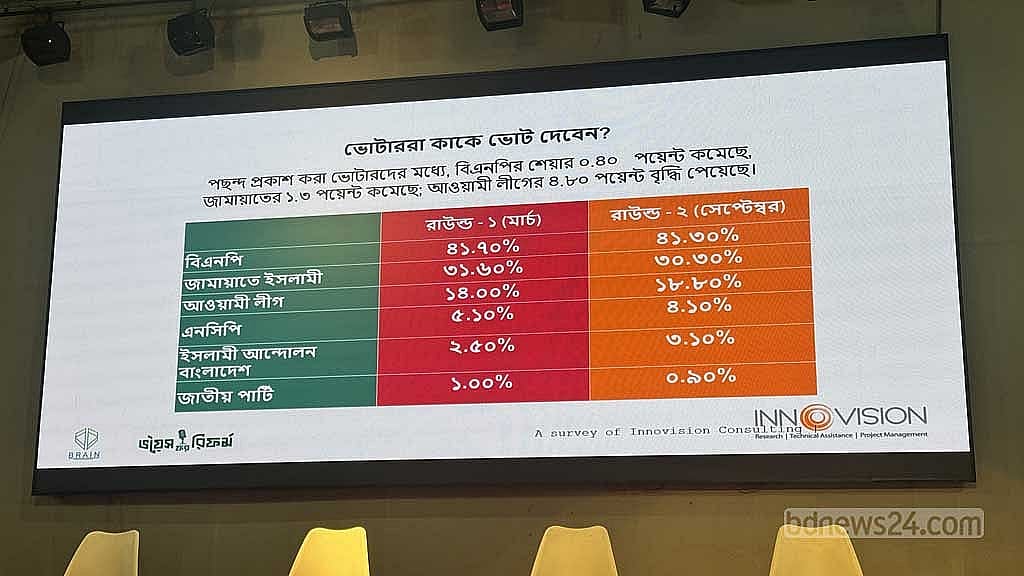
The survey, which polled 10,413 voters across 521 wards in all 64 districts, showed that 18.8 percent of respondents said they would vote for the Awami League, whose political activities are banned -- up from 14 percent in March. The BNP saw a slight dip, from 41.7 percent to 41.3 percent.
Support for the youth-led National Citizen Party (NCP) dropped from 5.1 percent to 4.1 percent, while the Jatiya Party declined marginally to 0.9 percent.
Jamaat-e-Islami fell from 30.9 percent in March to 28.1 percent in September, though the Islami Andolon Bangladesh edged up from 2.5 percent to 3.1 percent.
The findings were presented at the National Archives building in Dhaka’s Agargaon by Rubaiyat Sarwar, managing director of Innovision Consulting.
“We mainly tried to see who the public wants to vote for in the upcoming election,” he said.
He explained that in March, fewer respondents were willing to disclose their voting decisions, but more voters expressed their choices in September, which led to increases in the reported percentages for the BNP, Jamaat, Awami League, and Islami Andolan.
The NCP’s share fell, while the Jatiya Party’s support remained unchanged across both surveys.
MOST FIT TO GOVERN
Detailed responses show the Awami League made the largest gain in disclosed support. In March, 5.7 percent of respondents had said they would vote for the party, which rose to 8.5 percent in September.

When asked which party they saw as most capable of forming the next government, 39.1 percent of respondents named the BNP, 17.7 percent named the Awami League, and 28.1 percent favoured Jamaat. The NCP drew 4.9 percent support, while 10.2 percent pointed to other parties.
Voters were also asked where the Awami League votes might go if the party was unable to contest the election due to its current ban on political activities. In that scenario, 45.6 percent said they would back the BNP, 33.5 percent Jamaat, 4.7 percent the NCP, 3.8 percent Islami Andolan and 2.1 percent the Jatiya Party.
Among 1,840 respondents who identified the Awami League as their top choice, nearly half -- 49.5 percent -- said they considered the BNP the “second most suitable” party.
The survey suggested that support for the BNP increases with age, while Jamaat’s backing declines among older voters.
In contrast, higher levels of education were associated with greater support for Jamaat but less for the BNP.
PUBLIC PRIORITIES
The survey also highlighted shifting expectations. Inflation, which topped concerns in March at 71.2 percent, has now fallen to 54 percent.
Improving the law-and-order situation was cited by 57.5 percent of respondents as the most urgent task for the next government, while 36.9 percent prioritised reducing corruption, up from 32.4 percent.
FOREIGN RELATIONS
On foreign policy, more than 70 percent of respondents favoured maintaining good relations with both India and Pakistan. However, university students were more sceptical, with 15.1 percent saying Bangladesh should keep greater distance from India, while 8 percent preferred distance from Pakistan.