Published : 19 Jul 2026, 03:58 PM
Updated : 08 Sep 2026, 09:26 AM


Opposition lawmakers have regularly taken the government to task through the first two sessions of the 13th Parliament.
They have pushed for bills to be sent to standing or select committees, called for public opinion to be sought, and proposed amendments to different clauses.
They have risen on points of order and staged several walkouts.
Yet how far these objections have actually shaped the law-making and decision-making process has come under scrutiny as the two sessions draw to a close.
The Opposition's grievance goes beyond how much time they get to speak.
Relaxing procedural requirements to table and pass bills, they say, has narrowed the scope for scrutinising legislation, comparing it against existing law, and drafting amendments, weakening not just the Opposition's role but parliament's own role in law-making.
The government's position is that the Opposition does get the chance to speak, but that majority decisions or urgent legislation cannot be held up indefinitely.
Nizam Uddin Ahmed, a former professor of public administration at Chittagong University, observes that the opposition has not been short of opportunities to speak in the first two sessions.
When the opposition leader or other members rose to speak, the Speaker gave them the floor in most cases, he says.
The parliamentary analyst, however, views the same-day tabling and passage of the 67-clause "Invest Bangladesh Bill" as a break from established parliamentary convention.
Ordinance Pressure in the First Session
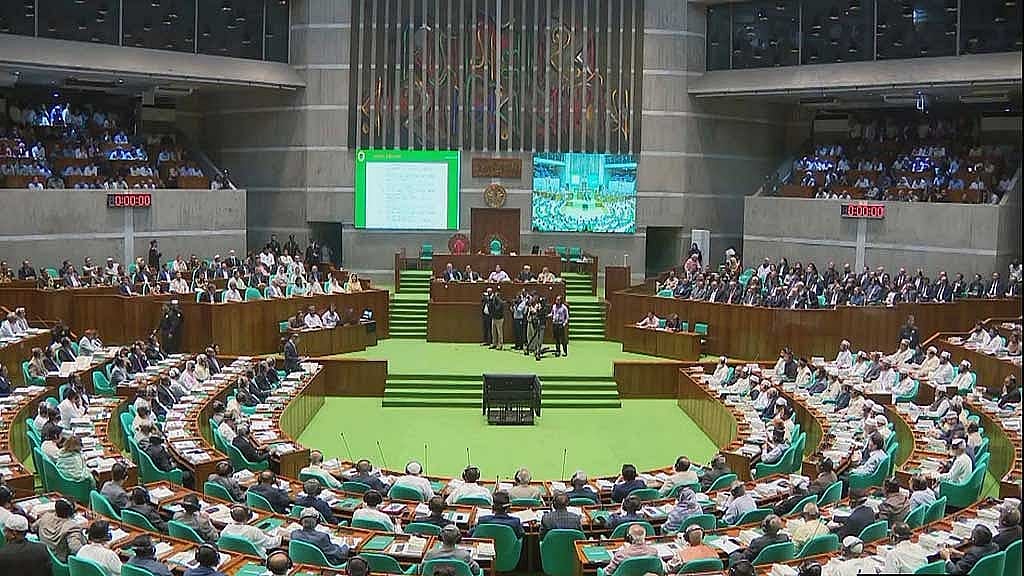
The parliament's first session ran from Mar 12 to Apr 30. Over 25 working days, 94 bills were passed.
The session also had to deal with 133 ordinances issued during the interim government's tenure, which carried a constitutional deadline for disposal, leading to 91 bills being passed in the session's final six working days alone.
A special committee of government and Opposition members was formed to scrutinise the ordinances.
It recommended passing 98 of them unchanged and 15 with amendments as bills, repealing four, and sending 16 back for further review before being brought as fresh bills.
Opposition members recorded written dissent on several ordinances, including those on referendums, the police commission, prevention and remedy of enforced disappearances, the Anti-Corruption Commission, and the right to information.
Even as the ordinances were disposed of quickly, this gave the Opposition a chance to put their positions on record within the special committee.
One of the committee's decisions was later overturned on the floor of parliament, prompting the Opposition to question the value of such "understandings”.
The special committee had recommended passing the July Uprising Memorial Museum ordinance unchanged, but once the bill was tabled in parliament, an amendment moved by a ruling party member was adopted.
It replaced a provision for an outside expert to preside over the museum's board with the culture minister or state minister instead.
Opposition Chief Whip Nahid Islam called it "broad-daylight trickery”.
Law Minister Md Asaduzzaman said the government had tabled the bill exactly as agreed by the special committee, and that a private member's amendment was later adopted through a voice vote.
The Opposition's objection was that if an understanding reached in committee could be overturned by a ruling party amendment on the floor, it would become difficult to trust such arrangements in future.
Procedural Rows Mar Second Session
The second, or budget, session ran from Jun 7 to Jul 15.
Over 26 working days, 10 government bills were passed alongside the budget.
Budget discussions ran for 48 hours and 51 minutes across 14 working days, with 316 members taking part.
Under Rule 71 of the Rules of Procedure, 715 adjournment motion notices were submitted.
Of these, 24 were accepted and 22 were discussed.
The parliament secretariat did not disclose party-wise data on how many notices came from government and opposition members respectively, how many proposals from each side were accepted, or how many opposition amendments were adopted.
Nazibur Rahman, spokesperson for the Opposition in parliament, told bdnews24.com that framing their grievance purely as a “lack” of speaking time misses the real problem.
His complaint is that bills are being passed by suspending procedural requirements, without giving members the time or documents needed to examine bills, prepare amendments, or compare them against existing law, narrowing the role of both the opposition and parliament in law-making.
He also alleged that while ruling party ministers get long stretches of speaking time, the Opposition is not given an equal opportunity to respond to their remarks.
When the Bangladesh Medical University (Second Amendment) Bill was tabled on Jun 28, the Opposition objected that they had not received a copy of the bill in advance.
Speaking in parliament, Nazibur said the Rules of Procedure require bill copies to be provided three days in advance, and that if that requirement had been relaxed, parliament should have been informed.
He also alleged that no comparative note on the bill against existing law had been provided.
Deputy Speaker Kayser Kamal, citing parliamentary records, said notice of the bill had been given on Jun 15 and copies distributed on Jun 23.
"According to the records we have, the notices and copies were given more than three days in advance," he said.
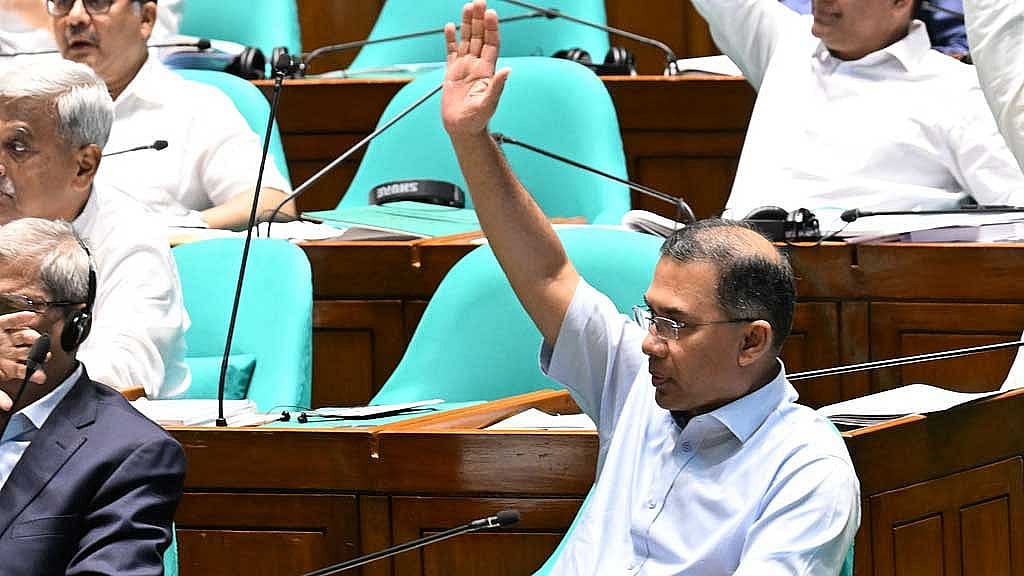
When Jamaat member Shahjahan Chowdhury then sought to speak on a point of order, the deputy speaker said it could not be allowed.
Opposition members walked out in protest.
Prof Nizam says not every issue belongs on a point of order, and that many matters can instead be raised through calling attention notices, short discussions, or other provisions under the Rules of Procedure.
He observes that when the Opposition leader or other members rose to speak, the speaker gave them the floor in most cases.
"The Opposition needs to specifically point to an issue they wanted to raise but were prevented from raising," he said.
He also believes that since most Opposition members are in parliament for the first time, they will need more time to make full use of the various tools available under the Rules of Procedure.
The 'Invest Bangladesh' Bill
The Opposition's sharpest objection in the second session came over the Invest Bangladesh Bill, 2026.
The 67-clause bill was tabled and passed on the same day, the session's last, with barely 28 minutes elapsing between the request to table it and its passage.
The bill merges the Bangladesh Investment Development Authority, the Bangladesh Economic Zones Authority and the Public-Private Partnership Authority into a single new authority, repealing the four related laws.
Opposition members sought time to send the bill to a standing or select committee, seek public opinion, and propose amendments.
At the time, Nazibur told parliament: "It isn't possible, in such a short time, to read the bill, compare it against existing laws, prepare amendment proposals, or demand public consultation."
He later told bdnews24.com that while the cabinet and presidential recommendation process had taken several days, members of parliament were effectively given just 10 to 15 minutes to scrutinise the bill and propose amendments.
His allegation is that the bill was passed under Rule 83 of the Rules of Procedure without giving members a real opportunity for amendment or discussion.
Home Minister Salahuddin Ahmed, arguing for the government, said sending every bill to a standing committee was not mandatory.
Three authorities carrying out similar functions were being merged, he said, and passing the bill before the session's last day was essential since investors were waiting on the agreement.
The deputy speaker said the relevant provisions of the Rules of Procedure had already been suspended to allow the bill's immediate consideration, leaving no time to accept written amendments and circulate them among members.
Prof Nizam said the speaker can, in cases of urgent necessity, suspend the rules to allow a bill to be tabled and passed on the same day, meaning the process was not unlawful.
He, however, noted that under parliamentary convention, a bill would typically go to its relevant standing committee after being tabled, or to a select or special committee if no standing committee existed.
His assessment: passing the bill on the same day may fall within the Rules of Procedure, but it departs from established parliamentary convention.
Opposition Boycotts Constitution Committee
Two days before the second session ended, on Jul 13, a 12-member special committee on constitutional amendment was formed, chaired by Home Minister Salahuddin.
Five seats were kept vacant for the Opposition, but they did not submit names.
Chief Whip Nurul Islam Moni told parliament that despite repeated requests for names, the Opposition had not responded, and that the committee would be reconstituted to include them once names were submitted.
Leader of the Opposition Shafiqur Rahman said, "We have made our position clear. We never said we would submit names. We have not accepted this conceptually."
His complaint is that the government is "bypassing" the process of implementing the referendum verdict by forming a special committee instead of letting the Constitution Reform Council do that work.
Opposition members walked out after his remarks.
The government's position is that any amendment must be brought within the framework of the existing Constitution.
Implementing the referendum verdict, it argues, first requires a constitutional amendment in parliament, and the special committee is the forum for that discussion.
Nazibur said he saw no scope for reconsidering the decision not to submit names for the special committee.
"There is no question of our taking part in this.”
In his view, the July National Charter was reached after discussions among political parties, and the public delivered its verdict in the referendum.
Starting fresh negotiations now with lawyers, academics and other stakeholders would open the door to revising past decisions rather than implementing the reforms.
He also said an oath taken by the Opposition has effectively become meaningless, since the Constitution Reform Council's session has not been convened.
His position is that the July Charter implementation order could be amended to extend the reform council's six-month term by another six months.
If the government extends the term and convenes the council's session, he said, the Opposition wants to sit there to implement the reforms.
He did not, however, speak of any decision to walk out of parliament altogether, saying the Opposition would continue its protest within parliament through speeches, notices, amendments, private member's bills and walkouts where necessary.
Prof Nizam Uddin believes that whatever changes are eventually made, they will have to be passed in parliament as a constitutional amendment bill, so forming a parliamentary special committee is “not unreasonable”.
He believes, though, that the committee would carry greater political legitimacy if it were formed through an understanding with the main Opposition alliance.
His assessment: "It would be rushing to a final verdict, calling parliament one-sided after just two sessions. A few more sessions need to be seen to understand how the government and Opposition behave."