Published : 26 Apr 2026, 12:50 AM
Updated : 21 Aug 2026, 03:36 PM


The Football Players’ Welfare Association (FPWA) reportedly submitted a memorandum to the football authority, asking for the revocation of the SAARC player quota policy under which players from the region are treated as locals if they are recruited by clubs.
The association’s biggest concern is that if footballers from Nepal or Pakistan or the Maldives play in the local leagues as local players in addition to foreign recruits then budding Bangladeshi footballers will be deprived and demotivated.
But to understand the whole situation better, let’s look at the possible reason as to why regional footballers were allowed to play as locals in the first place.
Seasoned Booters at a Low Cost
In the 1980s, the local league and the players were sharper, more skilled because the Bangladeshi footballers could play and hone their skills in the lower division before moving to the top-flight.
Only a few of the big names could import international players which meant that even in the first division, the mid and upper mid-level clubs relied fully on local footballers.
The same was true for second and third division clubs.
Foreign players for top clubs came not as the key player in a particular position but usually as a support.
This is the reason why the national team was never short of a proper striker.
Kazi Salahuddin, Sheikh Mohammad Aslam, Ashish Bhadra, Imtiaz Ahmed Nakib, Alfaz Ahmed had risen to the top by playing in less prominent outfits.
As strikers or attacking midfielders for top clubs they had the support of a foreigner to bolster the offence.
Whether the foreigner was from Nigeria or Nepal, the player from outside the country was deemed a foreign player.
From 2004 onwards, there was a flood of footballers from African nations to the extent that matches played between villages in some part of Bangladesh also saw African booters, playing as hired legs.
The onslaught and inclusion of African players in clubs from all tiers may have injected pace and quality to the club level games but had devastating consequences for the national side.
That is why, after Zahid Hasan Ameli and Mamunul Islam, there has not been a solid striker in the national team.
In protesting the inclusion of regional players in the league as locals, football lovers contend that such a move will shut the door of upcoming local booters.
This fear is not unfounded. However, the issue has to be seen from the club’s perspective as well.
If a club cannot bring results and is relegated then patrons lose interest, leading to clubs becoming bankrupt, comments Shamsu, a former player for Victoria Sporting.
Therefore, to secure wins, clubs must have skilled booters which they can get at an affordable rate from Nepal, Maldives, Pakistan and Bhutan, he adds.
Understandably, clubs will want the South Asian Association for Regional Cooperation nation players playing as locals because this will save money, observes, Tuhin, also a former footballer, adding: “However, there can be a rule that if three SAARC players are fielded in the first 11 then only one foreign recruit will be allowed.”
Another way to promote local players is to announce a special financial package for a club, fielding all Bangladeshi born players, contends former Kosaituli player Kaliji.
To add to the incentive, such outfits may be exempt from relegation even if they end up bottom of the table, maintains Kaliji.
In the 1980s, Ganesh Thapa from Nepal, Pakir Ali, Chandrasiri Damodaran and Ratnayaka Premalal from Sri Lanka played for Mohammedan and Abahani respectively, but they were here as foreign recruits.
So much was the appeal of Pakir and Premalal that many fans fantasised these two donning the Bangladesh national colours.
Later, in the 1990s, South Asian Federation (SAF) Games gold winning Nepal team players Raju Kaji Shakya, Baal Gopal Mahajan played here but again under the foreign quota.
Essential to Find a Middle Ground
The SAARC player issue will divide football but to prevent the matter from wading into muddy waters, the authority must find a middle path.
Speaking about the conundrum, Abdur Rahim, a former player for Agrani Bank, says: “One way can be to pass a rule stating that a club maybe allowed to field two regional players as local, a third player, say form the same nation, will be deemed a foreign inclusion.”
Rahim also feels that inclusion of any booter whether foreign or regional must be prohibited at the lower-level leagues to allow local booters to hone their skills at all positions, striking in particular.
Mazhar Mithun, a football enthusiast, feels that once special incentives are offered to clubs fielding a full-fledged local side, they will move away from relying on too many foreign recruits.
Recently, after Italy failed to qualify for the World Cup, former Bangladesh and Abahani striker and a superstar of the 1980s, Aslam reportedly pointed to the over reliance of Italian clubs on foreign players, as a key reason for the debacle.
In finding a solution to the present contention, the impact on the national side and Bangladeshi football in general must be given top priority, feel most football lovers and former players.
Before Hamza Choudhury, Shamit Shome and other foreign-based Bangladeshi players were included in the national side, Bangladesh was struggling to score at international matches.
However, in the recently concluded qualifying for the Asian Cup, Bangladesh secured five points and scored six goals.
The result could have been better but, though it's not the worst either.
With SAFF Football meet coming up, the football authorities need to find a way which, in the long run, benefits the national plus the age level sides.
Tajul, a former player for Rahmatganj, feels that if foreign players' numbers are restricted to four, the damage will be minimal.
“There should be a rule to field one promising player for thirty to forty minutes in 80 percent of matches.”
If all clubs follow this rule, at least for a majority of the league matches, the line to supply players for the national side will not dry out, he feels.
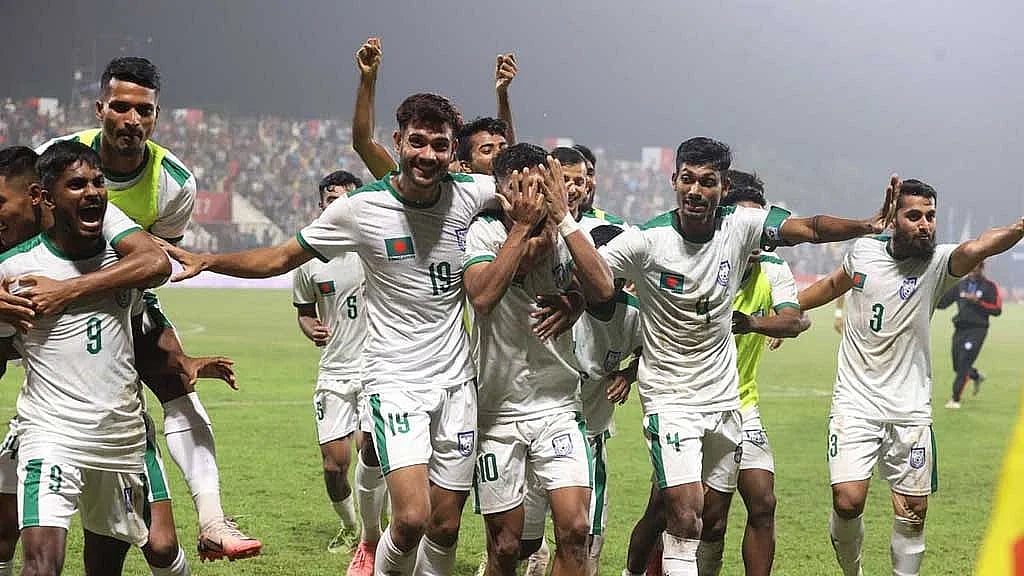
Football is seeing a resurgence in the country as Bangladesh are poised to host the SAFF meet later this year.
Keeping the game’s re-birth in mind, the solution should be such that local football and footballers are not left in the lurch.
[Towheed Feroze is a former journalist!]