Home
+
Published : 02 Oct 2024, 02:20 PM
Dear honourable chief advisor,
You have stepped forward to take the helm of the government at a very critical time in our history. R
Regardless of how one might view our arrival, your courage indeed deserves high applause! Even more promising and deserving of applause was your commitment to embracing the country as one ‘family’ and striving to fix the fissures and fractures in the governing processes.
As an academic myself, I saw in your words the true manifestations of the spirit of our academic community, our commonly held faith in ourselves as selfless scholars in pursuit of truth and the common good, free of the contamination of narrow political interests or alignments.
The country needs reforms, but with your background in economics you know quite well that building institutions to serve as the guard rails of nationhood in all its dynamism is not a one-day affair, nor can we build institutions through rewriting the constitution or by constructing committees and councils. The British democracy, enduring as it has been, does not stand strapped to a written constitution!
The walls and pillars of nationhood are best constructed by monumental examples of fairness, transparency and disbursement of justice with inviolable guarantees of human rights. We, as a nation, need to build “living national memories” of the ideals we cherish. And, honourable chief advisor, you stand at a point in time that calls for you to set such examples that will forever become a beacon to beam light for us in our forward journey.
Your clarion call for the nation to unite as a family was most timely. We hope that you will indeed work towards that now that you are in the position to put in motion our drift towards unity. But before you can delve deep into this territory, an important question to ask is why did we get so fragmented in the first place?
The first realisation that comes to mind is the disrespectful fragmentation of our history of liberation: the motivated practice of selective and redacted reading of our history after the brutal assassination of the father of the nation, Bangabandhu Sheikh Mujibur Rahman, has become a cause of the ever-widening chasm in the mantle of our nationhood. This needs to stop; there cannot be and should not be any abuse of our integral history for narrow political constituency-mongering.
There cannot be two readings of our history; it is a saga of a long and bloody struggle to realise our equitable rights and dignity as a people and eventually our independence as a sovereign nation among the nations of the world; it is a tale of tears and tribulations that stretches across decades, starting with the language movement.
Bangabandhu’s political career, that twice grazed death, is our long march to independence, and Gen Ziaur Rahman’s announcement over the radio on his behalf was the call of a son of the soil that galvanised us to rise as an army of freedom fighters ready to lay down our lives for independence. No party owns them individually and no party should build its brand on singular ownership of one of them while excluding the other. Honourable chief advisor, there needs to be a commission that includes scholars and members of civil society to settle this for all time.
The second important step is to set an example of unity-thinking. Right now, the Awami League seems to be cornered and its members are in hiding for fear of arrest. Ironically, on the other hand, Jama’at affiliates are coming out of the closet and freely expressing their thoughts and ideas. By no means does this have any semblance of a nation marching in unity as a family. Honourable chief advisor, we need to take steps that unambiguously give proof of our commitment to national unity, and not leave out Awami League and its allies. 
In that spirit, we need to rethink the constitution of the interim government. This interim government, with its claim of being a page-turner in our national history, needs to bear the hallmarks of a unity government by its documentable inclusivity. We need this if all the planned reforms are to receive the life force of an enduring code of governance. In my humble opinion, you should invite all political parties that have had parliamentary representation at some point in time, the leaders of civil society and professional classes to constitute a super advisory council to serve as the equivalent of a legislative entity. Let this body have the final say in approving reforms by absolute majority. This would effectively give the reforms the force of law.
The third step, but by no means any less important than the first two, is about the transparency and integrity of the judicial process, an equitable legal system homogeneous in its deployment.
Right now, the indiscriminate hounding and incarceration of Awami League affiliates even before the indictments have been formalised or preliminary investigations completed, is unmistakably, and I will say indelibly, undermining the standing of the interim government as an honest and unbiased arbiter of justice.
Further, taking into account the recent appointment of attorney Tajul Islam, a defence lawyer for Jama’at leaders charged with war crimes, as the prosecutor general of the International Crimes Tribunal, it all begins to add up to “Operation Pay Back Time”. At least so it would seem to any external non-Bangladeshi observer of these events.
It seems as if the majority of pro-liberation political party members have gone into hiding and their usual opponents are out in the open marching with pride and an unmistakable sense of impunity. The protection of law, freedom and right of expression should be equally accessible to all; so, why this stark lopsidedness? This was not among the constructive changes we had aspired for!
Honourable chief advisor, you wouldn’t want such a stain on your legacy, so please do not condone or endorse decisions that could be attributed to you as an act of vengeance. Yes, you had your differences with Sheikh Hasina that led to legal difficulties for you, but you are also an academic who won the Nobel Peace Prize. Can a Peace Prize winner stoop to such base instincts as exacting revenge? I am loath to believe that this can be a trait of your humble character.
Living abroad, I will say that both you, as our first Nobel Prize winner, and Hasina, for her remarkable strides in development, have made us proud. The falling out between the two of you has already caused much harm to the nation.
Even at the risk of sounding naïve, may I ask, “Is it possible for you two to patch up your differences and join hands to build this country as a sovereign and self-sufficient nation?”
Hasina missed her chance for reconciliation. Perhaps you can succeed where she failed. The two of you together can make our country great in the league of nations.
You have been very successful in building an international network of well-wishers. It is time for you to do something similar within the country and not let pride get in the way. The country and the nation need a rapprochement between the two of you. Please do seriously consider this suggestion of mending your differences, even if it comes at some personal cost. This would be yet another example of unity-building that will inspire and guide generations after you…and possibly become your most enduring legacy in history. I earnestly appeal to you, even if it seems it is too late, to heal this fracture that divides the nation today!
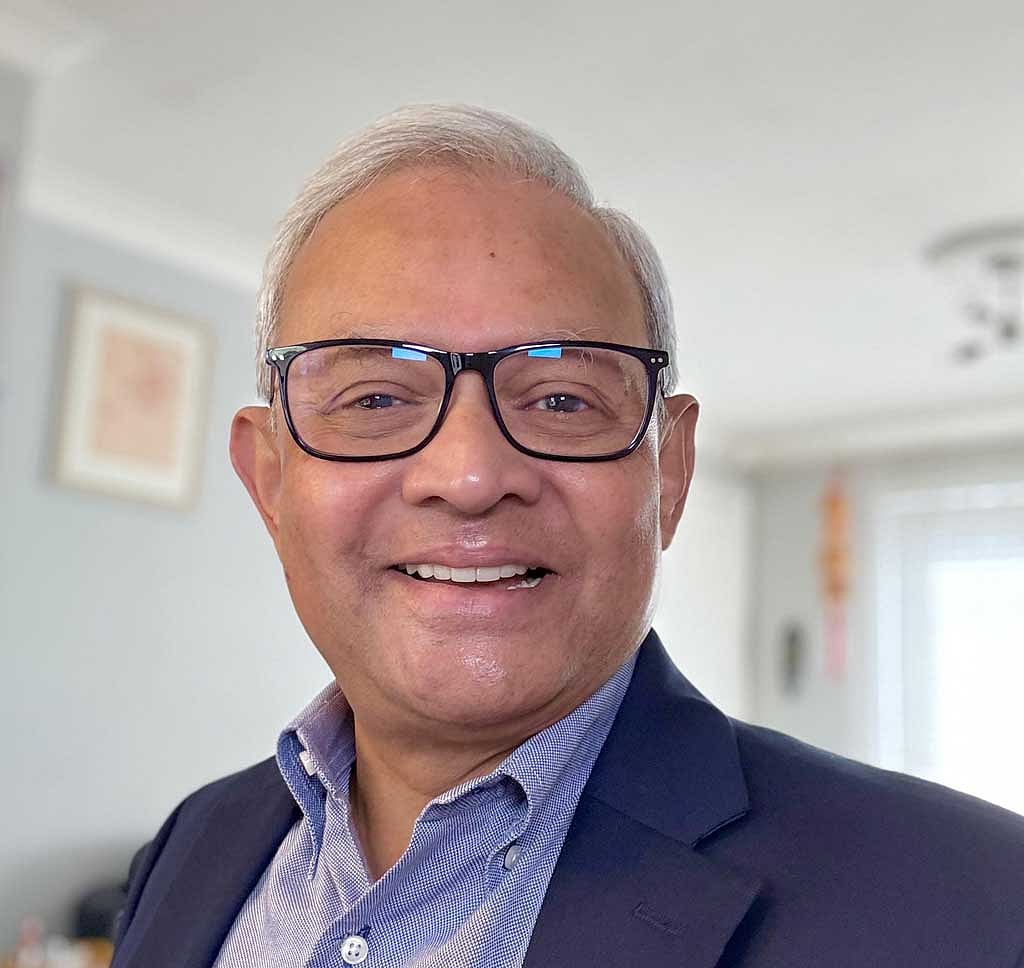
[Farooq Sheikh teaches at the State University of New York at Geneseo, specialising in operations management, business statistics, quantitative methods, and game theory, with a focus on fostering analytical skills and a commitment to lifelong learning.]