Published : 18 Jul 2026, 02:10 AM
Updated : 08 Sep 2026, 09:25 AM


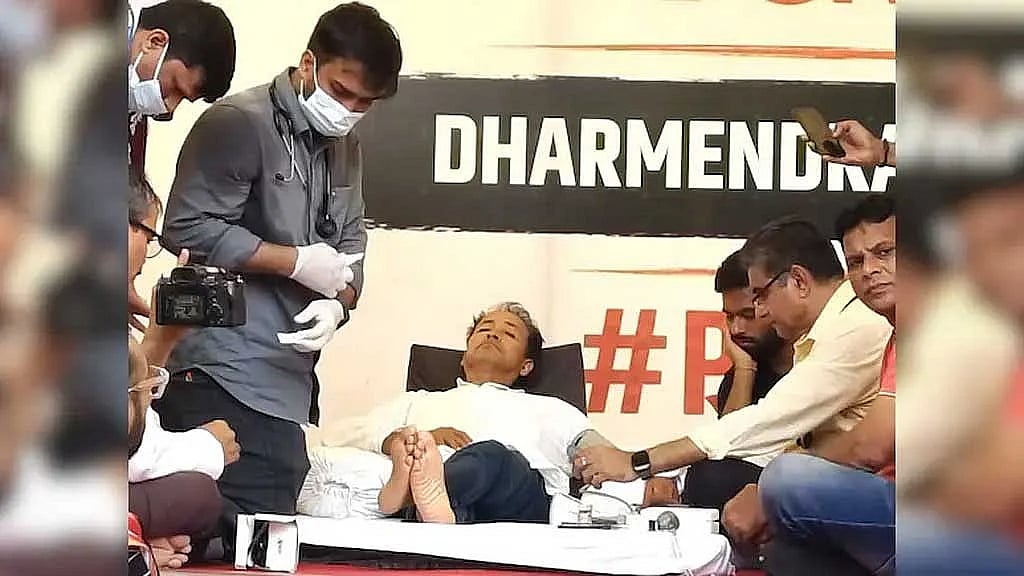
Since starting a hunger strike in late June, Indian environmental activist and educationist Sonam Wangchuk has lost has lost more than 9kg as he has been living on salt and water despite growing calls for him to end it.
The 59-year-old started the protests in New Delhi on Jun 28 in support of an online satirical movement called the Cockroach Janta Party (CJP) which is seeking educational reforms after reports of alleged question paper leaks in India's National Eligibility cum Entrance Test (Undergraduate), or NEET-UG, and other public examinations, BBC reports.
They have been demanding the education minister’s resignation too.
As the government on May 12 that the examination held nine days earlier had been voided amid reports of the question leaks, at least four candidates died by suicide.
On Friday, Wangchuk vowed to continue fasting until Monday.
But on Thursday, doctors warned that his health condition had entered a critical stage due to his prolonged fast and the next phase could be alarming and his organs could get affected.
The Delhi High Court has ordered the government to monitor his health and provide treatment if needed.
The bigger question now is whether Wangchuk’s hunger strike can reshape not only India’s education system, but also the politics of the world’s largest democracy.
India has a history of major national developments including a change to its map through hunger strikes.
Such an incident was a 58-day hunger strike by Potti Sriramulu seeking a separate state for Telugu speakers in 1952.
Then prime minister Jawaharlal Nehru had repeatedly resisted, but Sriramulu, a quiet Gandhian, knew only self-sacrifice could help fulfuill his demand.
And he passed away on the 58th day, stirring street protests across the Telugu-speaking regions. The protesters attacked government buildings, blocked railway lines. Several reportedly died in the unrest.
A few days later, the government announced the formation of the state of Andhra.
India got the States Reorganisation Commission and underwent the linguistic remaking in the following years.
Between 1918 and his assassination in 1948, Mahatma Gandhi, the leader of India's independence movement, fasted repeatedly.
His hunger strikes were against religious violence, caste discrimination and political discord, turning the empty plate into one of the defining symbols of India's freedom struggle.
Activist Anna Hazare's 13-day fast in 2011 gave fresh momentum to an anti-corruption campaign that briefly captured the national imagination. Irom Sharmila, protesting against the draconian Armed Forces (Special Powers) Act in India's north-east, refused food for 16 years.
Medha Patkar, another social activist, repeatedly went on hunger strikes to demand fair compensation and rehabilitation for people displaced by big dam projects.
Opposition Support Pours In
Wangchuk’s protests have already garnered backing from the opposition block, according to The Hindu.
Nationalist Congress Party (Sharadchandra Pawar) MP Supriya Sule recently met him, saying the matter of NEET-UG students would be raised in the Monsoon Session of the parliament which starts on Jul 20.
Sule also told reporters that the opposition would carry his fight forward inside Parliament.
Former law minister Ashwani Kumar also met the educationist, requesting him to preserve his health and life by ending his fast.
Kumar said the lives of conscientious dissenters should be prized and not compromised.
Mehbooba Mufti, the president of the Jammu and Kashmir Peoples Democratic Party (PDP), also extended her support to the protests on Friday.
“The distressing scenes unfolding at Jantar Mantar, where Sonam Wangchuk is risking his life to safeguard the future of our Gen Z, evoke memories of the sacrifices made by our freedom fighters to liberate India from colonial rule. The British may have left, but the colonial mindset seems to endure,” she wrote on X.
“How else can one explain the indifference of a democratically elected government that remains so callous that it refuses to engage with the youth at Jantar Mantar, the very generation that will shape India’s future?”
Congress leader Kumari Selja on Friday Wangchuk’s hunger strike symbolises the concerns of millions of students and youth over recurring paper leaks, flaws in the examination system and the lack of accountability.
Congress leader Pawan Khera also met Wangchuk on Friday.
“In a democracy, peaceful protest is a constitutional right. When citizens undertake a fast to be heard, the duty of the government is to listen -- not look away. That is Raj Dharma,” Khera posted on X.
Sikkim University Students’ Association has extended its support to him.
Can Wangchuk Succeed?
Referring to the hunger strikes before India’s independence from the British, many academics and historians said the habit continued to prevail in the liberated country.
There have been hunger strikes demanding farmers' rights, affirmative action, environmental protections, anti-corruption laws and the repeal of controversial security legislation.
"Hunger strikes are a global form of protest, not uniquely Indian," said Sayantan Saha Roy, an anthropologist at the University of Connecticut.
"But in India, where governments can become deeply unresponsive, protesters often see fasting as the only way to force those in power to act." says Saha Roy.
According to him, India has a “rich tradition” of the hunger strike because Gandhi transformed it into an enduring moral and political act.
"In a world of self-interested politics, they stand out as acts of self-sacrifice. As the protester's body weakens, the moral and political pressure on those in power grows."
Saha said, "In the public demonstration of his suffering, Wangchuk seems to be following Gandhi's path.
"As his health deteriorates, his protest gains traction and raises the political stakes for the government. How this unfolds remains to be seen."