Home
+
Published : 31 Jan 2026, 12:40 AM
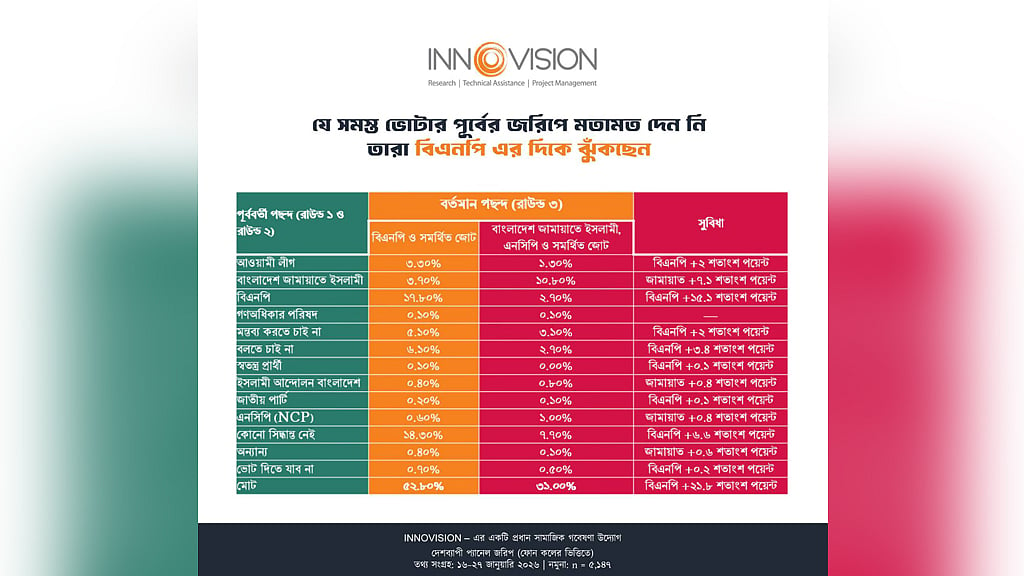
A survey by the private firm Innovision Consulting indicates that the Bangladesh Nationalist Party (BNP) is favoured over other parties to form the next government.
The third round of the firm’s survey, titled “People’s Election Pulse”, shows that 52 percent of respondents consider the BNP the most suitable party to form the next government.
The survey also found that 47.6 percent of participants believe Tarique Rahman will become the next prime minister.
Md Rubaiyath Sarwar, managing director of Innovision Consulting, released the survey results at the BDBL building in Karwanbazar in Dhaka on Friday.
The survey was conducted between Jan 16 and 27, based on telephone interviews with 5,147 participants, in collaboration with two platforms -- BRAIN and Voice for Reform.
The respondents in the round took part in the first two rounds of the survey as well.
The survey revealed 51.7 percent of respondents consider the BNP and its alliance the most suitable to form the next government, while 30.4 percent favoured the Jamaat-e-Islami and its alliance.
Of the respondents, the survey results showed, 22.5 percent see Jamaat’s Shafiqur Rahman as the next prime minister, and 2.7 percent choose Nahid Islam of the National Citizen Party (NCP) as prime minister.
The survey noted that the next election’s outcome hinges on roughly 30 percent of undecided voters, who did not indicate a preference in any round.
The second round of the survey was conducted from Sept 2 to Sept 15, with 10,413 voters participating from 521 wards across Bangladesh.
The second round of the survey also showed that the BNP had the highest support, with 41.30 percent of respondents expressing their intention to vote for the party.
In the first round conducted in March last year, the figure was slightly higher at 41.70 percent.
For Jamaat, support fell from 31.60 percent in March to 30.30 percent in September.
For the NCP, it dropped from 5.10 percent to 4.10 percent, and for the Jatiya Party, from 1 percent to 0.90 percent.
The only exception is Islami Andolan Bangladesh, whose support rose from 2.50 percent in March to 3.10 percent in September.
The survey revealed that 59.5 percent of respondents said they would vote “Yes” in the referendum, while only 6.8 percent opted for a “No” vote.
About 22 percent of respondents were unaware of the referendum, and 11.7 percent said they are still undecided.
Over 93 percent of respondents said they plan to vote.
The survey also found that, compared with other age groups, Gen-Z shows lower interest in voting, with 91.6 percent of respondents indicating they would vote.