Published : 26 Jan 2026, 07:23 AM
Updated : 21 Aug 2026, 03:04 PM


The air in Dhaka’s Mohammadpur is thick with both anticipation and anxiety.
In the afternoon of last November, a young man wielding a machete stormed into the Muslim Sweets factory owned by Md Selimuzzaman, ransacking the premises and fleeing with mobile phones and cash. The incident, though now months behind, remains etched in memory.
Standing beside his factory in the neighbouring Shekhertek, the veteran businessman reflected on his hopes for the February elections: “Whoever comes, first restore law and order here. We don’t want much, just to run our businesses in peace. We want to walk around without fear.”
A resident of Shekhertek, Selimuzzaman paints a grim picture: gas shortages, waterlogging, and unrelenting street crime have turned daily life into a negotiation with danger.
Daytime robberies, extortion, and brazen gang activity -- often nurtured under the patronage of political figures -- have left residents weary.
“How many more years will this go on?” he asks.
ELECTION FEVER MEETS CRIME-WEARY STREETS
As campaigning began on Thursday, candidates crisscrossed neighbourhoods, offering pledges wrapped in banners and fliers. But for most residents, the first and foremost demand is simple: restore security.
In the wake of the July Uprising, law and order across the country evolved, yet Mohammadpur remained a glaring exception. Despite police initiatives, violence continues unabated.
Viral videos have shown machete-wielding youths robbing shopkeepers in broad daylight, leaving locals terrified and some even seeking to move elsewhere.
Now, as votes approach, the streets are saturated with campaign posters, festoons, and the din of door-to-door canvassing.
Mohammadpur, Adabor, and Sher-e-Bangla Nagar police jurisdictions together form the Dhaka-13 constituency, which is witnessing nine contenders officially in the fray.
At the heart of the contest, voters are watching the duel between BNP candidate Bobby Hajjaj and Bangladesh Khelafat Majlis candidate Mamunul Haque, the head of the party.
Both promise to restore discipline, tackle gang violence, clamp down on drug abuse, and end extortion.
CANDIDATES’ PLEDGES
Bobby told bdnews24.com, “We’ve already begun discussions with residents of high-crime areas. Locals know where gangs gather. CCTV cameras and lighting will be installed at these hotspots.
“Any extortion backed by political influence will be completely stopped.” He believes his measures will significantly reduce crime.
Mamunul, representing the Jamaat-led coalition, emphasised the need to confront the political tolerance that underpins gangs, drugs, and extortion: “My main agenda is to make Mohammadpur safe. I will take a firm stand to free residents from terror, drugs, and extortion. This is my resolve; this is my promise.”
VOTERS SEEK IMPLEMENTATION, NOT PROMISES
Local residents have grown cynical.
Md Ali Rubel of Tajmahal Road lamented decades of unfulfilled pledges: “All I want is to move freely without trouble. But it never happened.
“From the 1990s until now, law and order has never truly improved here. Some days better, some worse -- but the public never benefits.”
Rubel blames Geneva Camp, a longstanding slum area, for much of Mohammadpur’s crime.
“Walk along Gajnabi Road at night and you’ll see -- questions asked, drugs smoked openly. This is why the zone has never improved.”
Other concerns include winter gas shortages and traffic congestion caused by illegally set-up shops, often backed by local political actors collecting informal levies.
“We no longer want assurances,” Rubel said. “We want action, results, and implementation.”
CONSTITUENCY SNAPSHOT
Dhaka-13 encompasses wards 28–34 of the Dhaka North City Corporation. The constituency has 408,791 registered voters: 209,812 men, 198,971 women, and eight third-gender voters.
Of 11 nominations, nine candidates are contesting:
• Independent Sohel Rana
• Khelafat Majlis’ Mamunul Haque
• BNP’s Bobby Hajjaj
• Bangladesh Minority Janata Party’s Md Shahabuddin
• Bangladesh Socialist Party-BaSaD’s Md Khalequzzaman
• Insaniyat Biplob Bangladesh’s Fatema Akhter Munia
• Bangladesh Muslim League’s Shahriar Iftekhar
• Independent Sheikh Md Robiul Islam
• Gono Odhikar Parishad’s Mizanur Rahman
Mamunul’s candidacy received endorsement from the Islami Andolan Bangladesh after withdrawing their candidate, Murad Hossain. Mamunul runs on the “Rickshaw” symbol; Bobby contests on the “Sheaf of Paddy” symbol.
Notably, eight constituencies feature candidates who left other parties to join BNP, contesting under the “Sheaf of Paddy”, while nine other seats were ceded to coalition partners.
ON-THE-GROUND CAMPAIGNING
Campaigning has intensified in Mohammadpur, Adabor, and Shyamoli.
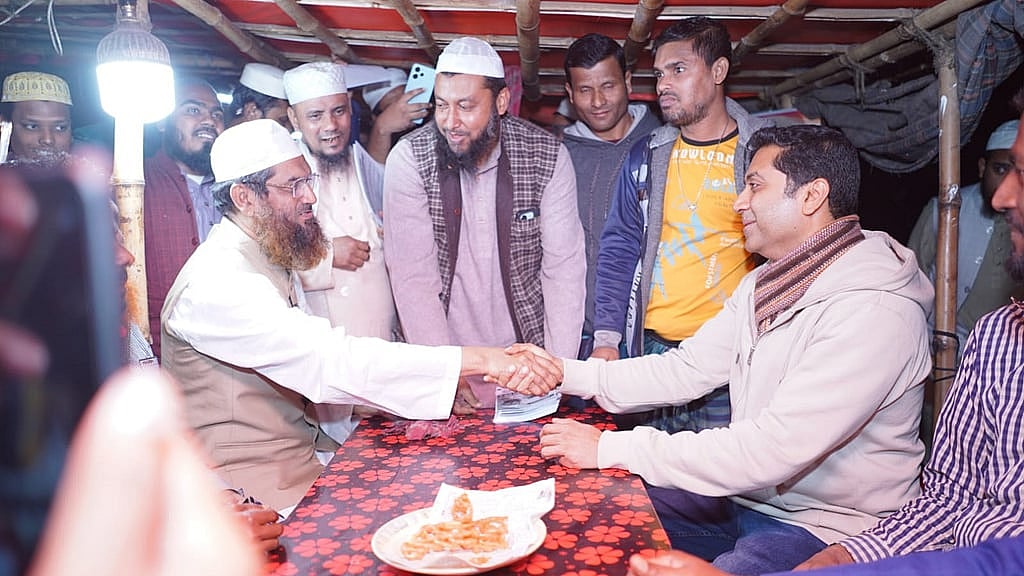
Foot marches, door-to-door canvassing, and market visits see men and women engaging voters directly, distributing manifestos, and discussing local concerns.
While posters are prohibited, banners and festoons remain omnipresent. Electoral offices attract steady footfall, and teashops like Golapti Stall in Katasur serve as hubs for political discussion.
Security personnel at Shekhertek buildings note a slow but steady rise in candidate visits: “As more time passes, engagement will intensify,” said Atatur Rahman.
CONTRASTING NARRATIVES
On Tajmahal Road, Bobby framed the contest as a clash of two forces: democratic versus extremist.
“This is a clear battle -- democracy on one side, extremism on the other. Voters must see who stands where,” he said, dismissing rival claims of offering heavenly rewards to supporters as extremist propaganda.
Mamunul’s Sunday roadshow from Shankar to Mohammadpur Bus Stand highlighted unity among Islamic parties in challenging entrenched political dominance.
He called for votes on his Rickshaw symbol to safeguard the community from looters and corrupt officials: “Traditional Mohammadpur has become a zone of fear. This election is about saying no to gang rule, terror, and extortion.”