Published : 22 Dec 2025, 08:51 PM
Updated : 28 Aug 2026, 01:34 AM


Journalists, politicians, writers, business leaders and civil society figures in Bangladesh have called for a united stand to protect media freedom, questioning the government’s response to "mob violence" targeting leading national dailies Prothom Alo and The Daily Star.
The call came at a protest meeting, titled “Bangladesh facing mob violence”, in Dhaka on Monday organised by the Newspapers Owners’ Association of Bangladesh (NOAB) and the Editors’ Council following attacks involving vandalism, looting and arson at the offices of the newspapers.
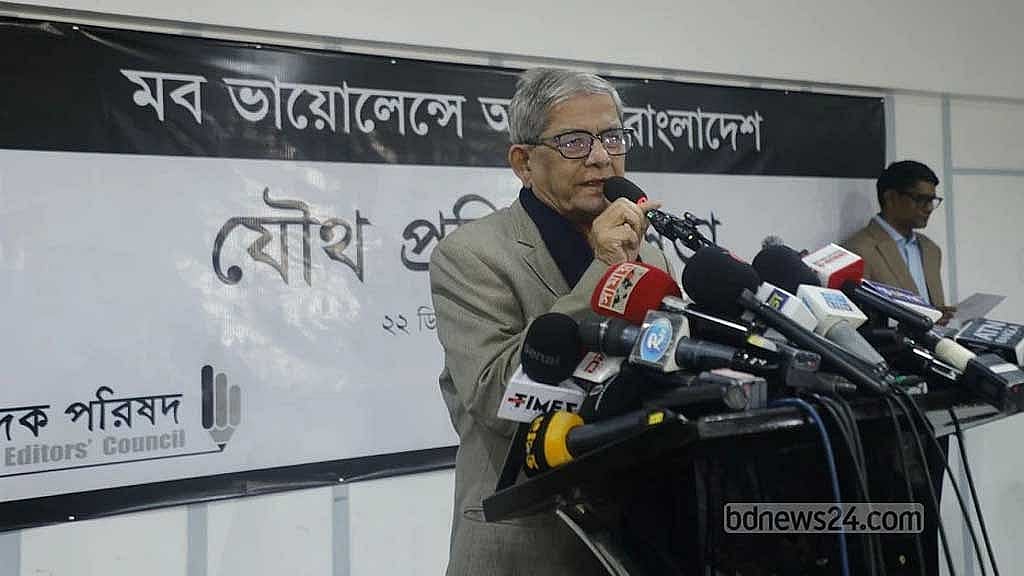
Addressing the gathering, BNP Secretary General Mirza Fakhrul Islam Alamgir said the attacks went beyond individual institutions.
“An attack on newspapers is an attack on democracy and the July Uprising. Now it is no longer enough just to be aware. We must stand up against these dark forces."
“I do not know what kind of Bangladesh we are living in at this moment. I have spent my entire life struggling for an independent, sovereign and democratic Bangladesh. The Bangladesh I see today is not one I ever dreamt of.”
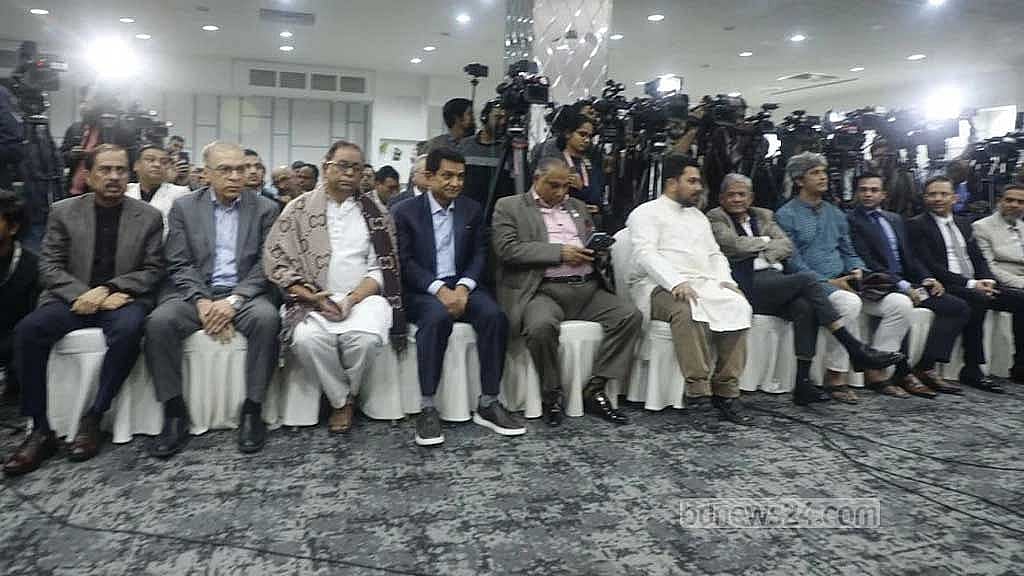
Participants observed a one-minute silence, demanding the arrest and punishment of those responsible for the attacks and arson.
Referring to the attack on The Daily Star on Dec 18, the newspaper’s Editor Mahfuz Anam said the incident posed a direct threat to life.
“About 25 or 26 of my colleagues were trapped on the rooftop, and the Fire Service was not allowed to enter. What does that mean? They did not just want to burn the building -- they wanted to kill The Daily Star staff."
“Freedom of expression is a distant concern now. It has become a matter of survival. We are standing with you, and we ask you to stand with us.”
Transparency International Bangladesh Executive Director Iftekharuzzaman said “mob rule” had taken hold within state structures.
“Mobocracy has begun inside the state structure. Those who are in charge of the state consider the forces behind mob violence to be one of the main pillars of their power.
“There is no doubt that it is the responsibility of all of us, the people of this country, to resist the situation that has emerged. But the primary responsibility lies with the government."
He added that the government must answer questions about what it was doing to ensure the safety of citizens.
Criticising the interim government’s response, Dr Debapriya Bhattacharya, an honorary fellow of the Centre for Policy Dialogue (CPD), said there had been repeated public warnings that such violence could occur.
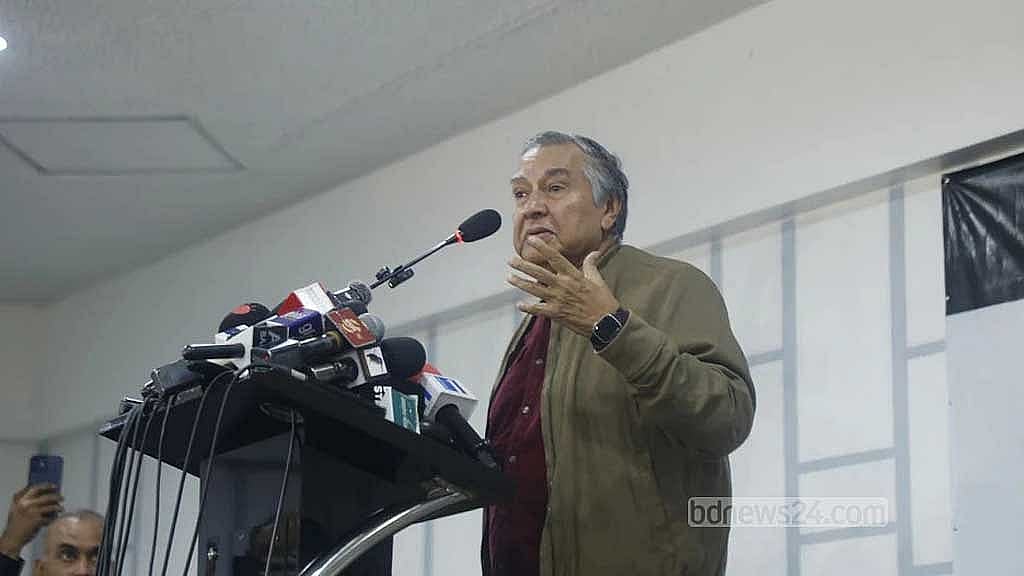
“This incident did not come without signals. People had given indications at various times that this could happen. Everyone has pointed fingers at the current government. There is a consensus on this. If one institution must take responsibility, it is the present government.
“They should remember that they are not an elected government. They may be a legitimate government, but they are not an elected one. An unelected government’s ability to govern lasts only as long as it retains moral legitimacy. Through this incident, the current government has reduced that moral legitimacy in many ways.”
Zonayed Saki, chief coordinator of the Ganosamhati Andolon, said: “The government’s mysterious silence must be broken. If you cannot deliver justice, your failure itself will be our verdict.”
National Citizen Party Convenor Nahid Islam, a leading figure in last year's July Uprising that toppled the Awami League regime, said the attacks contradicted the ideals of the movement.
“This situation is unfortunate for us. What is happening does not align with the commitments we made during and after the July mass uprising. Those who carried out the attacks used the slogans of July to shape public opinion.
“There is political backing behind this. Without the coming together of three forces, such a major incident would not have been possible.”
Manab Zamin Editor Matiur Rahman Chowdhury said the fight for press freedom would be prolonged.
“The struggle to secure media freedom is not a one-day fight. This battle will continue for a long time — until we are victorious. Until then, everyone must stay with us.”
New Age Editor Nurul Kabir, who was harassed while trying to stop the attack outside The Daily Star building, said unity among journalists and intellectuals was now essential.
“Unity among journalists and intellectuals is more necessary now than ever. In the future, we will organise even larger programmes.”
NOAB chief and Samakal publisher AK Azad said the protests would continue.
“Everyone has said the same thing -- we must resist this together. Our movement will continue until justice is delivered for the attacks on The Daily Star, Prothom Alo, Chhayanaut, Udichi and all others.”
Bangladesh Federal Journalists Union (BFUJ) Secretary General Kader Gani Chowdhury called for compensation for the two newspapers.
“We condemn this attack. An attack on the media is an attack on the very existence of the state.”
Bangladesh Jamaat-e-Islami Assistant Secretary General Ahsanul Mahboob Zubair said, “We expect all media outlets in Bangladesh, including The Daily Star and Prothom Alo, to carry out their responsibilities freely. We have made this clear in our statement.
“We believe that media freedom, as the fourth pillar of the state, is tied to everyone’s existence. Journalists and media outlets have been attacked before. Those responsible must be identified and brought under the law, and these attacks must come to a complete stop.”
Following the meeting, participants also formed a human chain outside the Sonargaon Hotel in a further show of protest.