Published : 16 Nov 2025, 07:02 PM
Updated : 28 Aug 2026, 01:29 AM


Nearly 4 out of 10 children in Bangladesh have “worrying” levels of lead in their blood, according to a new study by UNICEF and the Bangladesh Bureau of Statistics (BBS).
It said, "Thirty-eight percent of children aged 12 to 59 months (i.e. nearly four children in every 10) and nearly 8 percent of pregnant women have blood lead levels 'above the safe limit'."
Dhaka residents were the worst affected, with 65 percent registering levels above the safe limit.
UNICEF says lead pollution poses a threat to children's brain development and impacts all socio-economic classes.
More than half of the affected children are from higher-income families, while 30 percent are from lower-income families, the survey report says.
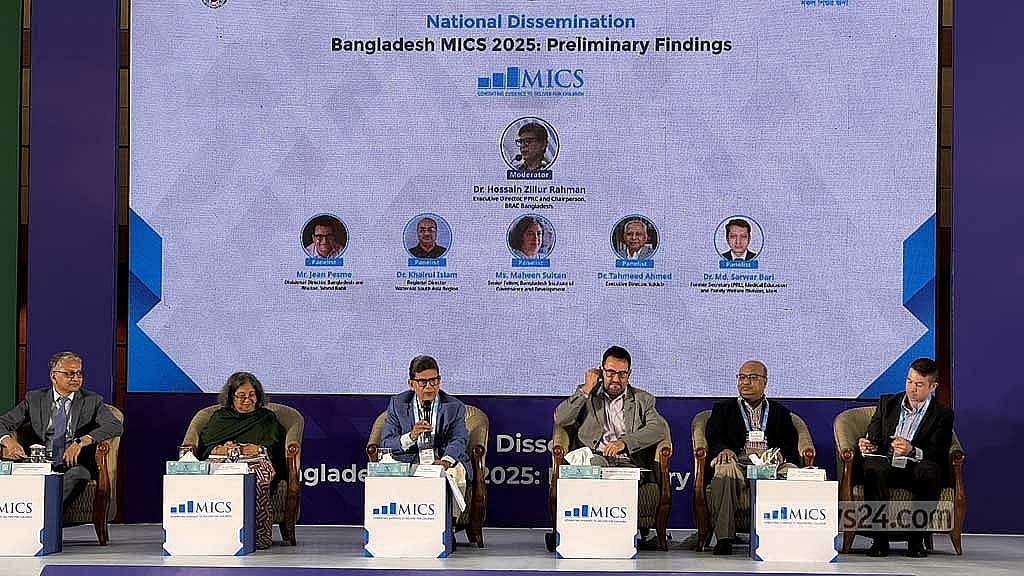
The Bangladesh Bureau of Statistics (BBS), in collaboration with UNICEF and other partners, released on Sunday the preliminary results of the Multiple Indicator Cluster Survey 2025 (MICS 2025), the most comprehensive survey of children and women in the country.
BBS Director General Mohammed Mizanur Rahman and UNICEF Representative in Bangladesh Rana Flowers attended the event.
The survey, based on a sample of about 63,000 households, highlights the progress and challenges in the health, nutrition, protection and development of children.
The survey has highlighted 172 criteria and 27 Sustainable Development Goal (SDG) indicators in line with national priorities and global standards.
The survey results provide an overview of the situation in all divisions, districts and three city corporation areas in the country, with the intent of helping policymakers identify areas of inequality and allowing them to take targeted measures.
The report shows that the rate of child labour in the country has also increased significantly.
The results show that the child labour rate among children aged 5 to 17 in the country is now 9.2 percent, up from 6.8 percent in the 2019 survey.
This means, the child labour rate has increased by 2.4 percentage points in six years, with most of the growth seen in the country’s north.
The child labour rate in the Rajshahi Division is 12.4 percent, and in Rangpur it is 11.8 percent.
As a result, UNICEF highlights that “another 1.2 million children are at risk” in the country.
The rate of Caesarean sections has also increased recently.
The report shows that the rate of births by Caesarean section, which was around 9 percent in the previous survey, has rocketed to 52 percent in the new survey.
The rate is 34 percent among the poor and 68 percent among the rich.
UNICEF says that the increase in the rate of Caesarean section use in deliveries, which is currently 75 percent in healthcare facilities, is increasing both “health risks and economic pressures”.
However, the survey showed some positive progress in indicators such as child mortality and child marriage.
The child marriage rate has come down to 47 percent from 51.4 percent in 2019, but almost half of girls are still married before the age of 18.
The neonatal mortality rate is 22 per 1,000 live births and accounts for 67 percent of the total deaths of children under the age of five (33 children).
In the previous survey, this number was 24 per 1,000 live births.
The highest child mortality rates were observed in Sylhet (29) and Dhaka (25). The lowest were found in the Khulna (15) and Mymensingh (18) divisions.
A doctor asked why the child mortality rate is high in Dhaka, even though advanced healthcare is available in the area.
In response, the BBS said that the answer could be uncovered with further analysis, but the information available now is based on the initial results.
“Reducing child marriage and child mortality rates show that progress is possible, but crises like lead pollution and child labour are denying millions of children their potential, and rising rates of Caesarean sections are putting women’s health at risk,” said UNICEF Representative in Bangladesh Rana.
“When every child’s right to survive, thrive and learn is respected, then it will stand as a measure of Bangladesh’s economic development.”
Emphasising the need for government policies to take these survey results into account, she said: “UNICEF is committed to supporting the government in translating this information into concrete action and making changes to ensure that no child is left behind.”