Home
+
Published : 12 Jun 2026, 03:25 AM
High Ambition, Hard Times
The household squeeze: Ordinary families face immediate living cost pressures while waiting for future business investments to yield jobs
Tax threshold frozen: Despite soaring inflation, the tax-free limit is unchanged, hitting anyone earning over Tk 400,000 annually.
Savings relief cut: Tax relief on popular middle-class investments, like savings certificates, is slashed from 15 percent to 10 percent
Compliance burden rises: New tax return rules will target ordinary citizens during basic transactions like land inheritance and mutation
Black money loophole: In a highly controversial move, the state retains the policy allowing undeclared wealth to be legalised tax-free
For a country that has spent the better part of four years wrestling with punishing inflation, rising living costs and shrinking purchasing power, the first budget of the BNP government arrived carrying unusually high expectations.
Many expected immediate relief.
Instead, the government's inaugural fiscal blueprint has opened a broader debate about priorities, trade-offs and who ultimately stands to benefit from Bangladesh's next phase of economic policymaking.
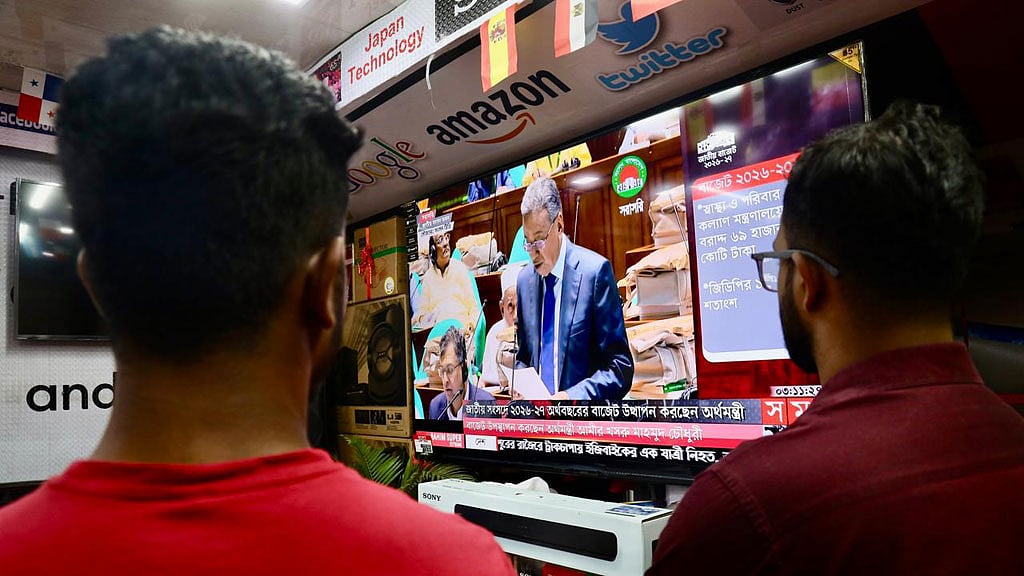
Presenting a Tk 9.38 trillion budget under the slogan "Journey Towards a Democratic, Humane and Inclusive Economy", Finance Minister Amir Khosru Mahmud Chowdhury offered a vision of recovery powered by investment, private-sector growth and economic expansion.
The budget seeks to propel Bangladesh towards a future trillion-dollar economy, expand social protection, attract investment and revive business confidence.
Yet behind the optimism lies a more difficult question: how humane is a budget that expands benefits for selected groups while asking many middle-income and lower-income households to absorb higher tax burdens, reduced tax reliefs and continued inflationary pressure?
The answer may ultimately depend less on what the budget promises than on whether it can be implemented.
A Bigger Budget, Bigger Expectations
The proposed budget is 19 percent larger than the revised budget of the outgoing fiscal year.
At Tk 9.38 trillion, it is equivalent to 13.73 percent of GDP.
By comparison, the final budget prepared by the Awami League government before the July Uprising was only 6.18 percent larger than the revised budget preceding it and represented 12.65 percent of GDP.
The increase reflects the ambitions of a government that returned to power after nearly two decades outside office and now finds itself under pressure to deliver both political promises and economic recovery.
Policy analysts have already begun asking how such an ambitious spending plan will be financed after the government simultaneously expanded incentives and introduced a range of tax concessions.
The concerns become sharper when viewed against the backdrop of an economy still struggling with weak investment, fragile banks, revenue collection challenges and persistent inflation.
Hope Without a Roadmap
The budget arrives after one of the most turbulent periods in Bangladesh's recent economic and political history.
The Awami League government's final budget for FY2024-25 promised a "Smart Bangladesh". It never had the opportunity to fully implement those plans.
Within a month of that budget taking effect, the July Uprising ended Awami League rule after over 15 years in power.
The political unrest, violence, curfews and internet shutdowns disrupted economic activity and damaged business confidence.
The interim administration led by Muhammad Yunus then spent much of its tenure battling double-digit inflation, foreign exchange pressures and weaknesses in the financial sector.
The BNP government has inherited many of those same challenges.
Yet while Khosru's budget speech outlined ambitious targets, it provided fewer details on how the country would navigate persistent inflation, weak investment, external financing pressures, banking-sector fragility and the challenges associated with graduation from Least Developed Country status.
The finance minister expects GDP growth of 6.5 percent in FY2026-27 and says inflation will be contained at 7.5 percent after four years of elevated prices.
Beyond familiar commitments to investment promotion and economic discipline, however, the budget offers limited clarity on how those targets will be achieved.
The result is a budget that offers optimism, but not always a convincing roadmap.
Growth Before Relief
The government's economic logic is straightforward.
Stimulate investment through tax incentives.
Encourage businesses to expand.
Create jobs.
Allow increased economic activity to filter through the wider economy and eventually ease pressure on households.
The budget speech repeatedly signals a willingness to support investors and businesses through incentives, tax reforms and regulatory changes.
The assumption is that higher investment will generate employment, increase incomes and boost economic activity.
But that strategy raises a timing problem.
For families already struggling with high food prices, expensive energy and stagnant incomes, the benefits of future investment may feel distant compared with today's financial pressures.
There are also questions about financing.
Businesses may welcome incentives, but banks remain constrained by liquidity shortages, weak confidence and elevated lending rates.
If credit remains expensive and difficult to obtain, some economists question how quickly tax incentives alone can translate into meaningful investment growth.
The Middle-Class Squeeze
Perhaps the most immediate impact of the budget will be felt not by investors but by ordinary taxpayers.
Despite years of inflation and mounting pressure on household finances, the government has left the tax-free income threshold unchanged.
As a result, taxpayers earning Tk 400,000 annually will face higher tax payments than before.
Where an individual previously paid Tk 5,000 in tax, the amount will now rise to Tk 7,500 under existing provisions retained by the new government.
At the same time, the budget reduces tax relief on approved investments, including savings certificates, a popular savings instrument among middle-income households.
Under existing rules, taxpayers receive relief based on the lower of three measures:
The proposed changes reduce the investment-based relief from 15 percent to 10 percent and lower the maximum eligible amount from Tk 1 million to Tk 750,000.
The effect is straightforward.
Many taxpayers will face higher effective taxation while receiving less relief.
For households already struggling with inflation, it amounts to a double squeeze.
A Wider Tax Net
The budget also expands compliance requirements into areas affecting ordinary citizens.
Proof of income tax return submission will be required for land mutation and inheritance-related property transfers.
Families dividing inherited property could find themselves navigating tax procedures even when no commercial transaction has taken place.
Additional requirements may also affect individuals opening bank accounts to receive remittances or family support payments.
For many marginal taxpayers and rural citizens with limited familiarity with tax procedures, the growing compliance burden could prove challenging.
Another controversial provision affects property development arrangements.
Individuals who provide land to developers in exchange for apartments would face a 15 percent capital gains tax on apartments allocated to developers under revenue-sharing agreements, even if those apartments have not been sold and no cash has been received.
Critics argue that such provisions risk pulling more ordinary citizens into the tax net without necessarily reflecting their actual financial capacity.
Black Money Returns
One of the most debated provisions in the budget is the decision to retain an opportunity to legalise undisclosed income.
Nearly two decades after returning to power, the BNP government has followed previous administrations in preserving the controversial provision.
The proposal also includes legal protection against questioning the source of disclosed investments.
The Finance Bill proposes amendments allowing individuals to disclose previously undeclared investments in land, buildings and apartments.
It says, "Notwithstanding anything contained in this law or any other law in force in Bangladesh, no question shall be raised or proceedings initiated regarding the source of voluntarily disclosed investments, purchases or receipts and the tax paid thereon."
Under the proposal, taxpayers whose actual purchase price exceeds the value recorded in property documents will be allowed to pay tax on the undeclared portion.
For sales transactions, a 15 percent capital gains tax would apply to the additional value.
The measure has already drawn criticism from political parties and economists who argue that repeated amnesties undermine tax compliance and reward undeclared wealth.
What the Budget Gets Right
Despite criticism, the budget contains several measures that have been broadly welcomed.
After 11 years, the government has announced the phased implementation of a new pay structure for public employees beginning in the new fiscal year.
The Ninth National Pay Commission recommended raising the minimum basic salary from Tk 8,250 to Tk 20,000 and the highest salary scale from Tk 78,000 to Tk 160,000.
Corporate taxpayers also gained greater certainty through the introduction of a five-year tax framework, potentially reducing policy unpredictability that has long frustrated investors.
Listed companies that have not transferred more than 10 percent of paid-up capital through IPOs will receive tax incentives if all transactions are conducted through banking channels.
Their corporate tax rate could fall from 27.5 percent to 25 percent.
The government has also replaced certain minimum tax provisions with advance tax arrangements, allowing taxpayers to seek refunds where withholding taxes exceed final liabilities.
Export-oriented leather goods, footwear, towel, linen and home textile industries will receive extended bonded warehouse facilities.
The validity of general bonds for eligible exporters would increase from one year to three years.
The government also proposes:
Additional incentives have been provided for solar energy, electric vehicles, semiconductors, agriculture and fertiliser production.
Taxes have also been increased on products deemed harmful to public health, including alcohol, cigarettes and nicotine pouches.
Welfare Expansion
The government's strongest claim to inclusiveness comes through social protection spending.
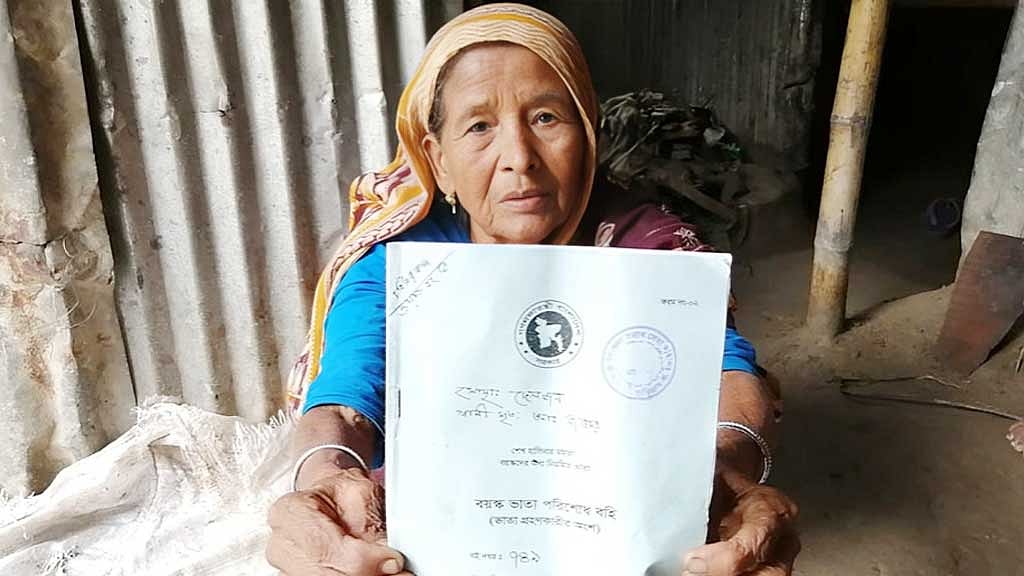
The budget proposes allocating Tk 1.44 trillion to social security initiatives, up from Tk 1.27 trillion in the revised budget of FY2025-26.
Among the key initiatives:
The government has also announced an ambitious environmental programme.
It plans to plant 70 million saplings in the coming fiscal year and 250 million trees over five years.
According to official estimates, the initiative could generate approximately 350,000 direct and indirect green jobs.
Questions Over Revenue
The budget's biggest challenge may be financing.
The government expects to collect Tk 6.95 trillion in revenue while running an overall deficit of Tk 2.43 trillion, equivalent to 3.6 percent of GDP.
To bridge the gap, it plans to borrow Tk 1.56 trillion from foreign sources.
That means more than 64 percent of the overall deficit would effectively be financed through foreign borrowing.
Of that amount, Tk 460 billion will be used merely to repay principal and interest on previous loans.
Net foreign borrowing is projected at Tk 1.1 trillion, nearly 90 percent higher than the revised estimate for the outgoing fiscal year.
Critics have also identified inconsistencies in the government's revenue assumptions.
In one section of the budget speech, Khosru says the tax-to-GDP ratio will rise from 6.8 percent to 9.6 percent by FY2030-31.
Yet elsewhere he projects revenue equivalent to 10.2 percent of GDP in the coming fiscal year alone.
The discrepancy has fuelled doubts about whether revenue targets are based on realistic assumptions.
Business Leaders See Opportunity, Critics See Risk
Business organisations have largely welcomed the budget's direction.
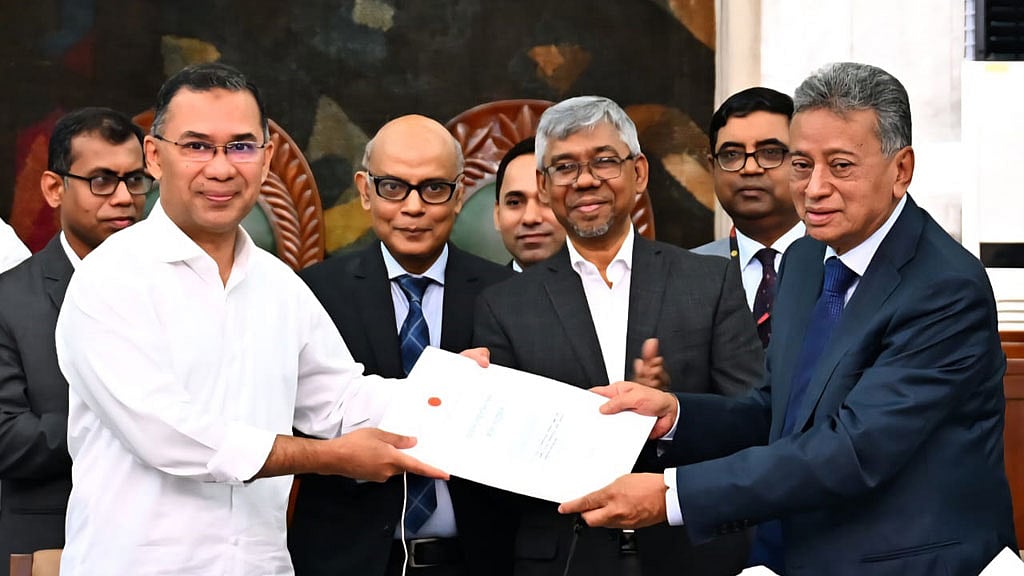
DCCI President Taskeen Ahmed described it as business-friendly but warned that achieving revenue targets would be challenging.
"Overall, the FY2026-27 budget can be considered supportive of business and investment. However, its real success will depend on achieving the ambitious revenue target and fully implementing the announced reforms."
BTMA President Showkat Aziz Russell said measures protecting local industry and improving competitiveness were encouraging.
FICCI welcomed reforms aimed at transparency, simplification and digitalisation.
Political parties were less enthusiastic.
NCP shadow budget committee chief Atik Mujahid described the budget as "an extremely ambitious and unrealistic budget".
Leaders of the Democratic Left Alliance criticised the continuation of black money legalisation.
The Communist Party of Bangladesh called the budget anti-people, saying: "There is no sign of hope for reducing living costs or creating new employment. This budget will increase inequality."
Saiful Haque of the Revolutionary Workers Party said, "Containing inflation will be the main test. If inflation cannot be controlled, growth figures will mean little."
That observation may ultimately become the defining verdict on the government's first budget.
For businesses, the budget offers opportunity.
For welfare recipients, it expands support.
But for millions of households still waiting for living costs to ease, the question remains whether prosperity promised tomorrow can compensate for pressures felt today.