Published : 17 Sep 2026, 05:16 PM
Updated : 17 Sep 2026, 05:16 PM


Prime Minister Tarique Rahman will inaugurate Batexpo 2026, an exhibition for Bangladesh’s export-oriented readymade garment sector, as the event returns to Dhaka after more than a decade.
President Mirza Fakhrul Islam Alamgir will attend the closing ceremony.
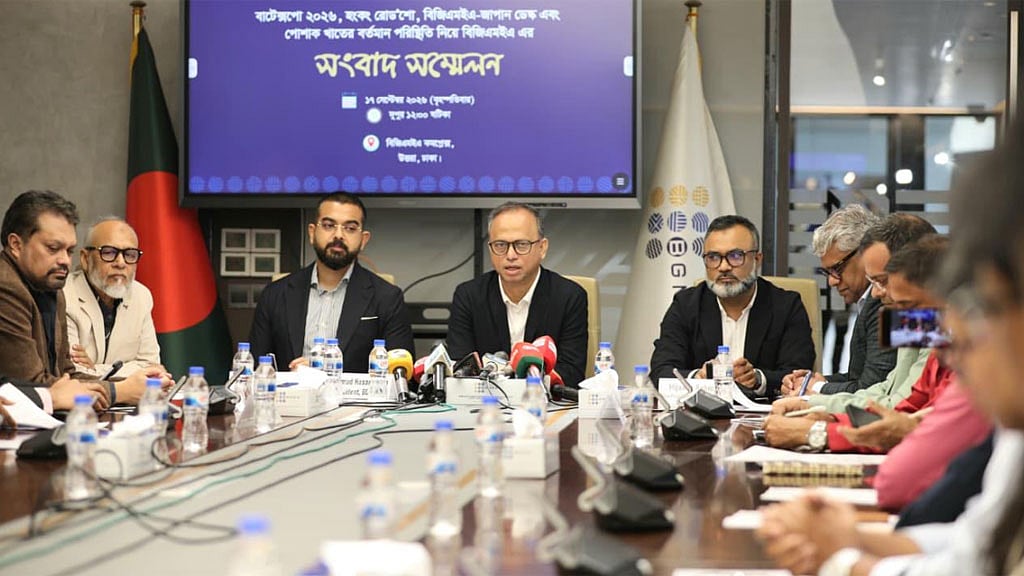
At a press conference in Dhaka’s Uttara on Thursday, BGMEA President Mahmud Hasan Khan said: “The silver jubilee edition of Batexpo is going to be held at the Bangladesh-China Friendship Conference Center on Nov 18 and 19.”
Mahmud said Tarique would inaugurate the fair, while the president would attend the closing ceremony as chief guest on Nov 19.
Responding to questions about the recent energy crisis, the BGMEA chief said no garment factory had so far closed because of fuel shortages, although the full impact could take several months to emerge.
“The gas situation has improved. The supply of gas has increased compared with the past few days. And no factory has closed due to power or fuel shortages,” he said.
“The impact of the fuel shortage will be felt after at least three months.”
Mahmud said the immediate impact on the garment industry was not yet fully visible, adding that decisions to close factories were not taken overnight.
“It takes about six months of planning to close a factory, considering various factors including completing orders in the pipeline, legal compensation for workers and ongoing bank liabilities.”
Garment factories operate for an average of eight to 10 hours a day, but amid the fuel shortage many have had to keep operations running for an additional five hours, he said.
Production costs have also increased as factories turn to alternative fuel arrangements.
The last Batexpo was held in 2013.
Highlighting the main objective of this year’s event, Mahmud said: “In line with the changing global situation, [Batexpo] aims to showcase the unprecedented transformation of Bangladesh’s garment sector and its high-level workplace safety and environmentally friendly production system to the world.”
The press conference also announced that the “Bangladesh Apparel Roadshow, Hong Kong 2026” will be held in Hong Kong on Oct 28-29 as a joint initiative of the BGMEA and HSBC Bangladesh.
Domestic and foreign buyers are expected to attend Batexpo, where discussions will focus on expanding markets, developing high-value products and increasing the use of technology and artificial intelligence.
Speaking about the Hong Kong roadshow, Mahmud said: “International brands and buyers who do not usually source from Bangladesh have been especially invited to this roadshow to introduce them to our capabilities and develop new markets.”
Mahmud also identified Japan as a potential growth market for Bangladesh’s readymade garment exports.
Bangladesh currently exports garments to 167 countries and signed an Economic Partnership Agreement with Japan on Feb 6.
The BGMEA chief said the agreement could help expand bilateral trade.
“To increase partnership in the Japanese market, a ‘Japan Market Strategy Committee’ has been formed and is working to liaise with brands and expand trade. For this, a ‘BGMEA-Japan Desk’ is being launched.”
The Japanese ambassador to Dhaka is scheduled to inaugurate the desk on Sept 23.
Mahmud said rising production costs and the energy crisis remained major challenges for the sector.
“Along with the global shock, a severe energy crisis has become a major obstacle to our domestic production system. The dyeing-washing and backward linkage sectors were severely disrupted due to the decrease in gas pressure.”
The BGMEA called for two additional floating LNG terminals to strengthen long-term energy security, greater LNG storage capacity and gas connections for SME factories, along with priority for the sector in gas rationing.
It also sought special policy support for the export sector for at least five years to address the challenges of Bangladesh’s post-LDC graduation and maintain continuity in customs and tax policies.
Mahmud also called for the modernisation of customs bond inspections and an end to the "unnecessary harassment" of professional institutions in the name of non-inclusive taxes and software errors.