Published : 19 Jan 2026, 07:30 PM
Updated : 28 Aug 2026, 01:31 AM


The Bangladesh Garment Manufacturers and Exporters Association (BGMEA) and the Bangladesh Knitwear Manufacturers and Exporters Association (BKMEA) have promised to source yarn from local spinning mills if it is supplied at international standards and at competitive prices.
Speaking at a joint press briefing, BGMEA Acting President Selim Rahman said: “Compared to imported yarn, local spinning mills are charging Tk 46 more per kg. Now, under the pretext of protecting domestic industry, import restrictions are being imposed, creating an artificial protection that is effectively turning yarn into a monopolised market.”
Pointing out that importing yarn from neighbouring India is cheaper, he said: “If yarn can be supplied at international standards and competitive prices, we are willing to buy locally even by paying 10–15 cents more per kilogram (around Tk 12 to Tk 18.5).”
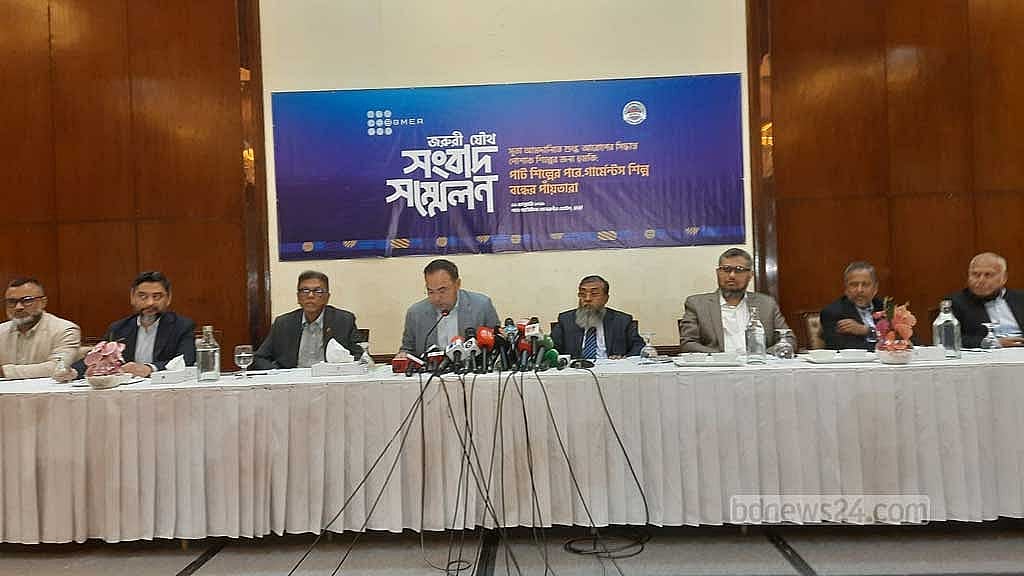
The joint press briefing was organised by BGMEA and BKMEA on Monday to protest the imposition of duties on yarn imports.
Speaking at the event, BKMEA President Mohammad Hatem said: “We operate on low profit margins. Why should we buy at higher prices? Protecting one industry at the cost of harming the garment sector makes no sense.”
He urged the government to consider alternative support measures, such as incentives, to protect the textile sector if needed.
“The garment sector is now in the ICU. After jute, the garment industry will be destroyed next,” the BKMEA president warned.
BGMEA Director Faisal Samad said: “We will go wherever raw materials are cheaper. Imports must be kept open.”
The garment sector currently sources around 60 percent of its total yarn demand from local spinning mills.
Explaining why the remaining 40 percent is imported, BGMEA Director Fazle Shamim Ehsan said: “There are many types of yarn that are not produced locally. They simply cannot supply those. Where will we get such yarn now?”
“Another reason is that buyers set garment prices based on international raw material prices. If prices are lower abroad and higher in Bangladesh, buyers will not accept it,” he added.
The business bodies claimed that the government has decided to impose duties on the import of 10–30 count yarn at the request of local spinning and textile mill owners, citing the need to protect domestic industry.
The maximum yarn count used in the ready-made garment sector ranges from 30 to 32. Yarn count is a measure used to determine the quality and thickness of yarn depending on the type of fabric or its use.
Yarn count is measured up to a maximum of 100. The higher the count, the finer and lighter the yarn; conversely, the lower the count, the heavier and thicker the yarn.
Last year, the government stopped yarn imports from India through land ports. Allegations were raised that yarn of higher counts—60 to 80 counts, above the declared 32 count—was being imported under the name of the garment sector and illegally delivered to the local market.
There were also allegations that such yarn was being imported at lower duties under export-oriented facilities and then sold domestically at higher prices, and that yarn brought in through land ports was being shown low-priced compared to shipments via waterways.
Following complaints from textile sector entrepreneurs, the government imposed a ban on yarn imports through land ports.
Now the government has decided to impose duties on yarn imports through both routes.
Exporters enjoy bonded warehouse facilities for importing yarn as raw material for export-oriented production, under which no duties are charged.
Textile entrepreneurs have sought the withdrawal of bonded warehouse facilities for yarn imports. In response, the Ministry of Commerce wrote to the National Board of Revenue (NBR).
The ministry, however, wants bonded facilities withdrawn for all grades of yarn, particularly for the most-imported 10–30 count yarn.
They demanded the withdrawal of the decision to impose duties on yarn imports and called on the government to protect the textile sector through alternative measures such as cash incentives and ensuring uninterrupted energy supply.
BGMEA Director Mohammad Abdus Salam said: “Imposing duties is not the solution. We want to move towards a win-win situation through discussions with all stakeholders. We want to resolve this through dialogue with the government to save the industry.”
It was also stated at the press briefing that the new duties would increase the cost of yarn imports by more than 29 percent.