Home
+
Published : 25 Jan 2018, 08:38 AM
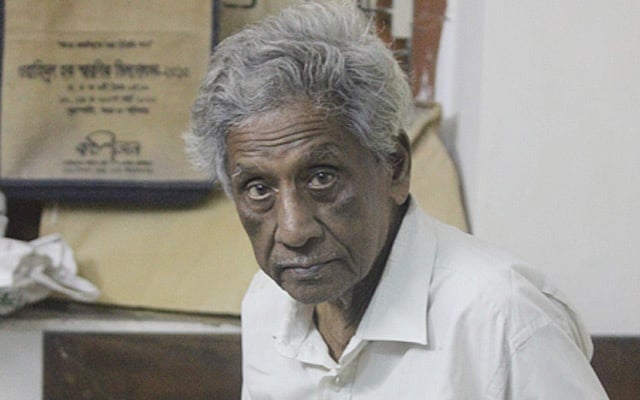
Doctors at Bangabandhu Sheikh Mujib Medical University Hospital declared the veteran litterateur dead at 8:15am on Thursday, said his son Asif Showkat Kallol, a journalist.
Ali got admitted to Dhaka’s Labaid hospital on Jan 4. He was put on life support there. He was later shifted to BSMMU.
“The death of Shawkat Ali is an irreparable loss to Bangla literature,” President Md Abdul Hamid has said in a statement.
Writer Khaliquzzaman Elias, playwright Main Uddin, Jagannath University teacher Mirza Harun-Ur-Rashid, Jatiya Ganafront leader Rajat Huda, Foyzul Hakim Lala, general secretary of Jatiya Mukti Council, and Abdus Sattar, an amanuensis for Shawkat Ali, arrived at the hospital to pay their last respects.
BSMMU Vice-Chancellor Kamrul Hasan Khan and Director Brig Gen Md Abdullah-Al-Harun paid last respects to the mortal remains of Shawkat placed in a coffin outside the hospital.
The mortal remains were taken to his Tikatuli home. After a funeral service, they were taken to the Central Shaheed Minar premises where people from all walks of life paid tributes.
Professor Abul Kashem Fazul Huq said Ali was one of the greatest contemporary litterateurs.
“He depicted social injustice, wrongfulness, and mass people’s lives in his works,” he said after paying respects at the Shaheed Minar.
Professor Serajul Islam Choudhury thinks Shawakat Ali realised and implemented in his works the truth that life should be seen more transparently in order to change the volatile society.
“He wrote about changes in the marginal people’s lives in his own language,” he said.
Ali was laid to rest at the Jurain graveyard next to his wife Shawkat Ara’s grave in the evening after a Namaz-e-Janaza at Tikatuli Jame Masjid, his son Asif Shawkat Kallol told bdnews24.com.
The writer was born in West Bengal, India on Feb 12, 1936.
He got involved in communist movements while in college. Soon after that he joined Bangladesh’s language movement.
Pakistani occupation forces detained him during the 1971 War of Liberation.
Ali started his career as a journalist but later moved into academia. He started writing for ‘Nutan Sahitya’, a mouthpiece of leftist politicians.
Many of his stories, poems and write-ups for children were published in Dainik Millat, monthly Samakal, and the Daily Ittefaq.
Ali’s novel ‘Warish’ has a vivid description of Hindu-Muslim riots following the 1947 partition. In his novel ‘Prodoshe Prakritajan’, Ali has narrated the miseries suffered by low-caste groups. It also sheds light on how the so-called untouchables revolted against oppressors.
Ali received the Ekushey Padak in 1990 for his contributions to Bangla literature. Bangla Academy Award, Humayun Kabir Memorial Prize, Ajit Guha Smriti Sahitya Award are some of the other awards he bagged later.
Ali received the Philips Sahitya Prize for three novels: ‘Dokkhinayoner Din’, ‘Kulay Kalsrot’ and ‘Purbaratri Purbadin’.