Moinul Hoque Chowdhury
bdnews24.com correspondent
Dhaka, Jan 10 (bdnews24.com) – The government is preparing a policy for allowing captive breeding and rearing of deer with licences from forest authorities.
Forest department officials said the proposed Captive Deer Breeding Policy would provide cheaper licence fees for people to breed and rear deer which has hitherto been legally forbidden.
"The policy is now waiting for the final approval of the ministry of forest and environment," chief forest conservator Md Abdul Motaleb told bdnews24.com.
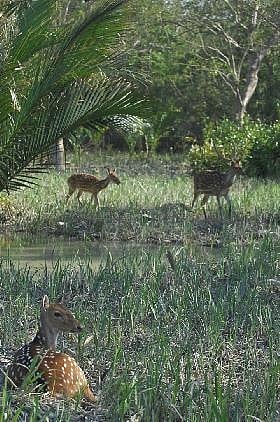
But the proposed policy would be applicable only for Chitra deer, the colourfully dotted graceful species, whose poaching is banned since 2005.
The draft of the policy that was prepared late last year proposes Tk 500 for rearing deer while Tk 100 will have to be paid as possession fee for each deer. There will be a provision for renewing the license every year for Tk 100 each deer.
If the decision to relocate the rising number of Chitra deer from Nijhum Dwip, the tiny island in the Bay that became breeding ground for the species, is approved the authorities would allow such domestic deer rearing, said Motaleb.
But zoologists and animal experts are skeptical about the proposed policy citing past experiences that were not good.
Instead of allowing the wild animals to be raised in human habitats, initiatives should be taken to create natural habitat for them, they pointed out.
"We have to see whether the idea of reducing the number of deer would encourage poachers or not," said Ronald Haldar, vice president of Nature Lover and Bird Club.
"When the tiger in Sundarbans had shortage of food after cyclone Sidr or any other calamity, there were no talks of relocating deer to that mangrove forest," he said.
In the past, he cited that frogs and turtles were on the verge of extinction as a result of their commercial exports abroad.
The number of deer went down in the 1950s due to rampant poaching for its meat and hide. The situation however improved after the government enforced wildlife protection laws in 1973.
At present, there are around 1.2 lakh deer in the 14.9 lakh acre area of Sundarbans forest. And on Nijhum Dwip, there are more than 20,000 of them inhabiting on some 5,000 acres of forest on the island.
The proposed policy suggests very small fees for deer rearing in the village areas and a comparatively higher fees in the urban areas, said Kazi Abdul Fattah, professor of botany at the Dhaka University and a member of the government's wildlife conservation advisory board.
"Deer rearing and poaching is approved in many countries. The British rear deer by taking permission. But here in Bangladesh, deer rearing is banned," he said.
He suggested for creating awareness about utilizing the deer by keeping them alive, instead of culling them to reduce their number.
At present, possession fee for each pair of deer is Tk 10,000 and the annual renewal fee for the license is Tk 5,000.
The government is paying Tk 75,000 every year at this rate for rear 15 pairs of deer at Bangabhaban, the presidential palace.
Besides, Chitra and other species of deer are being reared at some military cantonments and at home of some wealthy businessmen.
Under the proposed policy, there will be no problem in rearing fawns of Chitra deer which grow up quickly and start reproducing.
There is no fixed mating season for Chitra deer. Their pregnancy period is seven months and they give birth to one fawn at a time and sometimes twins. And they become mature in two years. A mature deer weighs around 85 kg.
Some forest officials are upbeat that the deer rearing policy would help the government to earn substantial revenue.
bdnews24.com/mhc/qh/dg/ec/1446h