Published : 23 Jul 2022, 01:23 AM
Updated : 23 Jul 2022, 01:23 AM


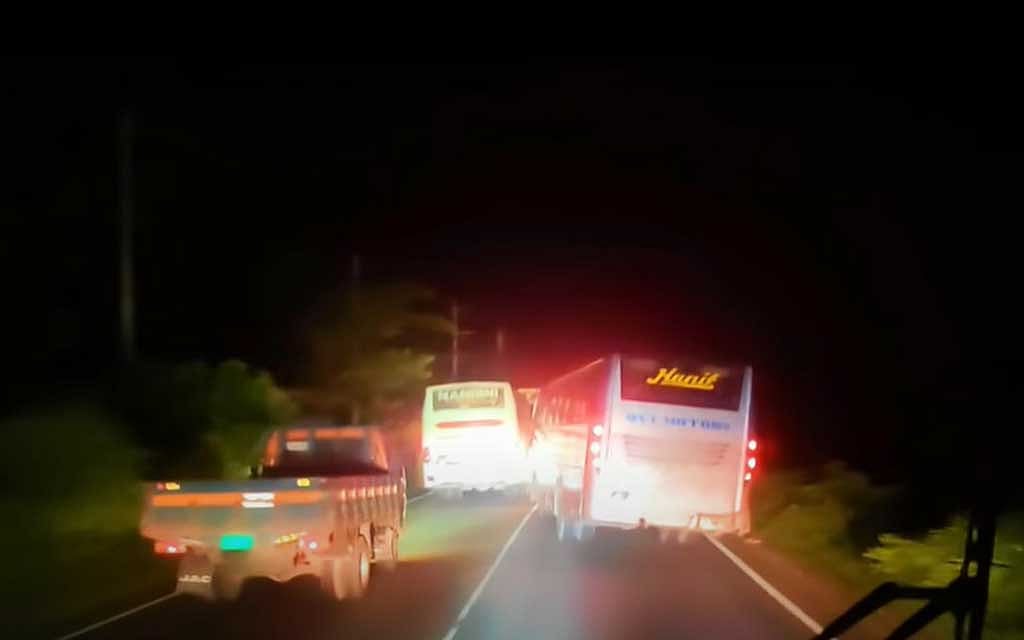
Steve Long, a German travel vlogger, perhaps described it best what it feels like when you travel by coach in Bangladesh.
On a YouTube video uploaded in 2018, he literally said on the record: “Thank God I’m still alive. I have wet my pants.”
For some Bangladeshis, such experiences are as normal as having three meals a day.
As Long described when the speeding coach by Shyamoli Paribahan was overtaking one after another vehicle by changing lanes like champion Formula One driver Sir Lewis Hamilton, some of the native passengers were actually sleeping!
Not everyone feels the same though. To many, such travel, even if they survive in the end, takes a massive physical and mental toll.
Banker Ahsan Habib, a regular passenger of coaches on the Dhaka-Thakurgaon route, described in minute detail how he felt during a recent trip.
“I was on a Dinajpur-bound coach, operated by Ahad Paribahan, on Jul 5. The driving was okay until we reached Chandra. After that, the driver sped senselessly. The speed was so high on rough highways that the cushions on the seats were flying off and passengers like me were struggling to keep ourselves on the seat. The driver and the staff on the coach didn’t bother. I was praying the whole time,” he said while being interviewed by bdnews24.com.
On Jun 29, two days after the Padma Bridge was opened to the public, a video of how a Sakura Paribahan coach drifted off the Mawa Expressway went viral.
The video, filmed by a passenger on a different coach and later uploaded on social media, showed how the coach was swerving and overtaking one vehicle after another in a dangerous manoeuvre on the highway and eventually could not steady itself and simply crashed.
Speeding buses and how they operate on the highways have become a hashtag-worthy trending topic on social media in Bangladesh lately. A quick search on YouTube comes up with hundreds of results, with Bangla vernacular tags like “bus er race” (Best bus races), “sera bauli” (Best swerving), and “bauli master” (Best swerve masters).
Commenters under those videos discussed at length how some of the drivers from some top nationwide operators, especially Ena Paribahan, Hanif Paribahan, and Shyamoli Paribahan, have become myths of urban legend.
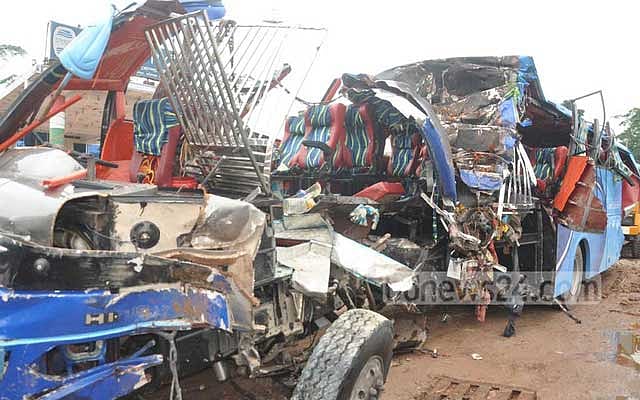
Experts have long pointed out that such reckless driving techniques are one of the major reasons for the exponentially rising number of accidents and casualties on Bangladeshi highways.
During the recent Eid-ul-Azha holidays, at least 398 people were killed on the highways in 319 accidents in just 15 days, the highest in the last seven years, according to a report prepared by Jatri Kalyan Samiti, a passenger welfare organisation.
But there is no apparent sign that stakeholders in this sector are taking responsibility and actively trying to do something about it.
Owners of coach operators have been claiming that they had done everything that was asked of them, such as installing a centrifugal governor to regulate speed, punishing reckless drivers, and more training and briefings for the drivers.
But all these efforts, according to the operators, fell flat on their face.
On the other hand, police and administrators have been blaming the operators instead, saying they were not doing enough and that they say one thing and do the opposite.
SO, WHAT LIES AHEAD?
The answer to this question, at this very moment, is quite straightforward.
No one knows.
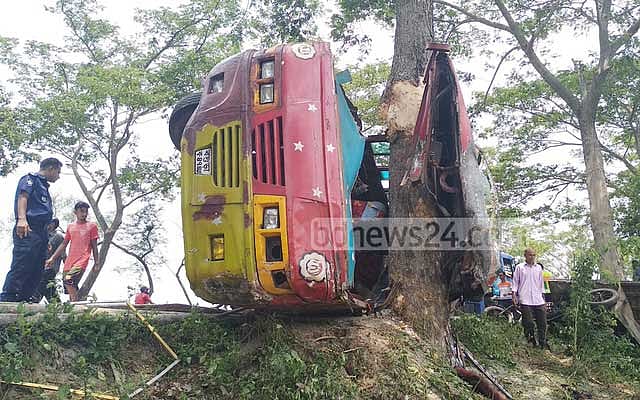
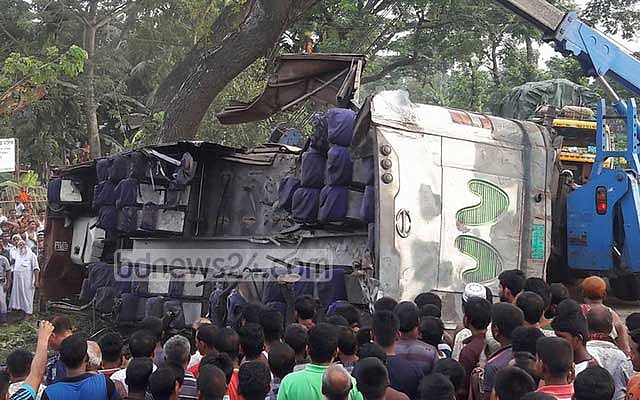
On May 29 this year, at least 10 people were killed when a driver rammed his Pirojpur-bound coach into a highway-side tree in Barishal’s Wazipur.
Officials of the operator, Jamuna Line Paribahan, told bdnews24.com that the driver of the bus had lost control of the wheels when another speeding coach was attempting to overtake it, forcing the Jamuna Line coach to change lanes and the driver, Arif Khan, failed to keep his control.
Media reports, however, give another picture.
Some of the injured, interviewed by bdnews24.com after the incident, unanimously blamed Arif instead, saying he was driving recklessly to make up for a lost couple of hours when the coach experienced a mechanical failure in Dhaka’s Savar.
“We had installed GPRS technology in every coach we operate and brief our drivers every time about speed limits and the conditions of the highway and weather when they are about to start a shift. But they hardly listen to us,” Saidul Islam, director of Jamuna Line Paribahan, said.
Khandaker Enayet Ullah, secretary general of the Bangladesh Road Transport Owners’ Association, believes enforcement of existing speeding laws is the key to controlling reckless driving on highways.
“There won’t be any reduction in the number of accidents as long as the existing speeding laws are not strictly enforced. Do that, and you’ll see the numbers [of the accidents] go down exponentially,” he said.
Ali Ahmed Khan, superintendent of Gazipur Highway Police, said the onus is on the operators instead.
“We’ve been advising the operators to install governor’s seal [centrifugal governor] in every meeting. But they aren’t doing it. And if we stop every coach that’s been breaking the speeding law on the highways, then we’d be dealing with tailbacks for miles. The idea is not reasonable and practical,” he said.
THE ‘SPEED LIMIT’ DEBATE
In Bangladesh, the general rule for the highest speed limit on the highway is 80 km per hour.
Experts, however, said except for some four-lane highways like Dhaka-Chattogram and the recently inaugurated Mawa Expressway, hardly any other highways in Bangladesh are safe enough to drive at such speed.
Md Hadiuzzman, professor of BUET’s Accident Research Centre, said the chances of passengers’ survival directly correlate with the speed of a moving vehicle. More speed means chances of casualties are higher, he said.
“In our research, we never found any coach that runs below 80-90 km per hour threshold.”
Enayet Ullah, who also owns the infamous Ena Paribahan, admitted that despite numerous attempts of helping the drivers to understand the dangers of speeding, he failed.
“The drivers and the staff are well aware that the chances of crashes of a speeding coach are higher. It appears they just love driving rash. We’ve advised, counselled, and briefed them many times that they should not do it as crashes drive our maintenance expenditures up and significantly reduce the life expectancy of a coach,” he said.
He went on to claim that some of the drivers broke open the centrifugal governor installed to regulate the speed of coaches.
“We owners are sort of helpless here as this industry largely depends on the drivers and the staff. Some of them even doctor the engine settings, remove the governor’s seal we put in place.”
He claimed that in a last-ditch attempt, Ena Paribahan recently hired a seasoned driving instructor, who used to work for BRAC driving school in Dhaka, to routinely train and monitor drivers’ capability.
Kafil Uddin, chairman of Hanif Paribahan, concurs with his competitor in the industry.
“We employed two people just to monitor and advise our drivers. An accident means we will be facing immense financial liabilities. We even have a strict three-strikes policy in place; if a driver is accused of reckless driving three times, we sack them. But they still won’t listen,” he said.
Both Enayet and Kafil demanded that the authorities start putting in place state-of-the-art technologies like speed guns and cameras and heavily penalise the offending drivers to force a behavioural change on their part.
PROBLEMATIC LEGAL PROVISIONS?
Filmstar Ilias Kanchan, who has been engaged in safe road activism for decades, claimed that the law put the total liabilities of an accident on the owners, which he believes is totally unfair.
“The existing law is not forcing reckless drivers to change their behaviour since they are operating without impunity.”
Enayet Ullah said the same.
“We never advise our drivers to drive recklessly. But when they don’t listen to us and eventually cause a major accident, the law chases us instead. How is it fair?” he said.
When interviewed, some of the drivers and their support staff, especially the younger ones, seemed proud to show off their ‘mad’ driving skills and described in detail how they drift, swerve, and overtake other vehicles in a dramatic fashion on the highways.
Seasoned drivers admitted that the highways in Bangladesh are not safe enough for such style of driving.
Emdad, an experienced driver on the Dhaka-Chattogram Highway who identified himself by a single name, said the new generation of drivers do not care about passenger safety.
“Common sense does not dictate them when they take out their vehicles on the highway. All they care about is how to show off tricks and skills,” he said.
“But when you are on the road, it is actually difficult to maintain calmness,” said another experienced driver, who did not want to reveal his identity.
Md Mamun, a driver for an air-conditioned coach operator, blamed passengers instead.
“Some of them do not like it when we maintain the speed limit. They keep yelling at us for driving slowly,” he said.
POLICE FIND NEGLIGENCE FROM OWNERS
Gazipur Highway Police Superintendent Ali Ahmed Khan dismissed all the claims made by the owners and accused them of gross negligence and misinformation.
“They [owners] claim they installed the governor's seal. When we investigate, we find no signs of it. They claim they do not install hydraulic horns. Misinformation again. They claim they do not overwork their drivers. We spoke to drivers who were on shifts of over 24 hours at a stretch. The bottom line is the owners say one thing, do the opposite,” he said.
The police official, however, admitted that the highway police are currently in the process of installing state-of-the-art speed limit checking technology on the highways.
“We’re in the process of placing special speed cameras and automated speed guns on the Dhaka-Chattogram Highway, which will be activated very soon,” he said.
[Writing in English by Adil Mahmood; editing by Biswadip Das]