Published : 24 Sep 2025, 08:06 AM
Updated : 21 Aug 2026, 01:51 PM


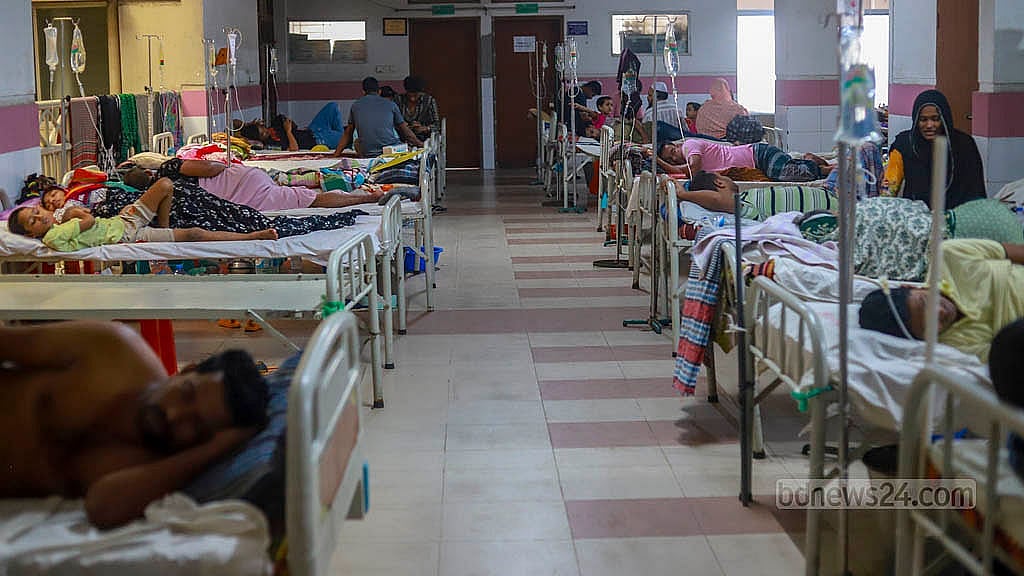
As the monsoon draws to a close, dengue is once again taking an ominous turn. In just the first three weeks of September, the Directorate General of Health Services is reporting the year’s highest monthly infections and deaths.
So far this year, 43,173 patients have been admitted to hospital with dengue and 182 have died.
Between Sept 1 and 23 alone, 11,697 people were hospitalised -- the highest of any month this year -- while the mosquito-borne disease claimed 60 lives over the same three weeks.
Recalling last year’s pattern, Prof Kabirul Bashar of Jahangirnagar University’s Department of Zoology warned the situation could get “worse” in October.
Public health specialist Mushtuq Husain, noting dengue’s spread across the country, urged authorities to launch mosquito-control operations as a top priority with broad public participation.
In its Tuesday bulletin, the health directorate said 664 patients were admitted in the previous 24 hours and one person died.
Earlier, on Sunday, hospitals recorded 740 admissions and nine deaths in a single day, in the highest one-day tallies of the year for both admissions and fatalities.
PARIENT NUMBERS STEADILY RISING
An analysis of health directorate data shows that from Jan 1 to Sept 23, hospitals admitted an average of 162.92 dengue patients per day. In September alone, the daily average has surged to 509.
By week, admissions have climbed consistently: an average of 419 per day in week 1 of September, 497 in week 2, and 556 in week 3 (Sept 15–21).
Earlier averages were 339 per day in August, 345 in July, 198 in June, 57 in May, 23 in April, 11 in March, 13 in February and 37 in January.
The average number of in-patients on any given day has also risen in September. Nationwide, hospitals had an average of 1,563 dengue patients under treatment in week 1, 1,761 in week 2, and 1,960 in week 3 (Sept 15–21).
Deaths have likewise increased. By Sept 23, the month’s total had reached 60 nationwide, an average of 2.61 deaths per day.
By week: an average of 1.86 daily deaths in week 1, 2.14 in week 2, and 4.14 in week 3 (Sept 15–21).
The health directorate compiles figures on patients admitted to hospitals with dengue.
Experts caution, however, that many infected people do not seek hospital care, meaning the true number of infections and deaths is likely higher.
OCTOBER EYES HIGH INFECTION RATES
In 2024, October saw the highest hospital admission rates from dengue.
In September 2024, 10,267 patients were hospitalised with the disease. The number surged threefold in October, reaching 30,879.
Specialists say infections peaked that month, and considering weather patterns and environmental factors, they fear a similar trend this year.
Under an agreement with Dhaka North City Corporation, Prof Kabirul Bashar led a mosquito survey in Dhaka. Along with his team, he also independently measured the density of Aedes mosquitoes in various parts of the country.
Kabirul said the data from their surveys show a dangerous presence of Aedes mosquitoes nationwide.
“We’ve worked in different places and found the Breteau Index at 40, 60, even 80 in some areas. In almost every part of Dhaka, the index is above 40. Outside Dhaka, you won’t find a single district where the index is below 20.”
He warned: “The situation is already bad and may get worse in the coming weeks. Public awareness is crucial because Aedes mosquitoes breed inside homes. Without community participation, there is no way out of this crisis. At the same time, larviciding must be carried out in urban areas.”
Mushtuq, advisor to the Institute of Epidemiology, Disease Control and Research (IEDCR), said September is still seeing rain, creating breeding grounds for mosquitoes.
He noted that there has been “no improvement in cleanliness,” fuelling the problem.
“When rain stops and the sun comes out, mosquito eggs hatch. When it rains again, breeding sites increase. That’s why the outbreak can continue for up to two months after the rains stop,” he explained.
“Dengue has spread nationwide,” Mushtuq said. “What we need now is a large-scale cleanliness drive with thousands of young volunteers. We were able to eliminate malaria in this country through mass participation.”
“Kolkata has managed to control dengue, we can too, if the government gives it top priority. But around us, the cleaning simply isn’t happening.”
LACK OF COORDINATED INITIATIVES
As dengue cases and deaths continued to rise, on Sept 16 the DGHS issued 12 directives to the heads of all medical colleges, specialised hospitals, district hospitals, civil surgeons and Upazila health and family welfare officers, aimed at improving patient management.
On Monday, the DGHS also held a press conference on dengue treatment management.
DGHS Director General Abu Jafar said local government bodies must take responsibility, as the Local Government Division is deeply involved in this issue.
He said dengue control needs a fully coordinated approach, but is uncertain about whether that’s happening.
“Mosquito control is not the health department’s job. It falls under city corporations, municipalities and union councils, all overseen by local government. That’s why coordination among all these bodies is absolutely essential. The efforts are not always jointly organised,” he added.
DGHS Director (Hospitals and Clinics) Dr Abu Hossain Md Moinul Ahsan said, “The health department cannot and should not carry out cleaning activities outside hospitals. That is the job of the local government bodies. We have written to every city corporation and municipality, urging them to intensify mosquito control.”
To ask about nationwide mosquito control measures, bdnews24.com called the Local Government Advisor Asif Mahmud Shojib Bhuyain, but his number was switched off.
Attempts to reach Local Government Secretary Md Rezaul Maksud Jahedi were unsuccessful.