Published : 19 Apr 2026, 05:47 AM
Updated : 21 Aug 2026, 03:37 PM


Alauddin, a farmer identified by a single name, has spent four days trying unsuccessfully to get diesel to irrigate his field.
On Saturday, he spent hours standing under the scorching sun, clutching an empty five-litre plastic bottle.
His goal was simple: two litres of diesel to save his parched paddy fields.
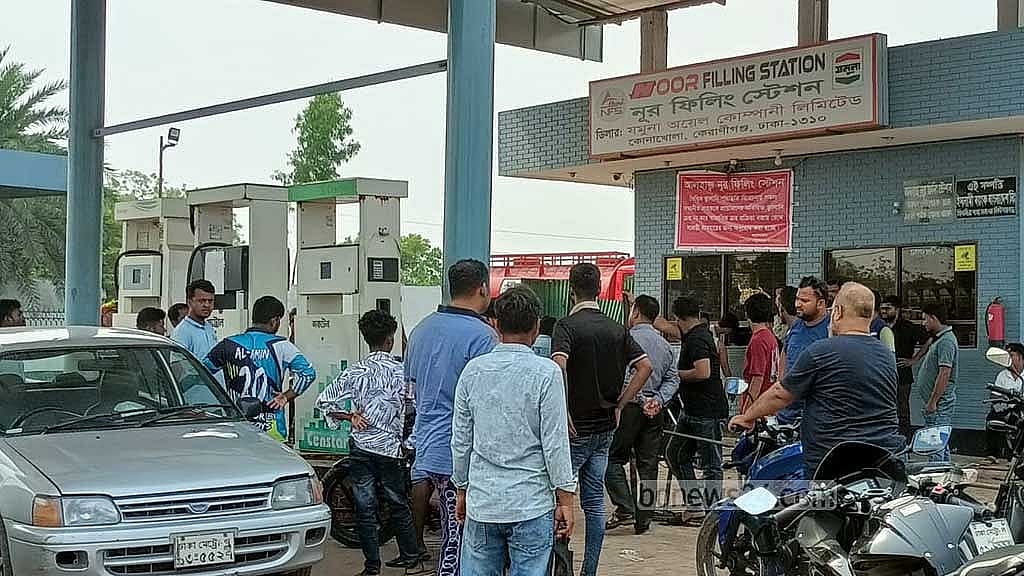
"The ears of the corn have started to emerge. If they don't get water now, the grains won't form. My family will have nothing to eat," Alauddin told bdnews24.com at the Noor Filling Station in Keraniganj on Saturday.
Despite his pleas, he returned empty-handed.
Like many farmers in the outskirts of the capital, Alauddin is a victim of a fuel crisis, with filling stations refusing to sell to them in loose containers or bottles without official clearance.
The Noor Filling Station became a site of desperation and disorder on Saturday.
Though the pump was scheduled to open at 6am, supply only began after 11am due to a delay in fuel delivery from the depot.
By noon, the station was swamped.
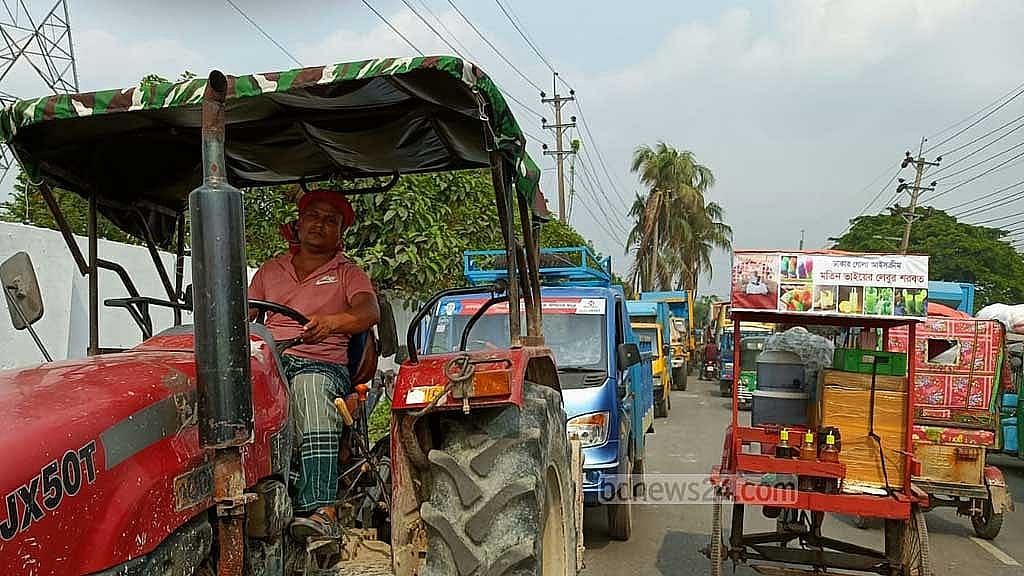
Long queues of trucks, pickups, and motorcycles snaked down the road, with farmers interspersed among them.
Between 1:37pm and 1:49pm, 459 motorcycles were counted waiting for fuel in the queue.
The scramble eventually turned into a scuffle between drivers, forcing authorities to briefly suspend supply to restore order.
Filling station employees said their hands are tied.
Shamim, an employee identified with a single name, explained that selling fuel in cans or "dhops" often triggers protests from motorcyclists, leading to heated arguments.
"We are advised not to give fuel in loose containers unless the farmer brings a 'slip' (clearance note) signed by the Upazila agriculture officer," Shamim said.
For farmers like Alauddin, this bureaucratic requirement is an insurmountable wall.
"I am an uneducated farmer. I don't have an ID card, I don't know the Upazila officer, and I don't know where they give these slips. Does that mean I won't get oil?" he asked.
Alauddin, who cultivated 52 decimals of land, relies entirely on this harvest for his family's yearly food supply.
After failing to find diesel in Ruhitpur for three days, his trip to Konakhola in Keraniganj also ended in despair.
The crisis is not just affecting individual farmers but the entire mechanised agricultural chain.
Modern farming -- from irrigation machines and power tillers to harvesters and sprayers -- is entirely diesel-dependant.
Zahir Islam, a tractor driver, had been in line since 9:30am.
By 2pm, he was still waiting.
"If I finally get 10 litres, it will be exhausted just ploughing two bighas of land. Farmers are surrounding us, begging for cultivation, but we are spending our whole day in fuel lines," he said.
Zahir noted that his daily income has plummeted from Tk 10,000 to barely Tk 2,000 because of the shortage.
Another tractor driver, Abul Kalam Azad, echoed the same experience, saying that the shortage of fuel has brought agricultural work to a grinding halt.
As the sun began to set, many farmers were seen leaving the station with empty bottles, their hopes for a successful harvest fading alongside the light.