Home
+
Published : 07 Jun 2026, 04:13 PM
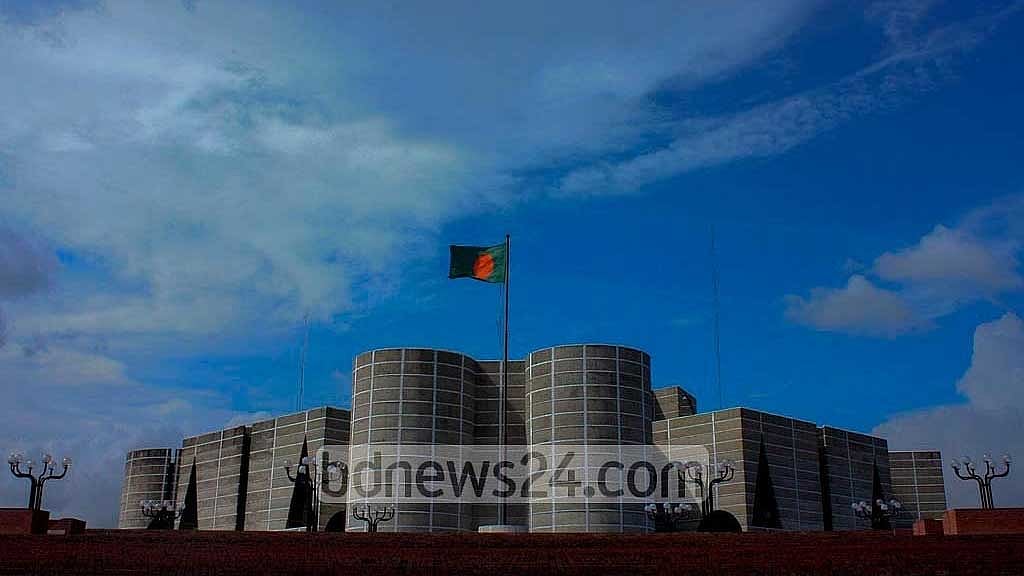
The first budget session of the 13th Parliament has begun.
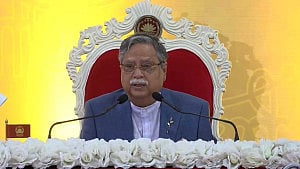
The meeting began at 3pm on Sunday under the chairmanship of Speaker Hafiz Uddin Ahmad.
At the beginning of the session, the speaker said this session carries special significance as it will include the presentation of the budget for the 2026-27 fiscal year.
“A clear policy and economic direction on how the hard-earned money of the common people will be spent appropriately for the country's development, economic stability, social security and public welfare will be presented to the nation through this session,” Hafiz said.
The agenda of the first day includes the presentation of the report of the special committee formed to deal with the recent energy crisis.
According to the agenda, a question-and-answer session will be held after the presidium nominations and acceptance of condolence proposals.
On this day, questions set for the Ministry of Information and Broadcasting, Ministry of Industries, Energy and Mineral Resources Division and Power Division will be answered.
Notices submitted under Rule 71 of the Rules of Procedure on drawing attention to matters of urgent public importance will also be disposed of.
Then, as per Rule 211(1) of the Rules of Procedure, the report of the “Special Committee Formed to Deal with the Recent Situation Arising with Regard to Energy” will be presented by Power and Energy Minister Iqbal Hassan Mahmood, the chairman of the committee and member of parliament from the Sirajganj-2 constituency.
Highlighting the importance of the budget session, the speaker said according to Article 87(1) of the Constitution, a consolidated statement of the estimated income and expenditure of the government for each fiscal year and the annual financial statement has to be presented to parliament.
According to Articles 88, 90, 91 and 92 of the Constitution, there is a constitutional obligation for the parliament to take decisions on matters related to expenditure, appropriation laws, supplementary and additional expenditure and accounts payable to the Consolidated Fund, he added.
“As a result, the budget session is not just a forum for approving financial plans, but also an important part of state accountability and fulfilling constitutional responsibilities,” he said.
Describing the parliament as the highest institution reflecting the hopes and aspirations of the people, the speaker said the budget is one of the main policy and economic documents for implementing those hopes.
“Therefore, your responsible, informed and constructive participation in this session is very important.”
He also expressed hope that all members of parliament, regardless of their place in government or opposition, will hold responsible discussions and present valuable opinions by giving top priority to national interests.
The speaker said, “There will be differences of opinion and disagreement in a parliamentary democracy. However, I seek your cooperation in ensuring that those discussions are conducted in the light of etiquette, mutual respect, parliamentary customs and code of conduct.”
Reiterating his "commitment to complete impartiality and fairness" in conducting parliamentary activities, he said: "An effective and people-oriented budget can be formulated through responsible discussions, constructive criticism and mutual respect in accordance with the spirit of parliamentary democracy."
The main topic of discussion of this session is the national budget for FY27. The finance minister will present the budget for the new fiscal year in parliament on Jun 11.
The possible size of the budget for the next fiscal year has been estimated at Tk 9.30 trillion. The size of the current FY26 is Tk 7.90 trillion. Accordingly, the size of the budget will jump by about Tk 1.40 trillion.
Implementing the promises of the government's election manifesto, expanding social security programmes, creating jobs and controlling inflation are understood to be the top priorities for the new budget.
A 10-member special committee was formed on Apr 26 with members of the government and opposition parties to respond to the pressures on the country's energy supply due to the ongoing war in West Asia.
Chief Whip Nurul Islam, while proposing the formation of the committee, said that the global energy crisis has also impacted Bangladesh.
The committee will determine what needs to be done to deal with the situation and submit a report with recommendations to the parliament.
In the first meeting of the committee on May 3, the Ministry of Power, Energy and Mineral Resources gave a presentation on the country's energy situation.
There, the ministry said the situation has become more complicated due to the instability in the international energy market surrounding the Iran war, coupled with anxiety and pressure in the market.
According to the ministry, since the country does not have sufficient energy storage capacity to meet long-term needs, a disruption in imports strains supply. The war has made the traffic of fuel-carrying ships irregular, which has put an additional stress on the supply system.
After that meeting, the special committee recommended that energy imports be kept uninterrupted. The report was finalised based on the opinions and observations of the members in subsequent meetings.
Speaker Hafiz also nominated the presidium at the beginning of the meeting.
The members of the presidium are Selima Rahman, Osman Faruk, Zainul Abedin Md Shahjahan and Shahjahan Chowdhury.
In the absence of the speaker and deputy speaker, the next member on the list will preside over the parliament.