Published : 14 Sep 2026, 07:18 AM
Updated : 16 Sep 2026, 11:50 AM


Bangladesh has made significant progress towards greener apparel manufacturing over the past decade, but decarbonising the sector at scale will require much more than action by individual factories, according to Cascale, a global alliance focused on sustainability in the apparel industry.
As the world's second-largest apparel exporter, Bangladesh has established a strong foundation through its large number of LEED-certified green factories and industry sustainability targets.
The apparel sector has committed to reducing greenhouse gas emissions by 30 percent by 2030, while improving energy efficiency and increasing the use of renewable energy.
But the next phase of the transition will require major investment, cleaner electricity, stronger energy infrastructure and financing that manufacturers can afford.
"Our report, 'Bangladesh Country Report: Macroeconomic and Sustainability Analysis' from June 2025, suggests that the country's apparel sector will require approximately USD 6.6 billion in investment by 2030, while a significant financing gap remains," Joyce Tsoi, senior director of Decarbonisation Programmes at Cascale, told bdnews24.com in an interview.
"This illustrates why decarbonisation cannot rest solely on individual factory owners."
Cascale, previously known as the Sustainable Apparel Coalition, is a global nonprofit alliance of over 300 organisations in the apparel, footwear, and textile industries that was originally founded in 2009 by Walmart and Patagonia. It drives systemic decarbonisation and sustainable transformation across supply chains.
Energy Transition is Key
Tsoi said the biggest opportunity for emissions reduction lies in the energy transition.
Most apparel factories rely on a power grid heavily dependent on natural gas and other fossil fuels. Cutting emissions from electricity and thermal energy could therefore deliver substantial reductions.
Factories can begin by measuring their energy use and emissions, improving energy efficiency and developing practical decarbonisation plans, she said.
Cascale's Higg Index Facility Environmental Module helps manufacturers measure energy consumption and carbon emissions, while its Manufacturer Climate Action Program (MCAP) supports facilities in developing greenhouse gas inventories, setting science-aligned targets and assessing climate risks.
"So far, the programme has validated 52 science-aligned targets (SATs), which represents a collective reduction potential of over 1.6 million metric tonnes of CO2e emissions," Tsoi said.
Decarbonisation, she added, should not be treated simply as a climate initiative. Energy efficiency and renewable energy can also reduce factories' exposure to volatile fuel prices, lessen reliance on backup diesel generators and strengthen operational resilience.
Measures such as waste heat recovery, more efficient boilers, renewable electricity procurement and rooftop solar can all contribute.
"Improving energy efficiency reduces energy demand, while expanding access to renewable energy can help create a more resilient energy system," she said, adding that this can improve operational stability and business continuity while reducing exposure to disruptions in global energy markets.
Rooftop Solar Has Room to Grow
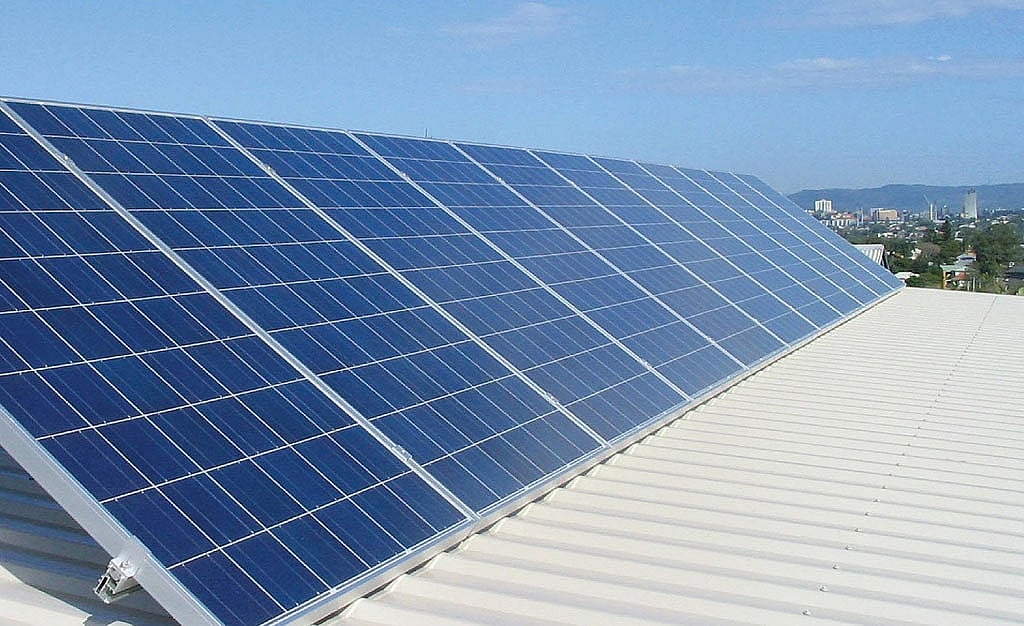
Rooftop solar is among the most practical renewable-energy options currently available to Bangladesh's apparel factories because it can be installed directly at manufacturing sites.
A study has found that Bangladesh's ready-made garment factories could generate up to 40 percent of the sector's power demand through rooftop solar, Tsoi said.
But she cautioned that solar cannot be viewed as a stand-alone solution.
"Rooftop solar should be viewed as one important component within a broader decarbonisation strategy that includes energy efficiency and access to larger-scale renewable energy," she said.
Whether a factory is suitable for rooftop solar depends on factors such as roof size and structural constraints. Newer facilities may be better suited to solar installations than older buildings that require retrofitting.
Cascale, in partnership with GIZ, has been supporting 129 manufacturing facilities across Bangladesh, Vietnam and Cambodia to assess the feasibility of on-site rooftop solar and develop bankable clean-energy projects.
Tsoi said larger renewable-energy projects could also supply clean power to factories at scale. Corporate power purchase agreements could help manufacturers connect to such projects if the necessary policy frameworks are established.
Financing Remains the Biggest Hurdle
For many factories, however, the biggest obstacle is not technology but access to affordable capital.
"Upfront capital remains one of the biggest barriers, with most factories operating under tight budget pressures and little access to the large cash flows needed," Tsoi said. "When investing in decarbonisation, access to affordable finance is often as important as the technology itself."
She pointed to a July 2026 policy change that reduced tariffs on a range of solar and energy-storage technologies, including solar panels, inverters and battery storage systems, to zero through 2031.
The measure should lower the cost of installing rooftop solar and encourage more manufacturers to invest in on-site renewable energy, she said.
Factories should also consider longer-term benefits such as energy savings, greater resilience and competitiveness rather than focusing only on the initial investment and payback period.
Solar generation will still be possible during Bangladesh's monsoon season, although output falls in weaker sunlight.
Tsoi said solar efficiency can drop by 15 percent to 35 percent compared with clear-day capacity, but panels continue operating in indirect light.
For the apparel sector as a whole, she said, the financing requirement is far beyond what factory owners can reasonably shoulder.
"The solution lies in blended finance approaches that bring together commercial lenders, development finance institutions, climate finance providers, brands and government support," she said.
"Concessional loans, green credit lines and risk-sharing mechanisms can help make investments commercially viable for manufacturers."
Brands Have a Role to Play
International brands and retailers also have a crucial role in financing the transition, Tsoi said.
Manufacturers should not be expected to absorb the entire cost, particularly when decarbonisation investments are made partly to meet evolving requirements from global buyers.
Brands can support the transition through longer-term sourcing commitments, co-investment, financing support and purchasing practices that recognise sustainability investments.
"Brands are key to making this transition," Tsoi said. "Manufacturers cannot be expected to shoulder the full financial burden of decarbonisation alone, particularly given the scale of investment required."
She said brands could also support suppliers through programmes such as MCAP, helping them measure emissions, assess climate risks and develop decarbonisation plans.
Development finance institutions, climate funds and international financial organisations can help reduce the cost of capital and make renewable-energy and energy-efficiency projects more accessible to manufacturers of different sizes.
Blended finance combining concessional and commercial funding is particularly promising, she said.
Competitiveness Need Not Suffer
Although cleaner technologies can increase costs in the short term, Tsoi said manufacturers should also account for potential savings from lower energy consumption, better energy management, reduced fuel costs and improved productivity.
Whether higher costs are ultimately passed on to international buyers will depend on the scale of investment, financing arrangements and market conditions.
But she said decarbonisation should be viewed as a long-term investment in operational efficiency rather than simply an additional cost.
It could also become increasingly important to Bangladesh's competitiveness as global brands strengthen their climate commitments and seek lower-emission, more resilient supply chains.
"Competitiveness is one of the strongest reasons to pursue decarbonisation," Tsoi said.
Manufacturers able to demonstrate progress in emissions reduction, renewable-energy adoption and sustainability performance are likely to be better placed to win future business, she said.
"Decarbonisation is becoming a competitive differentiator rather than a compliance exercise," Tsoi said.
If Bangladesh delays the transition, it risks falling behind competitors that can offer lower-carbon production, she said. Cleaner energy, on the other hand, could strengthen supply-chain resilience while helping factories meet buyer requirements.
Beyond Rooftop Solar
Over the next five to 10 years, factories should continue prioritising energy efficiency, stronger energy management systems, waste heat recovery and improvements to thermal systems such as boilers, particularly because of the sector's continued reliance on natural gas.
At the same time, Bangladesh will need to make progress in decarbonising its electricity system.
As cleaner electricity becomes more available through grid improvements, renewable-energy projects and new procurement models, factories can increasingly explore electrification, cleaner fuels, energy storage and renewable-energy sourcing.
Automation, digital manufacturing tools and advanced management systems can also improve productivity, reduce waste and support more efficient operations.
"There is unlikely to be a single technology that delivers the transition on its own; the most successful approach will combine efficiency improvements, smarter manufacturing and greater access to reliable, low-carbon power," Tsoi said.

Policy and Infrastructure
Tsoi said the government should prioritise greater access to renewable energy by creating clearer pathways for corporate power purchase agreements, strengthening support for rooftop solar and ensuring manufacturers can access affordable clean electricity at scale.
Supportive financing policies and investment incentives could further accelerate adoption.
Bangladesh also needs to upgrade its electricity grid and transmission network, she said. A stronger grid would reduce reliance on natural gas in the energy mix and make it easier to integrate variable renewable energy.
The country's national target is to generate 20 percent of its electricity from renewable sources by 2030.
Three Priorities
Asked what Bangladesh should do over the next two to three years, Tsoi identified three priorities.
First, the country needs to upgrade its national electricity grid and transmission network while creating the policy and market conditions needed for factories to access reliable, competitively priced clean power at scale.
Second, it needs to close the financing gap by mobilising blended finance from banks, development finance institutions, climate funds, brands and investors.
Third, it needs greater industry collaboration involving manufacturers, government, brands and financial institutions.
"If Bangladesh can make progress on those three fronts simultaneously, it can reduce emissions, strengthen energy security and reinforce its position as one of the world's most important and competitive apparel manufacturing hubs," Tsoi said.