Home
+
Published : 26 Mar 2026, 08:47 PM
The searing memories of Bangladesh’s birth have been crystallised into a singular visual odyssey as bdnews24.com marked Independence Day with the launch of the third volume of its Liberation War anthology, “Bangladesh, Penned in Blood: History of Glory, Pain and Roots”.
More than a mere collection of images, the final volume of this landmark anthology serves as a profound archaeological dig into the history, unearthing over 550 rare frames that span the quiet stirrings of the Language Movement to the thunderous triumph of 1971.
Launched on Thursday in the presence of four decorated freedom fighters, the anthology challenges the new generation to look beyond the static pages of textbooks and witness the raw, unyielding cost of their freedom.
The series is edited by Editor-in-Chief Toufique Imrose Khalidi.
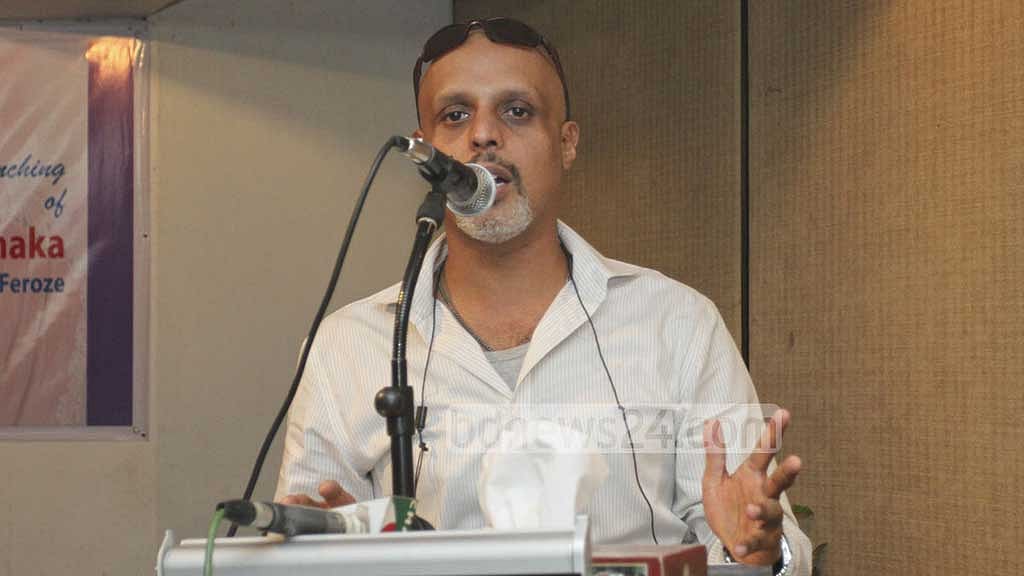
“To those who did not witness the war, 1971 is often just a few paragraphs in a textbook or a ritual on specific days,” said Khalidi in his introduction to the volume.
“But a photograph breaks that distance. It freezes time and pulls the reader into the heart of the moment,” he added.
"We want the youth to look at these photos and ask: Why was this war fought, how did a nation make such profound sacrifices and what is the value of that sacrifice to us today?"
The final volume of this ambitious trilogy is structured into 24 chapters, each serving as a visual portal to a specific era.
From the electoral triumphs of 1954 and the 1969 Mass Upsurge to the horrors of Operation Searchlight and the eventual surrender of Pakistani forces, the book captures the multifaceted nature of the birth of a nation.
The collection features the work of legendary local photographers, including Muhammad Takiullah, Rashid Talukder, and Naib Uddin Ahmed, alongside internationally acclaimed figures such as Raghu Rai, Marilyn Silverstone, Marc Godfrey, Raymond Depardon, Rabin Sengupta, and Kishor Parekh.
While the first two volumes, released on last year’s Victory Day and Jan 31, marking the liberation of Mirpur, the last battlefield of the war, focused on narrative accounts, this final volume uses imagery to challenge traditional perceptions of the war.
The editorial board noted that the project seeks to look beyond the conventional nine-month military frame.
The editorial board says it has tried to verify the source, time period and context of all photographs used in the publication. However, due to their rarity, it was not possible to trace the origin or timeframe of several images despite best efforts.
Each chapter includes rare photographs, along with captions in Bangla and English detailing the location, time period, photographer, and background of the images.
The launching ceremony, moderated by Kazi Sarah Sadeea Swarna, opened with the patriotic strains of ‘O Amar Desher Mati’.
Guests of honour included freedom fighters Mahfuz Alam Beg, Lutfa Haseen Rosy, Kamrul Aman, and Kazi Ashraf Humayun Bangal.
A short video featuring their wartime reminiscences was screened, bringing the static images in the book to life.
“We have lost much, but we have lost nothing yet,” said Mahfuz, his voice resonating with the spirit of 1971.
“We must stand again and organise the country. We must rebuild Bangladesh as the Bangladesh it was meant to be. Joy Bangla!”
He thanked bdnews24.com for taking the initiative to publish this compilation on the history of the Liberation War.
Toufique Khalidi handed copies of the compilation to the guests.
The programme concluded with the song “Joya Bangla, Banglar Joy”.
The anthology’s editorial board comprised Rajib Noor, Salek Khokon and Sirajul Islam Abed.
Nabanita Saha, Apu Mehedi, Pavel Rahman and Masum Kamal served as editorial assistants.
Azizul Parvez, Shahed Kayes, Ruma Modak, Ahmad Shamim, Maruf Billah Tanmoy, Pavel Rahman, Masum Kamal, Nabanita Saha, Apu Mehedi, Rajib Noor, Salek Khokon and Sirajul Islam Abed were the compilers.
The English translations were done by Turaj Ahmad, Shoumik Hassin, Zakia Rubaba Hoque and Arshi Fatiha Quazi, while Shahadat Parvez handled photo curation.
Inside the Anthology
The editorial board describes the trilogy as an expansive inquiry into the history of the war that birthed a nation.
The collection seeks to move beyond traditional narratives, posing fundamental questions: Was this war merely a story confined to a nine-month window? Was it strictly a conventional military struggle fought within the rigid framework of sectors?
The anthology further challenges historical terminology.
Does the word “genocide” truly capture the sheer scale and horror of the Pakistani atrocities?
Does the traditionally masculine imagery associated with the term “freedom fighter” adequately reflect the boundless sacrifice and struggle of the women of Bengal?
Across its three volumes, the war trilogy illuminates these multifaceted layers of history.
While the first two volumes compile selected writings on the Bengali struggle, tracing the journey from the Language Movement to the dawn of independence, the third and final volume brings that entire context to life through the lens of the camera.
Pricing and Availability
The first volume of the anthology is priced at Tk 1,500, while the second and third volumes are available for Tk 1,800 and Tk 3,500, respectively.
Readers can purchase all three volumes at the outlets of Baatighar, Kathaprokash, and Pathak Shamabesh, or order them directly through the publishers’ official websites.
The books are also available at the bdnews24.com head office. Copies can be ordered for home delivery by making payments through bKash.
The Guests
Freedom Fighter Mahfuz Alam Beg
Widely known as “Captain Beg”, Mahfuz’s journey in the Liberation War began with a daring escape from West Pakistan, where he was stationed at the onset of the conflict.
After making his way back to join the struggle, he initially served as the operational commander of Sector 9. He was later appointed as the commander of the Shamshernagar sub-sector.
He is particularly noted for raising the “Bichhu Bahini”, a specialised guerrilla unit comprising young fighters. Under his leadership, this unit conducted extensive guerrilla strikes, frontal assaults, and naval commando operations throughout the Satkhira region.
Among his notable military achievements was forcing the surrender of an entire company of Pakistani soldiers at Doarika in Barishal.
Freedom Fighter Lutfa Haseen Rosy
At the height of the Liberation War, Lutfa was a tenth-grade student at Azimpur School.
Stepping away from her studies to join the war, she served as a guerrilla member of the Bangladesh Liberation Force (BLF), more commonly known as the Mujib Bahini.
She is notably recognised for her active participation in the daring guerrilla operation in Dhaka's Gopibagh.
Freedom Fighter Kamrul Aman
In 1971, as nearly ten million Bengali refugees sought shelter in India, the Indira Gandhi government faced immense domestic pressure from certain states to halt aid and return the displaced populations.
It was against this volatile backdrop that a historic initiative titled the “world conscience awakening march” was conceived.
Kamrul served as the second deputy leader of this initiative, which comprised 38 young Bangladeshis from various districts who marched from the border to Delhi.
The primary objectives of the march were to mobilise international public opinion in favour of independence, demand the official recognition of Bangladesh by the Indian government, and secure the release of Sheikh Mujibur Rahman.
Along the route, Kamrul and his fellow marchers submitted memorandums to various foreign embassies, providing firsthand accounts of the genocide and atrocities committed by the Pakistani military.
Freedom Fighter Kazi Ashraf Humayun Bangal
A formidable figure within the Kaderia Bahini, one of the few independent military forces of the Liberation War, Ashraf served as the commander of the renowned “Hanuman Company”.
Under his leadership, the unit became a source of constant dread for the Pakistani occupation forces in Tangail, leading the military to announce a bounty for his capture, dead or alive.
His courage nearly cost him his life on Nov 30, 1971, during a high-stakes operation at the Nagarpur Police Station.
A bullet from a Pakistani Light Machine Gun (LMG) pierced through his back, entering from the right and exiting the left. Though the nation eventually achieved its independence, the physical toll of that battle remains with him as an enduring reminder of the struggle.