Published : 30 Dec 2025, 06:59 AM
Updated : 21 Aug 2026, 02:56 PM


Bangladesh has continued to face a high level of tobacco industry interference in its policymaking space, topping the list in Asia, according to the Tobacco Industry Interference Index: Bangladesh 2025.
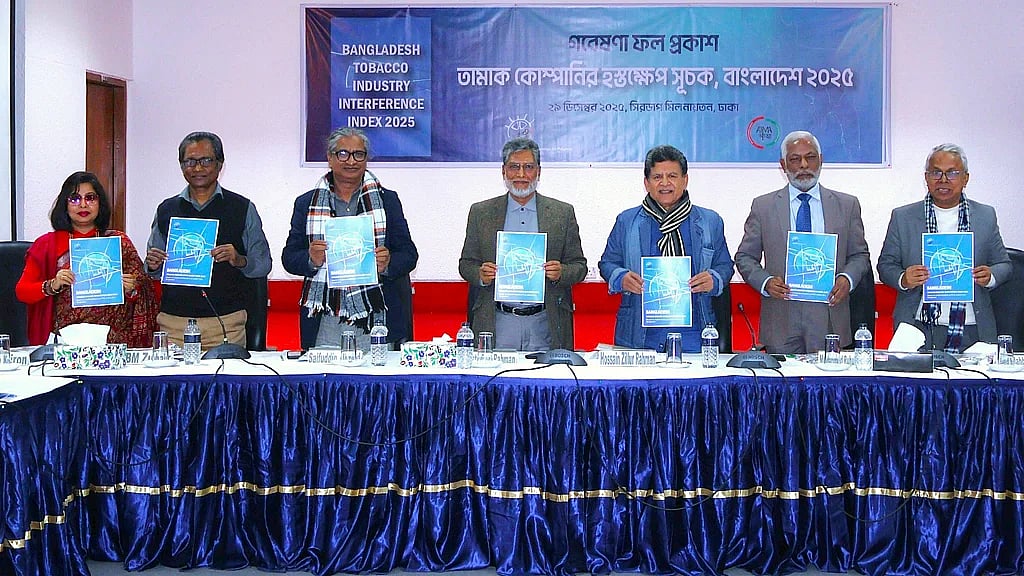
The findings have been unveiled on Monday at an event organised jointly by research and advocacy organisation PROGGA (Knowledge for Progress) and the Anti-Tobacco Media Alliance (ATMA), as per a media statement issued after the programme.
The statement said Bangladesh scored 69 out of 100 in the 2025 review, in which lower scores signify improved compliance with Article 5.3 of the WHO Framework Convention on Tobacco Control (FCTC).
The index has assessed 100 countries, placing Bangladesh 66th overall. Within South Asia, Nepal ranked 43rd, India 59th, Pakistan 54th, Sri Lanka 45th and the Maldives 39th.
Brunei topped the list with the lowest score of 14, while the Dominican Republic ranked last with a score of 98, it added.
The report said the majority of tobacco industry interference incidents in Bangladesh were linked to the amendment process of the tobacco control law initiated by the Ministry of Health and Family Welfare.
The Bangladesh country report, prepared by PROGGA as part of the global index, has been based on publicly available information on incidents recorded between April 2023 and March 2025.
It has assessed government responses to industry interference using the FCTC Article 5.3 Guidelines.
Funded by Bloomberg Philanthropies, the study has also received support from the Southeast Asia Tobacco Control Alliance (SEATCA) and the Global Centre for Good Governance in Tobacco Control (GGTC).
PROGGA has been publishing Bangladesh country reports under the index since 2018.
As per the findings, Bangladesh adopted the FCTC Article 5.3 Guidelines in 2008 but has yet to formulate or implement a code of conduct for government offices in line with the guidelines.
The absence of such a framework has allowed the tobacco industry to “influence the tobacco control law amendment process, maintain unnecessary engagement with policymakers, promote corporate image through CSR activities and continue to receive financial and other benefits”.
The report read that the tobacco industry has engaged in sustained lobbying through commissioned research, roundtable discussions, press conferences, media and online campaigns, petitions and CSR programmes.
It added that government disclosure of interactions with the industry has remained weak, while state ownership in a multinational tobacco company and the presence of former and serving public officials on its board represent a serious conflict of interest.
The study recommends that the government formulate and enforce a code of conduct in line with FCTC Article 5.3 for all public bodies; finalise the Smoking and Tobacco Products (Usage Control) (Amendment) Ordinance, 2025; block the entry of new domestic and foreign tobacco companies; and deny the establishment of tobacco-related factories in Special Economic Zones and Export Processing Zones.
It also urges the exclusion of cigarettes from the Essential Commodity Act 1956, divestment of government stakes in tobacco companies, and the introduction of a simplified tobacco pricing and tax policy in line with WHO FCTC Article 6 to curb demand.
Speaking at the event, former caretaker government advisor and economist Hossain Zillur Rahman said the amendment ordinance of the Tobacco Control Law had received final approval from the Advisory Council.
“Now, the ordinance must be published in the Gazette as soon as possible. We do not want to see any further interference at this stage,” the statement quoted.
The event featured Mary Assunta, head of global research and advocacy at GGTC; former BCIC chairman Md Mostafizur Rahman; former NTCC coordinator Md Ruhul Quddus; WBB Trust Executive Director Saifuddin Ahmed; Vital Strategies Senior Technical Advisor Syed Mahbubul Alam; ATMA Convenor Mortuza Haider Liton; and PROGGA Executive Director ABM Zubair. ATMA Co-Convener Nadira Kiron moderated the programme, while Md Hasan Shahriar PROGGA, head of programmes, presented the key findings.
Representatives of anti-tobacco organisations and civil society members were also present.