Published : 07 May 2026, 07:32 AM
Updated : 21 Aug 2026, 03:41 PM


The Harvest That Never Was
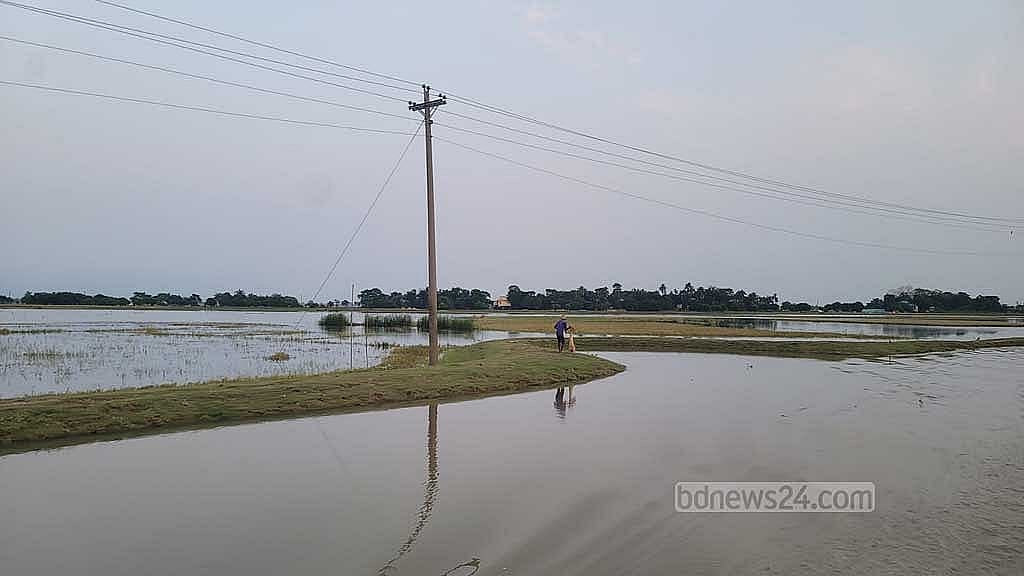
Sunken yields: Flash floods have swallowed 20,000 hectares of Boro paddy. Farmers in Udgal and Chhayar Haors watched golden fields turn into a vast, decaying inland sea.
Economic ruin: The single-crop cycle has shattered. From large landholders to sharecroppers, families face total loss as the "Daowamari" scent of fresh rice is lost to rot.
Disputed damage: As 50,000 families struggle to salvage sprouting grain, official reports of a 80 percent completed harvest spark fury, threatening to delay vital government relief.
The Haor does not sleep during harvest season. It never has.
But this year, the silence is heavy.
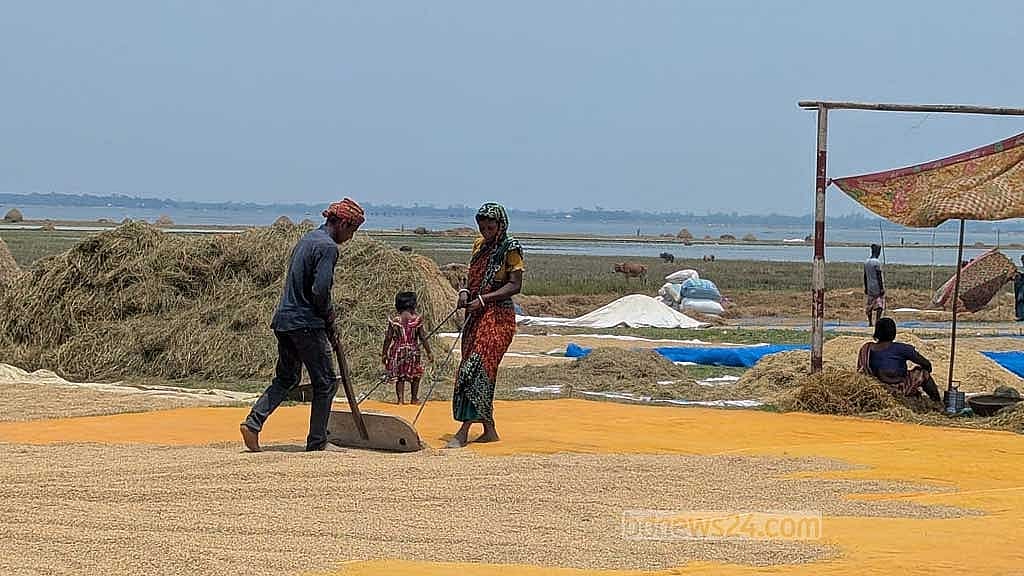
In Kalyani village on the edge of Udgal Haor in Sunamganj’s Dirai Upazila, the season of “Daowamari” -- the traditional Boro harvest period -- has arrived without its usual urgency.
Courtyards stand empty. The air carries none of the familiar scent of fresh paddy. The drying yards lie unused, as if the season itself has paused mid-breath.
For Anil Chandra Das, a relatively well-off farmer with more than 60 kear of land (around 7.28 hectares), the contrast is stark. Last year, he harvested around 1,300 maunds, or 52,000kg, of rice. This year, he is counting losses instead.
“Out of 60 kear, I could harvest about 40. The rest is under water,” he said. “Even what I cut has partly rotted. I spent Tk 300,000 excluding harvesting. I was expecting at least 1,200 maunds. I haven’t even got 300.”
Across the village, the pattern repeats -- large farmers, smallholders, and sharecroppers all speaking in variations of the same language: damage, loss, uncertainty.
Jagat Roy, a small farmer who leased 5 kear (0.6 hectares), managed to harvest only three. “Half of that has already rotted,” he said. Farming is his only livelihood.
Fields Turned into Inland Water
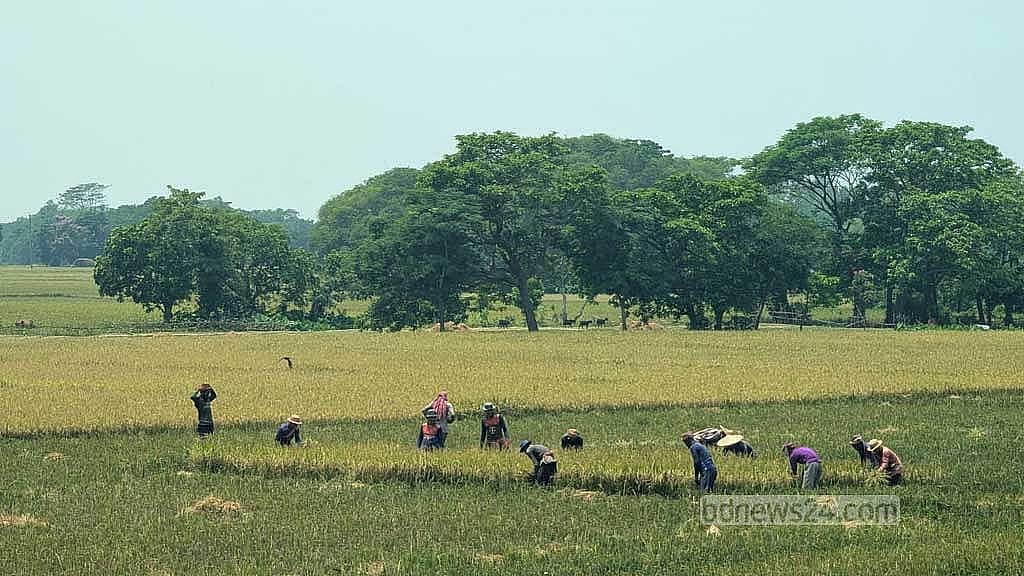
A road from Dirai town towards Shyamarchar leads to Bharargaon Bridge, where Udgal Haor spreads out like a vast sheet of water. According to agricultural officials, 1,313 hectares here were cultivated with Boro this season. Much of it now lies submerged.
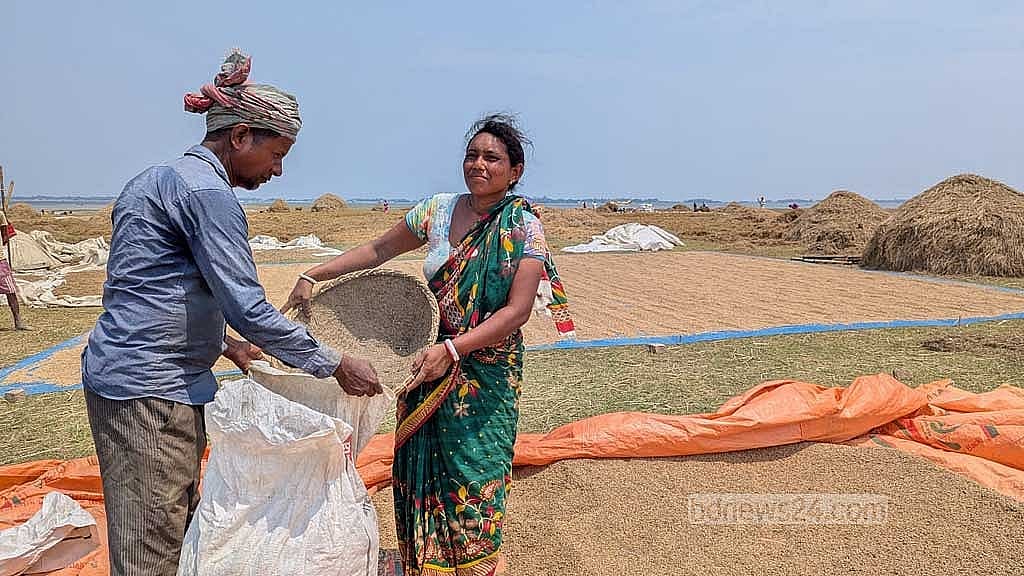
Farmers stand on makeshift drying grounds, spreading damp, sprouting grain under a reluctant sun. For a week, continuous rain denied them even this chance.
Further along, Chhayar Haor now resembles a vast inland sea. Where golden paddy once swayed, there is only water and drifting water hyacinth. The air carries the sour smell of decaying grain.
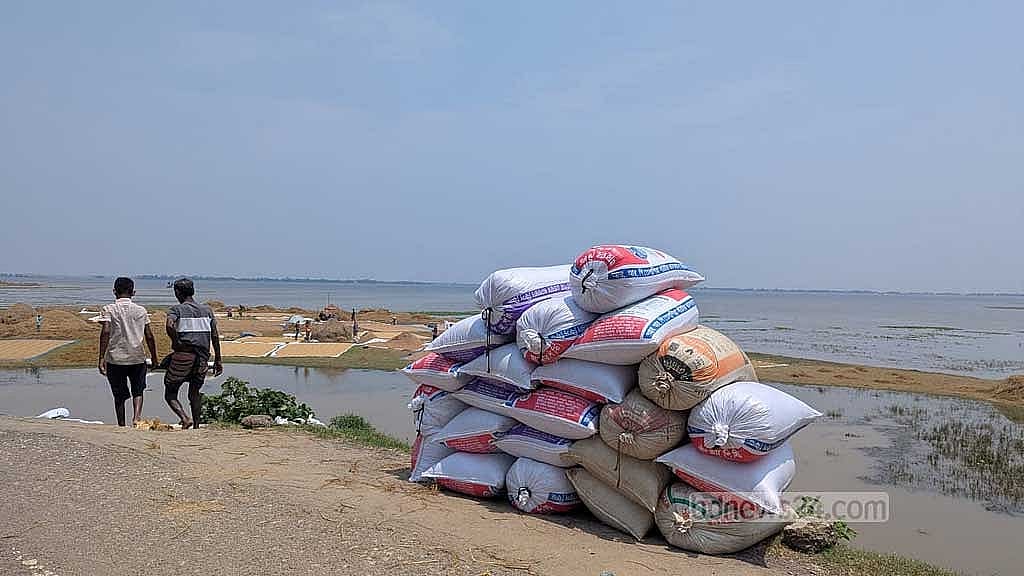
Continuous rainfall between Apr 26 and May 2 submerged large parts of Udgal and Chhayar Haors.
Sunamganj, a major food-surplus district, cultivates Boro across 223,511 hectares annually, targeting production worth about Tk 50 billion.
This year, at least 20,120 hectares have been destroyed, affecting more than 50,913 farming families and nearly 257,460 people.
A Harvest Season Without Harvest
The Haor economy depends on a single crop cycle. During harvest, families return home, labourers arrive, and nights are filled with boiling, drying and storing rice.
This year, that rhythm has broken.
Kalai Mia Talukdar harvested less than 50 maunds, or 2,000kg, from 22 kear (2.67 hectares), against an expected 250 maunds, or 10,000kg. “We rely only on farming. I am facing huge losses,” he said.
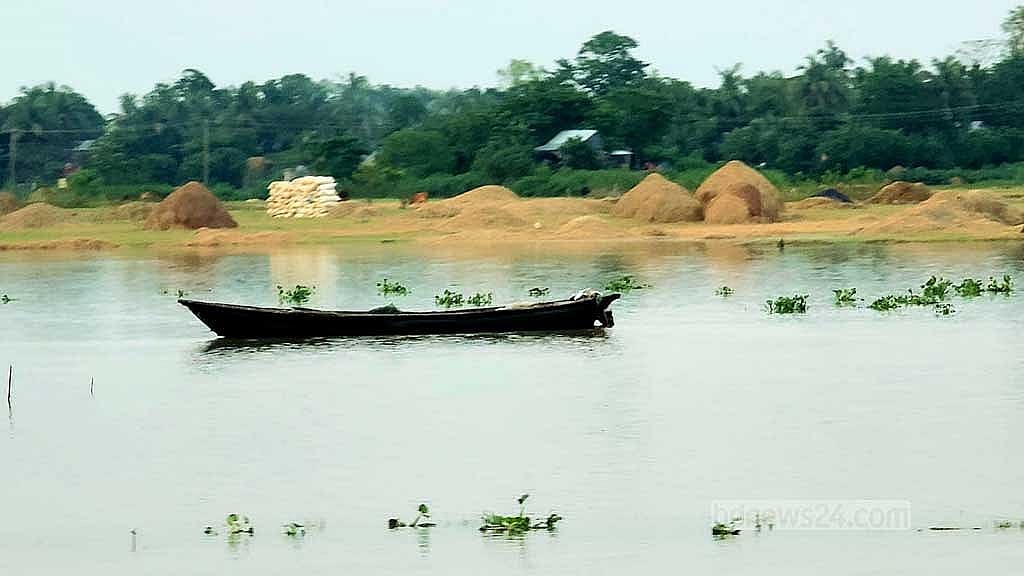
Makhan Chandra Das lost half of his 50 kear (6.07 hectares) to flooding, while much of the remaining harvest has rotted.
Pranesh Das, a sharecropper, lost all 15 kear (1.82 hectares). “Everything is submerged. How will I feed a family of five?” he asked.
“Without My Wife’s Job, We Wouldn’t Survive”
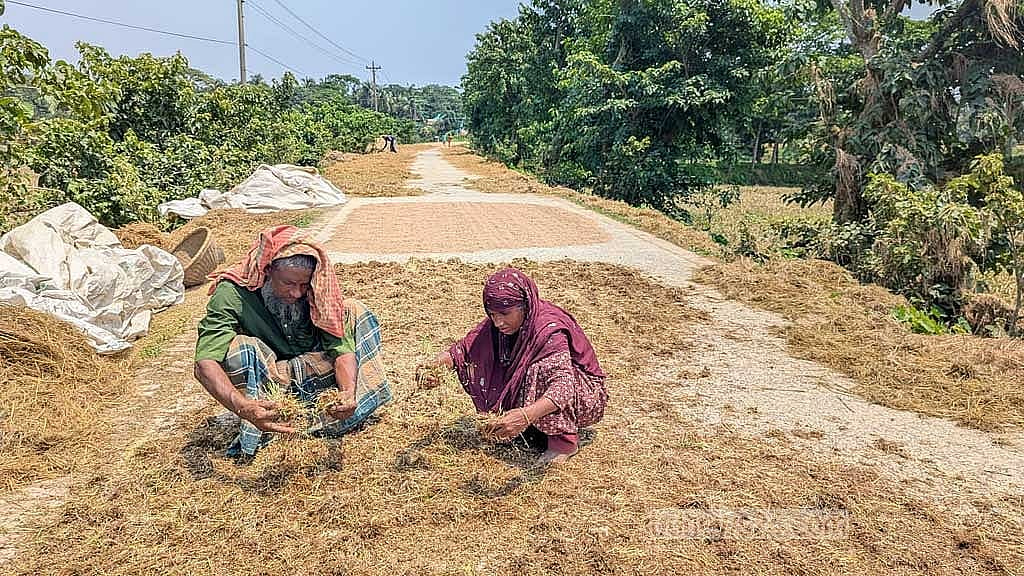
Along a roadside near Milanbazar, Ali Nur and his wife Syeda Nur spread sprouting, rotting paddy under the sun. The grains are breaking apart as they dry.
“I cultivated 9 kear (1.09 hectares). 4 kear (0.48 hectares) were harvested; the rest drowned,” Ali said. “I used all my savings. I am ruined.”
Adhir Das, another farmer, lost half his 24 kear (2.91 hectares) completely, while much of the remaining harvest has decayed. Labour costs alone required rice payments and cash per kear.
Nirapad Das, a mid-scale grower, was blunt: “If my wife didn’t have her job as a school aide, it would have been impossible to survive.”
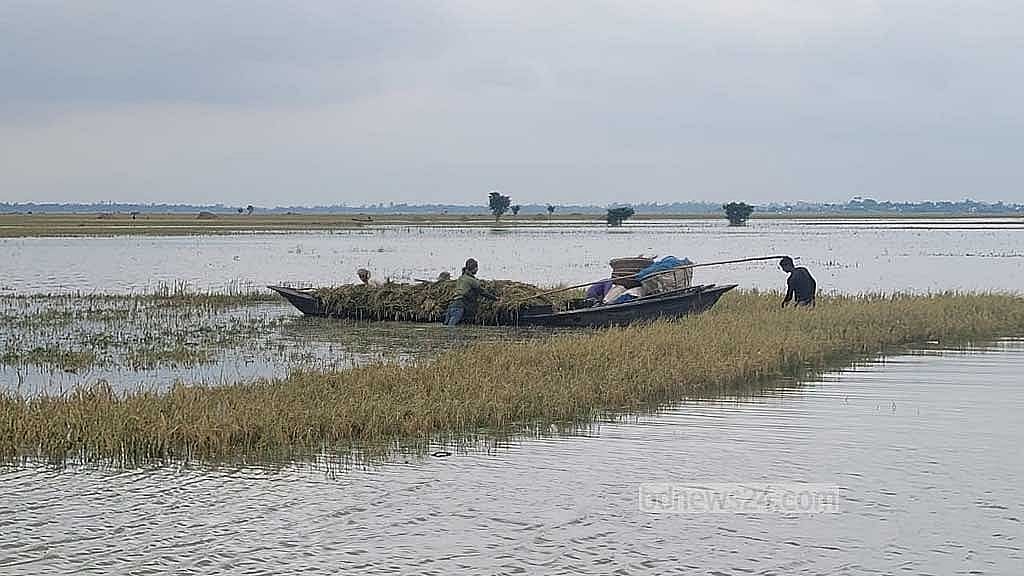
Disputed Numbers, Uncertain Relief
Official figures have triggered frustration among farmers and local leaders.
At a district event, agricultural officials claimed up to 80 percent of harvesting was complete, a statement contested by opposition leaders, who called the data inaccurate.
“If the real picture is not reported, farmers will be deprived of assistance,” said lawyer Sere Nur Ali.
Agricultural officials say full damage assessment will take another week. “Farmers are trying to salvage what they can,” said Mohammad Omar Faruk, deputy director of Sunamganj Department of Agricultural Extension.
For Sunamganj’s Haor belt, what should have been a harvest has become an inventory of damage.