Published : 10 May 2026, 07:15 AM
Updated : 21 Aug 2026, 03:42 PM


Nine-month-old Noor, identified with a single name, has been battling fever and respiratory distress since early April.
On Apr 8, the infant from Chandpur was admitted to the Bangladesh Shishu Hospital and Institute (BSHI) in Dhaka. When his condition worsened, doctors moved him to the intensive care unit (ICU).
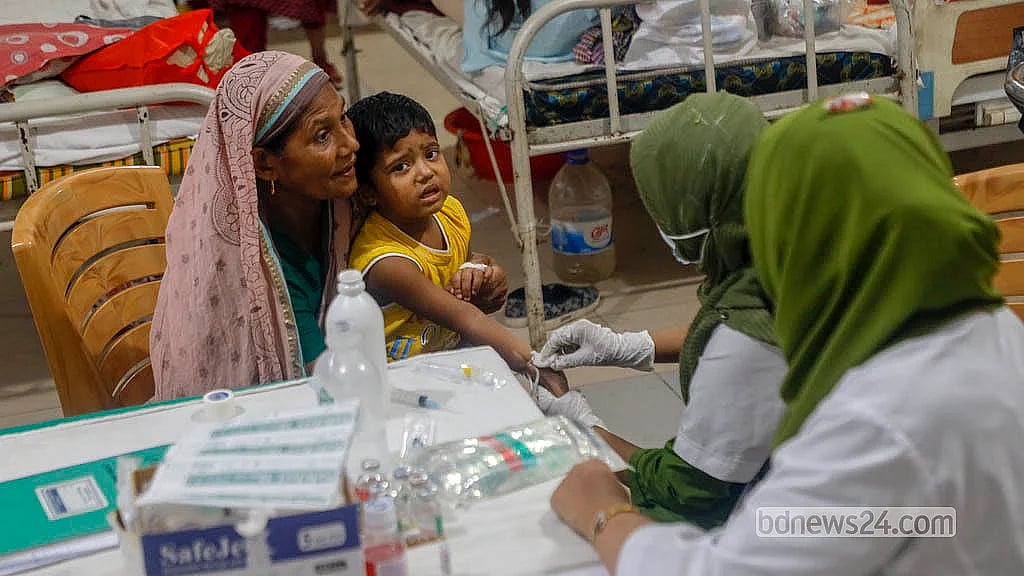
More than a month later, Noor’s mother, identified only as Sumaiya, is still sleeping on the hospital floor beside her child’s bed.
His father, Nurullah Hassan, watches the mounting bills with a heavy heart.
In just one month, medicine, ICU charges, and ancillary costs have exceeded Tk 80,000.
Nurullah, a small pharmacy owner with a monthly income of Tk 30,000, is at his breaking point.
"The shop is closed because I have to be here. If we stay a few more days, the cost will cross Tk 100,000," he said.
From inside the crowded ward, Sumaiya described the relentless expenses.
“Nothing is available here,” she said.
“Whatever the doctors or nurses ask for, we have to buy outside. Medicines, tests, injections — every day costs several thousand taka.”
According to her, the ICU bed costs Tk 1,000 a day, oxygen Tk 500 and nebuliser support another Tk 100, excluding medicines.
“The antibiotics and injections during ICU treatment cost the most,” she said.
The story is the same for Jewel Bepari, a driver who lost his job just before his son, Alif, identified with a single name, fell ill.
After a harrowing journey from Barishal and being turned away from multiple hospitals, Alif finally secured a bed at Shishu hospital.
"I spent Tk 13,000 for just one hour at a private hospital before coming here. Now, I’m surviving on loans from relatives. I don’t know what to do," said Jewel.
Across Bangladesh’s overwhelmed hospitals, families battling the country’s worsening measles outbreak say treatment expenses are pushing them into debt, while many are also losing income because parents must remain with their children in hospitals for weeks.
According to the latest Directorate General of Health Services bulletin, 6,979 confirmed measles cases were recorded nationwide between Mar 15 and Saturday, with 61 deaths.
Suspected cases have climbed to 47,656, while 291 people with measles symptoms have died.
Only Care is Free, Everything Else has a Price
At government hospitals, where treatment is expected to be subsidised, parents report that almost everything -- syringes, saline, and even mandatory vitamin A supplements -- must be purchased from private pharmacies.
While mothers stay beside the children, fathers or other relatives spend their days running between pharmacies and diagnostic centres.
For many low-income families, the financial pressure has become unbearable.
In Dhaka’s Shaheed Suhrawardy Medical College Hospital, Khalil Mia from Bhola has spent Tk 40,000 in a week.
A fisherman and farmer, his livelihood has come to a standstill.
"From a bottle of water to life-saving injections, we have to buy it all," he lamented.
Several parents said government hospitals should at least provide emergency medicines and oxygen free of charge during the outbreak.
Bobi Yasmin, another mother at the children’s hospital, said: “After admission, they didn’t provide anything. All tests and medicines are being bought outside. Even vitamin A supplements.”
“Given the situation in the country, emergency medicines and oxygen should be free for measles patients.”
Prof Mahbubul Hoque, director of the Shishu hospital, said patients in free beds receive food and some essentials without charge, while those in paying beds must purchase medicines separately.
He also claimed ICU charges for measles patients are being kept lower than usual.
Asked why some patients were not receiving government-supplied vitamin A supplements, he said: “All patients are supposed to get them. We will look into why some are not receiving them.”
Private Hospitals: A Financial Death Trap
For those unable to find a bed in the overcrowded public wards, private hospitals are the only -- and often impossible -- option.
While a government ICU bed costs Tk 1,000 daily, including oxygen and nebuliser charges, a private ICU bed can exceed Tk 25,000 per day.
A recent report by the Bangladesh Institute of Development Studies (BIDS) highlights this systemic failure, noting that 79 percent of healthcare costs in Bangladesh are borne out-of-pocket by individuals.
For the poor, these costs swallow up to 35 percent of their total income.
A representative of Padma General Hospital in Dhaka said the daily rent for a neonatal intensive care unit bed alone is Tk 6,000, while medicines must also be purchased separately depending on the child’s condition.
Crisis of Beds and ICUs
The World Health Organization (WHO) recently reported that measles has spread to 58 out of 64 districts in Bangladesh, with 79 percent of those infected being under the age of five.
Prof Mahbubul said they increased "measles-dedicated" beds from 46 to 74, but nearly 90 patients are currently admitted.
"We cannot increase beds any further," he said.
Similar overcrowding is reported at Rajshahi Medical College Hospital (RMCH) and the Infectious Diseases Hospital in Mohakhali.
RMCH currently has 90 measles and isolation beds combined, but 99 patients were admitted as of Saturday.
The infectious diseases hospital, on the other hand, has more patients than its 100-bed capacity.
On Apr 23, the health directorate issued an emergency directive instructing hospitals not to refer measles patients elsewhere and to expand bed capacity if needed.
But hospital directors say increasing beds also requires oxygen lines, equipment and space -- resources many facilities simply do not have.
According to the latest health bulletin, Bangladesh has 171,675 hospital beds in public and private facilities combined.
Of them, 71,660 are in government hospitals. Public hospitals have just over 1,600 ICU beds nationwide.
A 2022 survey titled “Critical care bed capacity of Bangladesh: A pre- and post-COVID-19 pandemic survey” estimated the total number of ICU beds across public and private hospitals at 2,856.
With Bangladesh’s population standing at nearly 173 million, the country has fewer than one hospital bed per 1,000 people and roughly one ICU bed for every 60,000 people.
Jayanta Kumar Mukhapadhyaya, chief technical manager at the National Electro Medical Equipment Maintenance Workshop and Training Centre, said government hospitals currently have around 1,620 ICU beds.
Health Services Director General Prof Pravath Chandra Biswas told bdnews24.com on Friday that ICU capacity has already been increased in Rajshahi and at the children’s hospital in Dhaka.
“Government supplies of antibiotics remain normal,” he said.
“If there are shortages anywhere, hospitals should submit requisitions.”
Why are Children Still Dying?
Over the last 54 days, an average of six children have died every day.
Dhaka Division has recorded the highest mortality with 173 deaths, followed by Rajshahi with 80 deaths.
By 8am on Saturday alone, nine children had died after contracting measles or developing symptoms linked to the disease.
Health officials say 47,656 suspected measles cases have now been reported nationwide, with 33,631 patients requiring hospitalisation.
"Measles has no direct cure," explained Mahbubul Hoque.
"We treat the complications it creates in the body. Often, children are brought to us in such critical condition that despite our best efforts, we cannot save them."
Health expert Mushtuq Husain believes the government should formally declare a public health emergency.
“In practice, everyone is already working in emergency mode,” he said.
“But many in government fear that officially declaring an emergency could reduce their authority,” Mushtuq said.
“Overall, the response still looks like firefighters trying to control a blaze after it has already spread. Even after COVID-19 pandemic, we still haven’t learned how to handle an epidemic properly.”
[Writing in English by Emran Hossain]