Published : 01 Feb 2026, 07:30 AM
Updated : 28 Aug 2026, 01:35 AM


Was Bangladesh’s Liberation War confined to nine months, and only a sector-based military campaign? Do “genocide” and “freedom fighter” alone capture the scale of violence, resistance and women’s sacrifices? The second volume of "Bangladesh, Penned in Blood: History of Glory, Pain and Roots" returns to these questions, arguing for a multidimensional reading of the struggle.
Published by bdnews24.com, the three-volume anthology "Bangladesh, Penned in Blood" (Roktorekhay Bangladesh) curates selected writings tracing the Bengali people’s journey from the Language Movement to independence. The series is edited by Editor-in-Chief Toufique Imrose Khalidi.
Volume II was launched on Saturday to mark the 1972 liberation of Mirpur, the war’s final battlefield. Mirpur remained under Pakistani control after Victory Day on 16 Dec 1971; more than a hundred members of the Bangladesh Army and police, including filmmaker Zahir Raihan, were killed there.
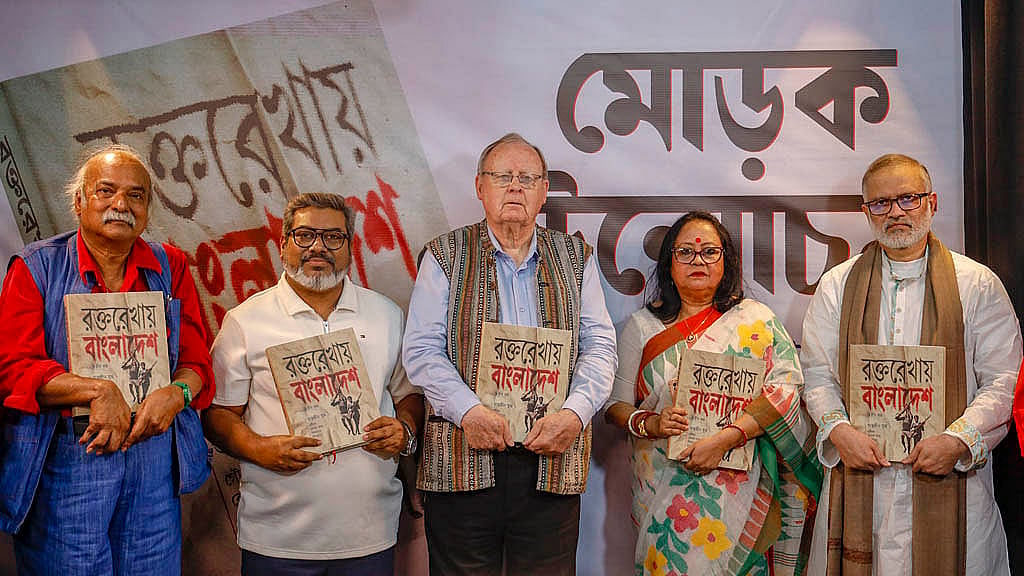
The book opens with “Genocide: More Than Mass Killing” and closes with “The Battle of Mirpur”, documenting the war’s last chapter.
In the foreword, Khalidi says the book does not claim to be a definitive history.
“This compilation does not seek to reassure readers by answering all questions. Rather, it seeks to confront them with questions," he said.
“When history goes unchallenged, it can all too easily slip into propaganda. In the name of building an ‘inclusive’ state and nation, it can become a pretext for making people forget. This collection is an attempt to stand against that propaganda and that enforced forgetting.”
He notes the spirit of the Liberation War evolved, from language rights through the 1969 mass uprising, and was rooted in a dream of a secular, democratic, exploitation-free society.
“In later years, we have seen this spirit used to consolidate vested power, so younger generations began to see it as a formula for staying in office,” he writes.
Khalidi says the set seeks to include all stakeholders’ voices. Volume I traced the path from the Language Movement, the Six-Point Movement, the 1969 Uprising and the 1970 election to an armed struggle, covering the Mujibnagar government, the proclamation of independence, the Mukti Bahini, battlefield accounts and life in refugee camps.
Volume II turns to the horrors of genocide, collaboration and betrayal, and the resilience that led to victory.
“War is not fought with guns alone,” Khalidi writes. “Songs, poetry, newspapers, cameras, protests on football fields, secretly listening to the BBC -- all were crucial fronts.”
He adds that global cultural and humanitarian efforts, from the Concert for Bangladesh to Testimony of Sixty, made the war a moral cause worldwide. “Without that solidarity, the course and outcome might have been different.”
The editorial board comprises journalist Rajib Nur, Liberation War researcher Salek Khokon, and journalist Sirajul Islam Abed.
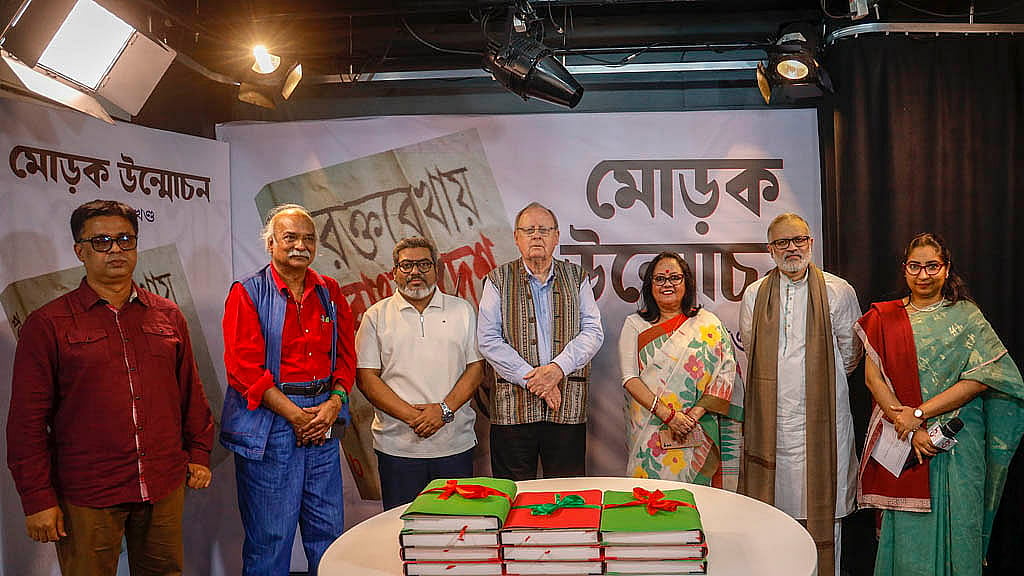
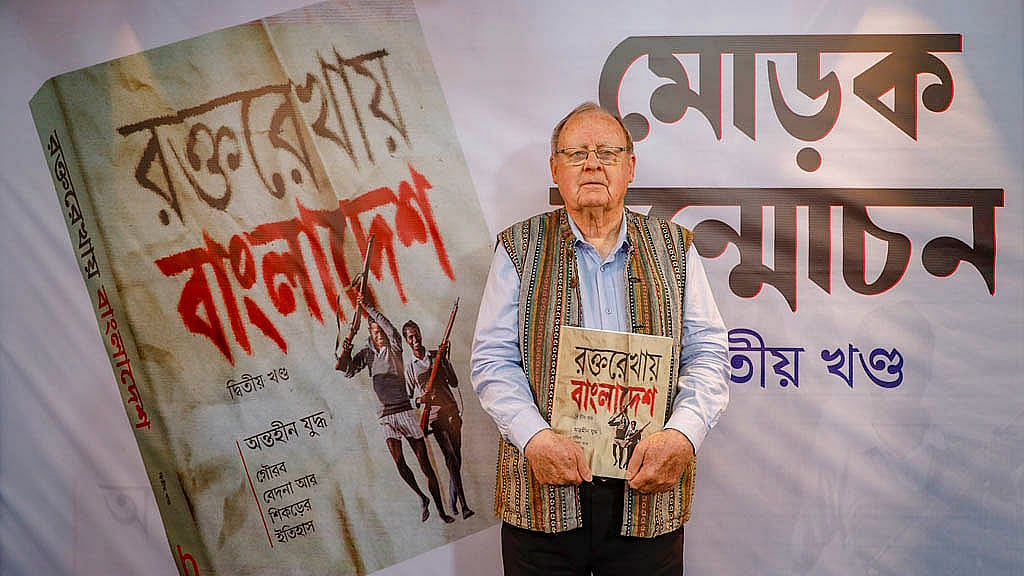
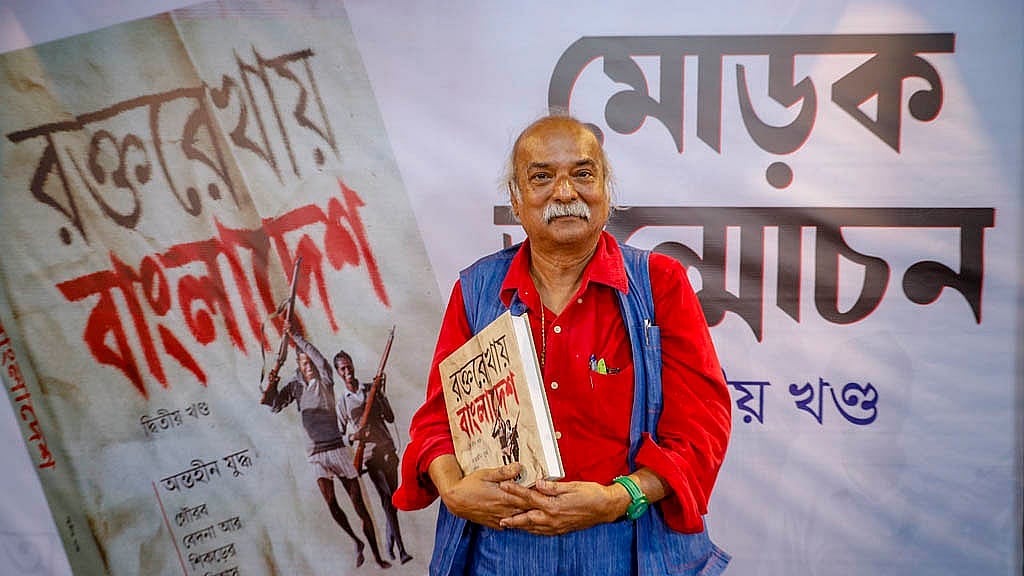
Saturday night’s launch opened with “O Bhai Khati Sonar Cheye Khati”. Guests included "Friend of the Liberation War" Julian Francis, freedom fighters Shafiqul Islam Swapan and Ferdousi Haque Linu (Linu Haque), and Tapu Raihan, son of martyred intellectual Zahir Raihan.
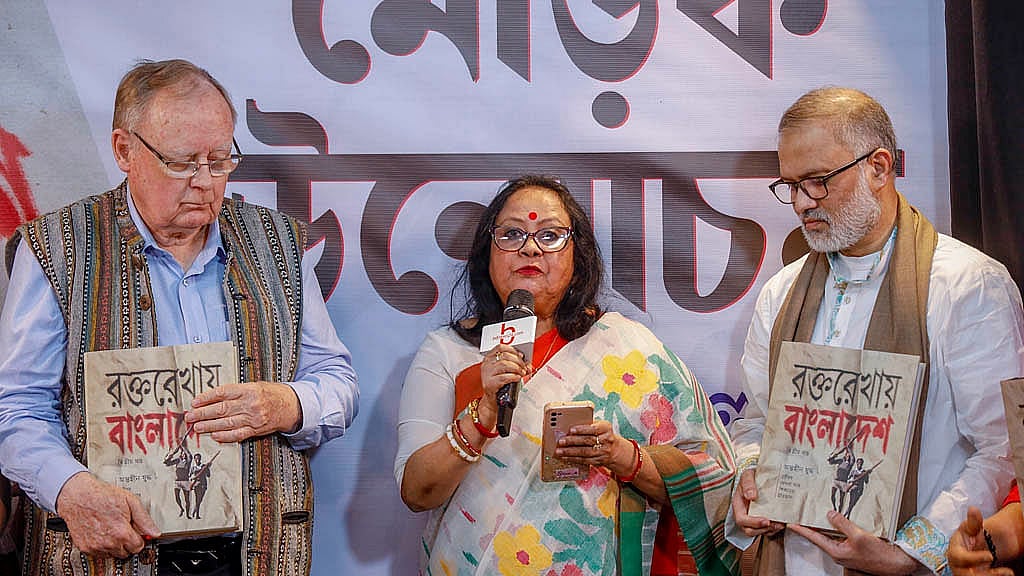
Linu Haque said the war unfolded on a canvas too vast for three volumes, but the set would give the next generation a continuous, people-centred view.
“Our Liberation War was a people’s war. Until the history of those people-warriors is fully told, the complete history of the war will remain unwritten.”
Drawing attention to women’s sacrifices, she said women “carried the country like a mother carries a child”.
“After independence, like a mother who forgets labour pain upon seeing her child, women forgot their suffering when they saw the free country. But did they receive what they deserved?”
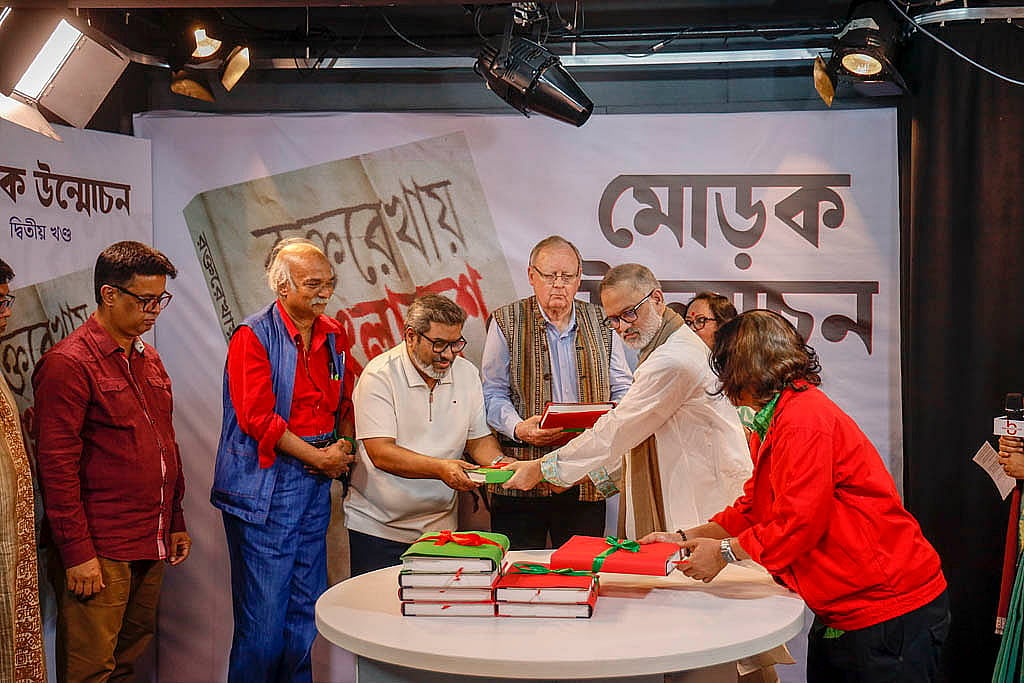
Khalidi formally handed the volume to guests. The evening, hosted by Kazi Sarah Sadeea Swarna, closed with “Tirhara Ei Dheuyer Sagor Pari Debo Re”.
WHAT VOL II CONTAINS
The second volume of “Bangladesh, Penned in Blood” opens with a stark exploration of genocide.
The chapter “Genocide: Not Just Mass Killing” lays bare the brutal reality of the systematic slaughter carried out by Pakistani forces across the country over nine months of the Liberation War.
Against the backdrop of independence won at the cost of the blood of three million martyrs, the chapter also confronts and refutes -- through facts, data, and reason -- the debate raised by certain quarters over the number of those killed, even 54 years after independence.
During the war, auxiliary forces such as the Razakars, Al-Badr, and Al-Shams were formed as collaborators of the occupying Pakistani forces, while the Peace Committee emerged to provide political backing.
The chapter “Razakar–Al-Badr–Al-Shams: The History of a Collaborator Network” documents the formation, roles, and historically recorded betrayals of these forces and organisations.
The organisation, strategies, and contributions of independent and regional forces that emerged during the Liberation War are the focus of “Beyond the Circle: Independent and Regional Forces”. Drawing on documents and memories, the chapter shows how these forces -- operating outside the central command -- strengthened local resistance and played an effective role against the enemy.
The chapter “Leftists in the Liberation War: Power Politics and History’s Barbed Wire” analyses the role of left-wing political forces and the communist movement. It offers a historical assessment of how organisational structures, ideological conflicts, armed resistance, and support from the international socialist world expanded the political landscape of the Liberation War.
For decades, the term “freedom fighter” remained trapped in a male-centric image, reducing women’s contributions largely to narratives of victimhood. “Women in the Liberation War: Obscured, Unrecognised, and Absent Histories” challenges that narrow view, presenting women’s multifaceted participation -- in combat, organisation, medical care, intelligence, and leadership -- in its full breadth.
The role of indigenous communities has remained largely absent from mainstream Liberation War histories. Yet in border regions, hills, forests, and remote terrain, indigenous people fought shoulder to shoulder with Bengali freedom fighters.
“Indigenous Peoples in the Liberation War: Present on the Battlefield, Missing from the Lists” brings to light their sacrifices and the strategic importance of their geographical knowledge in resisting Pakistani repression.
The chapter “Victorious unto Death, Drawn by the Soil: The Extraordinary War of Ordinary People” foregrounds the core strength of the Liberation War -- the courage, sacrifice, and commitment of ordinary citizens. The participation of women, minorities, marginalised communities, and gender-diverse people underscores that the war was not merely a military conflict, but a collective resistance across all layers of society.
Less-discussed forms of struggle emerge in “The War Was Not Only Fought with Weapons: In Thought, Creation, and Love”. Crossing borders on foot, documenting war through the camera lens, protests on football fields, or secretly listening to the BBC -- all reveal how multidimensional and creative the fight for freedom was.
The chapter “The Liberation War in Newspapers: Documentary Evidence from 1971” analyses the role of newspapers and media during the war. By examining the occupiers’ propaganda, publications from liberated zones and the government-in-exile, and the history of resistance journalism, it demonstrates that newspapers were an active front of the war.
Global protests, cultural movements, and public opinion formed in support of Bangladesh in 1971 are explored in “Bangladesh on the International Stage—Protests, Concerts, and Calls of Solidarity”. Concerts, songs, personal initiatives, and the awakening of global conscience turned the Liberation War into a question of international justice -- documented here through human and historical testimony.
From the outset of the war, one of the Pakistani Army’s core objectives was to destroy Bengali intellectual strength. Even as defeat became inevitable, they struck their final blow by targeting intellectuals. Through planning, execution, and the grief-laden memories of families, “The Killing of Intellectuals: The Final Target of Genocide” exposes the history of a nation’s intellectual annihilation.
The chapter “Surrender: The Flag of Victory Flies” documents the military and political process of victory. Drawing on Pakistani military admissions, international diplomacy, and the final act of surrender in Dhaka, it presents a documentary account of the birth of independent Bangladesh.
The return of Bangabandhu Sheikh Mujibur Rahman on Jan 10, 1972, marked the beginning of a new post-war chapter. “Bangabandhu’s Homecoming: Crossing the Difficult Road” captures the reality of devastation, grief, and reconstruction, showing that the struggle did not end with independence.
Julian Francis
Julian Francis’s bond with Bangladesh dates back to the 1971 Liberation War. During the war, he was a 25-year-old working with Oxfam, posted in India’s Bihar state. He later served as a relief coordinator for hundreds of thousands of Bangladeshi refugees who had taken shelter in camps across India.
In 1971, Francis was also associated with the publication “Testimony of Sixty”. The accounts of 60 witnesses, key figures, and relief workers played a vital role in building international public opinion in favour of Bangladesh’s independence.
For his contribution to the Liberation War, he was honoured with the title “Friend of Bangladesh”. Fondly known to Bangladeshis as “Julian Bhai”, he has since taken Bangladeshi citizenship and now lives in the country.
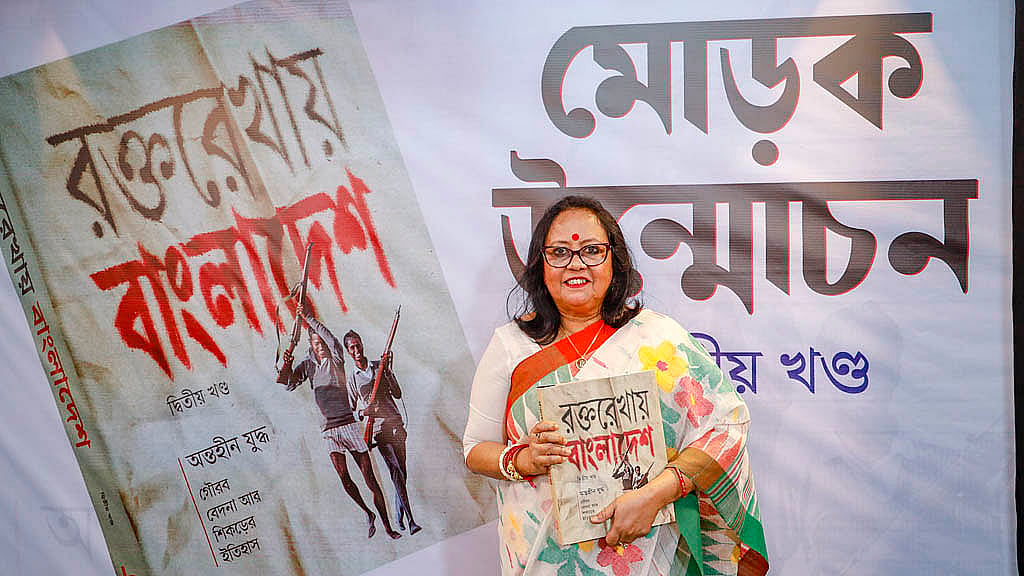
Shafiqul Islam Swapan
Freedom fighter Shafiqul Islam Swapan took up arms on the battlefield. He was a guerrilla fighter in Sector 2, where Rezaul Karim Manik served as their commander. After Manik was martyred towards the end of the war, leadership of the sector passed to Deputy Commander Nasiruddin Yousuf.
Alongside fighting, Swapan documented the war through his camera. Photographs taken by him form part of the rare visual archive of the Liberation War. He later won the National Film Award for Best Cinematography twice for his work in film.
Kazi Ferdousi Haque Linu
She is better known as Linu Haque, the name under which she also writes.
During the days of the Liberation War, girls in Dhaka’s Azimpur neighbourhood formed the Bichchhu Bahini. Linu Haque, then a school student, was part of that group.
They went door to door distributing leaflets to spread stories of the freedom fighters’ victories and reports of mass killings carried out by Pakistani forces. They issued “red letters” urging collaborators of the Pakistani Army to abandon their allegiance. During the war, they also distributed leaflets asking people not to observe Eid.
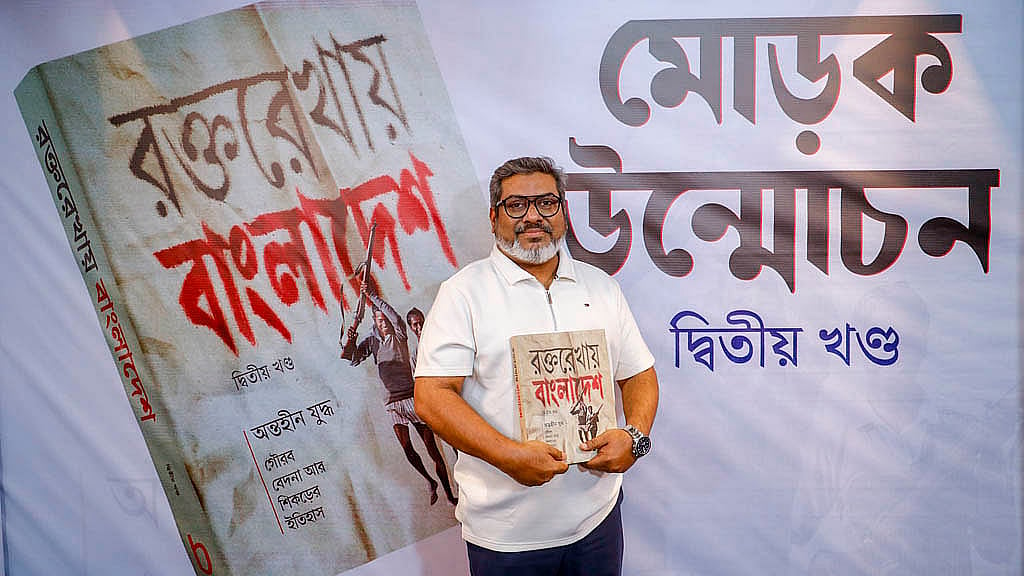
Topu Raihan
Topu Raihan, the son of martyred intellectual and filmmaker Zahir Raihan and actress Kohinoor Akhter Suchanda, is a business entrepreneur and social activist.
At one point, Topu acted in films. Driven by the belief that one can stand beside the people without being involved in party politics, he is contesting in the election this time.
Zahir Raihan went missing on Jan 30, 1972, after independence, when he went to Mirpur in search of his missing brother, martyr Shahidullah Kaiser. Mirpur had been the final battlefield of the Liberation War.
Had Zahir Raihan lived, many unknown truths surrounding the killing of intellectuals and the lesser-known chapters before and after the Liberation War might have been brought to light.