Home
+
Published : 16 Feb 2026, 01:55 AM
The July Uprising promised a reset. What followed was a pause. Tasked with justice, reform, and transition, the interim administration steadied a country in free fall -- yet stopped short of fundamental change.
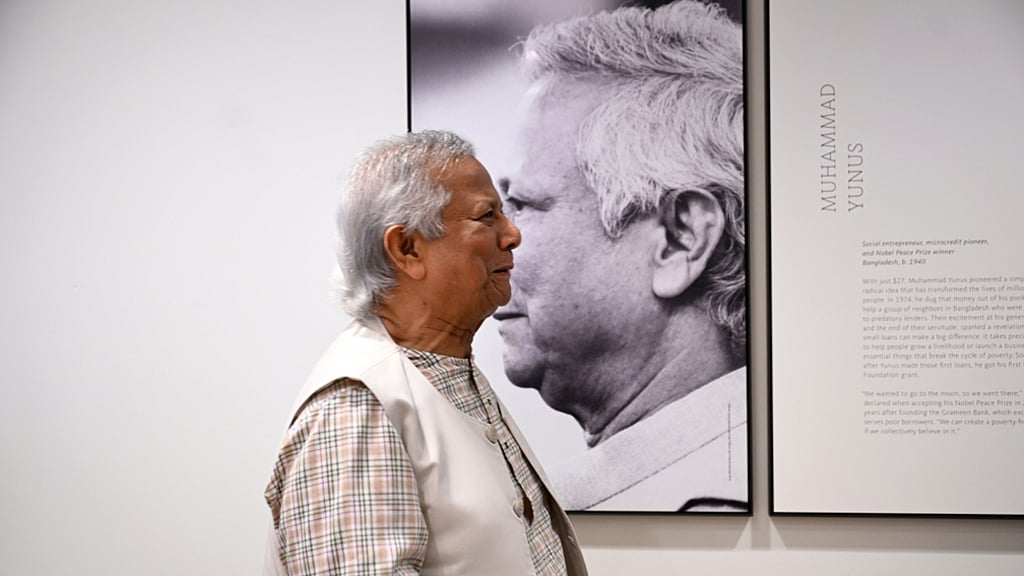
When Muhammad Yunus stepped into office at the crest of the Uprising, Bangladesh was not looking for miracles -- it was looking for balance. The streets had spoken. An old order had fallen, and the nation hung suspended between rupture and renewal.
The interim government vowed to steer Bangladesh “along the path shown by the youth” -- a promise laden with moral authority, revolutionary fervour, and extraordinary public expectation.
Eighteen months on, with elections concluded and the interim authority preparing to depart, Bangladesh is now weighing the government’s record.
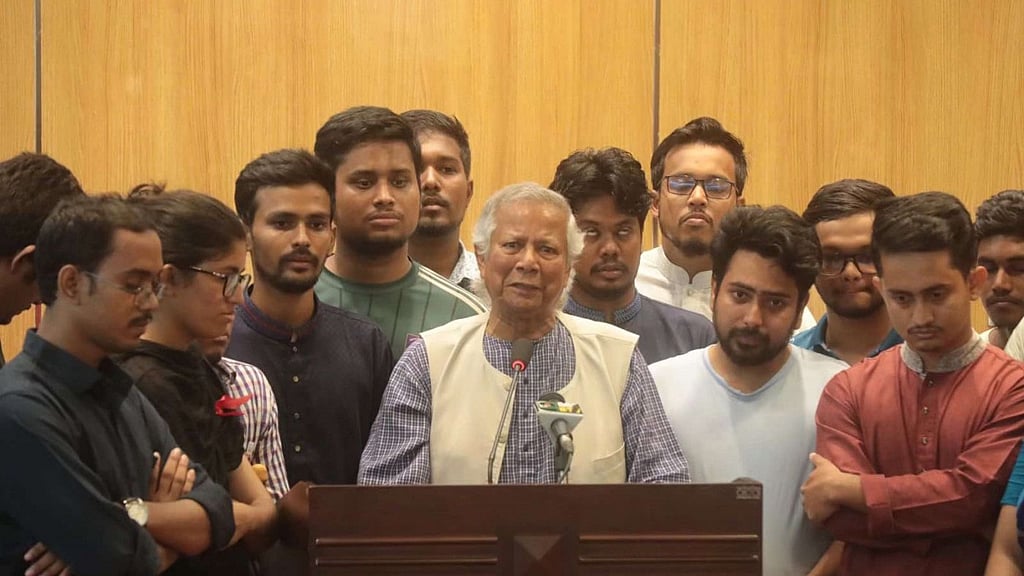
The question is no longer what was promised but what was delivered -- and what remains unresolved.
Led by Nobel laureate Yunus, the interim government’s mandate was urgent: deliver justice for crimes committed during the suppression of the Uprising, reform a broken political and administrative system, and guide the country toward a credible election.
From the outset, the government framed its mission around three pillars: accountability, reform, and transition.
Cases were launched over crimes against humanity, killings, enforced disappearances, torture, corruption, and money laundering linked to the previous regime.
Reform commissions were formed. A roadmap to elections was announced.
The election has since been held, and the referendum on reforms delivered a verdict in principle.
Now, the reckoning begins.
Government advisors insist the balance sheet tilts toward success.
Analysts, however, see a far more limited achievement.
Stability Amid Fragility
For many observers, the Yunus government’s principal success lies in one domain: preventing economic collapse.
Bangladesh, they argue, was on the edge of a precipice when the interim authority took over.
Foreign reserves were under pressure, inflation was eroding purchasing power, and confidence -- both domestic and international -- had been badly shaken.
That the economy did not spiral into famine, mass unemployment, or total breakdown is widely acknowledged as a significant achievement.
Yet beyond this stabilisation, critics say the record becomes murkier.
They point to a rise in “mob culture”, a growing sense of public insecurity, and the legitimisation of extrajudicial violence under labels such as “public anger” or “pressure”.
Human rights violations, suppression of dissent, and deteriorating law and order, they say, have collectively damaged Bangladesh’s image -- both at home and abroad.
Analysts also note that the government pursued international negotiations and struck agreements involving ports and national assets, often without broad public consultation.
For some, this was a stark contradiction: a government that claimed reform required public consent yet sidelined public opinion in strategic economic decisions.
Political vengeance, they argue, never fully disappeared.
The same impulses that contributed to Sheikh Hasina’s downfall resurfaced, revealing an authoritarian strain within a government born of popular revolt.
From Quota Reform To Uprising
The chain of events that reshaped Bangladesh began in early July 2024, when protests demanding reform of the government jobs quota system escalated into violence.
What started as a student-led movement soon transformed into a mass uprising, drawing citizens from across social and political divides.
Hasina was forced from office and fled the country. She now lives in exile in India.
The International Crimes Tribunal (ICT) has since sentenced the former prime minister to death in one case involving crimes against humanity.
She has also received prison sentences of varying lengths in corruption cases linked to plot allocation.
Under sustained pressure from the Jamaat-e-Islami, National Citizen Party (NCP), and other political groups, the interim government imposed a ban on Awami League activities, effectively excluding the party from the electoral process.
On Thursday, Bangladesh held elections without the Awami League, alongside a referendum on state reforms. The vote was largely peaceful.
Apart from some complaints raised by Jamaat and its allies, no major allegations of widespread manipulation emerged.
Yet questions remain.
With turnout at 59.44 percent, analysts continue to debate how inclusive the election truly was -- and whether participation reflected genuine consent or resignation.
Beyond elections lies the more complex task of implementing reforms.
That responsibility now rests with the newly elected parliament and government, where political will may prove decisive.
Life Beyond The Ballot
Strip away the headline achievements of justice and elections, analysts say, and a more troubling picture emerges.
They point to stagnant living standards, persistent insecurity, disruption in trade and industry, chronic energy shortages, failure to recover laundered funds, attacks on the legacy of the 1971 Liberation War, and the legitimisation of extrajudicial violence -- often carried out in the name of Islamist groups. Inflation, too, remains a daily burden for millions.
Across these areas, failure has been the dominant theme.
What The Advisors Say
As they prepare to depart, several advisors have acknowledged that much of their agenda remains unfinished -- while maintaining that their successes outweigh their shortcomings.
Finance Advisor Salehuddin Ahmed has been particularly candid, rating his own performance at 70 out of 100.
Two days before the election, he reflected on the government’s record: “Many initiatives were started, but it was not possible to carry everything through to completion. Still, working without any political agenda and in the public interest -- that itself is a major achievement.”
Managing the economy during the interim period, he said, was never easy: “Structural weaknesses, institutional limitations, and longstanding irregularities meant that many decisions took time to implement.”
Reforms at the National Board of Revenue (NBR) and in tax policy remain incomplete.

While some structural changes were introduced, comprehensive policy reform could not be carried through.
“If the policy divisions had been able to work fully from an earlier stage, the results would have been better,” he said, noting that a tax policy “guideline report” has been left behind to assist the next government.
On the banking sector, he warned that legal changes alone would not ensure independence: “Raising the governor’s status in law does not guarantee real independence. Operational capacity and accountability are essential.”
Inflation, he acknowledged, remains stubborn. Point-to-point inflation stood at 8.58 percent in January, compared with 9.94 percent a year earlier, but higher than December’s 8.49 percent and November’s 8.29 percent.
Employment, he said, remains the economy’s core challenge: “Without active business and industry, there will be no jobs. Without jobs, purchasing power will not rise.
“Inflation cannot be controlled through monetary policy alone -- it is multidimensional, linked to supply chains, energy, and import costs.”
On money laundering, he conceded the limits of progress: “We have gathered information on who transferred money and to which countries. But it is difficult to specify amounts.
“Repatriating funds is extremely complex and depends on international mechanisms like mutual legal assistance. The groundwork has been laid. If the next government is serious, it can use this information.”
He urged the media to take a broader view: “Criticise us, but look at the whole picture. It is not fair to say that nothing was done in 17–18 months. Many initiatives have begun, and their results will be seen in future.”
Power Advisor Muhammad Fouzul Kabir Khan echoed the theme of containment rather than transformation: “Our first task was containment -- so that the economy did not collapse and large-scale social unrest did not erupt.”
He noted that a collapse of trust with international suppliers had been the sector’s biggest challenge: “The government’s credibility with international suppliers had been badly damaged, creating risks in fuel imports.”
At a farewell press conference, he said written records had been left behind detailing completed tasks, pending decisions, and areas requiring a full-term government.
Uncertainty over the interim government’s tenure, he added, made major investment decisions impossible.
Commerce Advisor Sheikh Bashir Uddin claimed progress towards an inclusive economic policy: “The core objective was to move forward without excluding anyone.”

Failures Outweigh Successes
Analysts remain unconvinced.
Despite repeated promises of justice, only Hasina and a handful of Awami League figures have seen cases concluded at the ICT.
Many detainees, they say, remain imprisoned for extended periods without trial.
Reforms, too, remain contested. After months of deliberation and commission reports, a referendum was held -- but critics see ambiguity and deferral.
Almost all reforms, they argue, have been left to the will of voters and the goodwill of the next government. They also note the shelving of the women’s reform report.
Inconsistency, analysts say, is glaring.
While the government claimed reforms required public consent, it ignored public opinion when signing deals with foreign companies to manage ports and national assets.
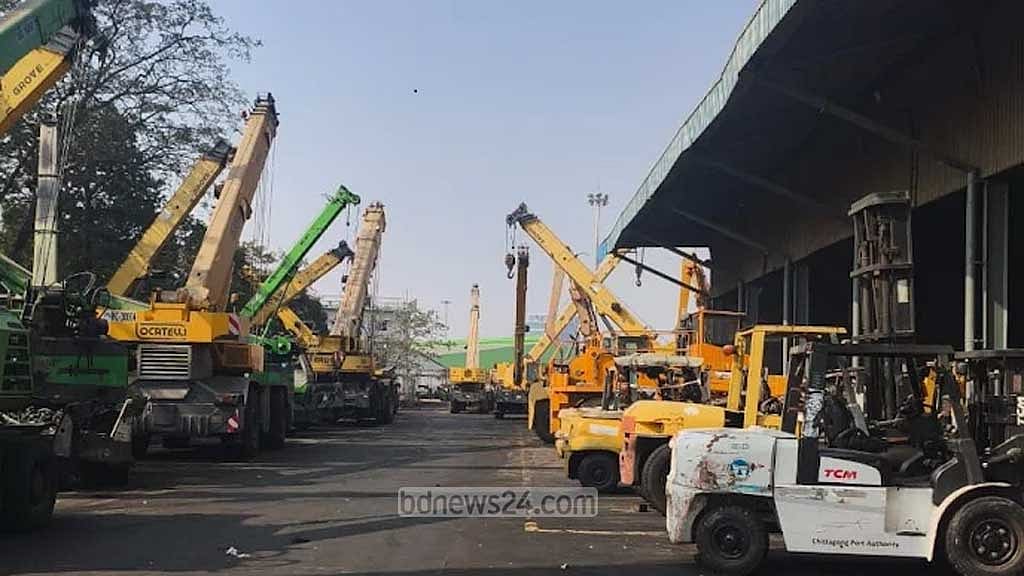
They cite agreements with APM Terminals of Denmark and Medlog of Switzerland, as well as the controversial attempt to hand over operations of Chittagong Port’s New Mooring Container Terminal to UAE-based DP World -- an effort that triggered labour unrest and was eventually abandoned.
More recently, Bangladesh concluded a trade agreement with the United States.
Under the agreement:
Public security, analysts argue, remains one of the government’s greatest failures.
Writer and researcher Mohiuddin Ahmad said: “When they came in, expectations were sky-high. Whether they met those expectations over the past year and a half is debatable. They were successful in one area -- bringing the economy back onto some kind of track.”
“From the dire situation they inherited, the country has reached a point of stability. But in administrative reform and ensuring public safety, they performed poorly.
“‘Mob justice’ and similar incidents exposed the government’s weakness. Overall, their performance was mixed.”
Analyst Prof Asif Mohammad Shahan, who teaches development studies at Dhaka University, said: “Expectations were extremely high… Beyond economic stability, they failed to control law and order, especially the alarming rise of mob justice.”
Another expert Sabbir Ahmed, professor of political science, said: “They managed to maintain minimum stability… Beyond that, I see no significant achievements.”
Political analyst Zobaida Nasreen, a professor of anthropology, was more scathing: “Its most frightening weakness was its dependence on mobocracy.
“The value of the Bangladeshi passport has declined… Internationally, a negative image has taken shape.
“Taken together, what endured was the authoritarian behaviour of a politically vengeful government.”
As the interim authority exits, Bangladesh is left with a paradox: collapse was avoided, but transformation was not delivered. The promise of the mass Uprising now rests with those who come next.