Home
+
Published : 30 Apr 2026, 11:09 AM
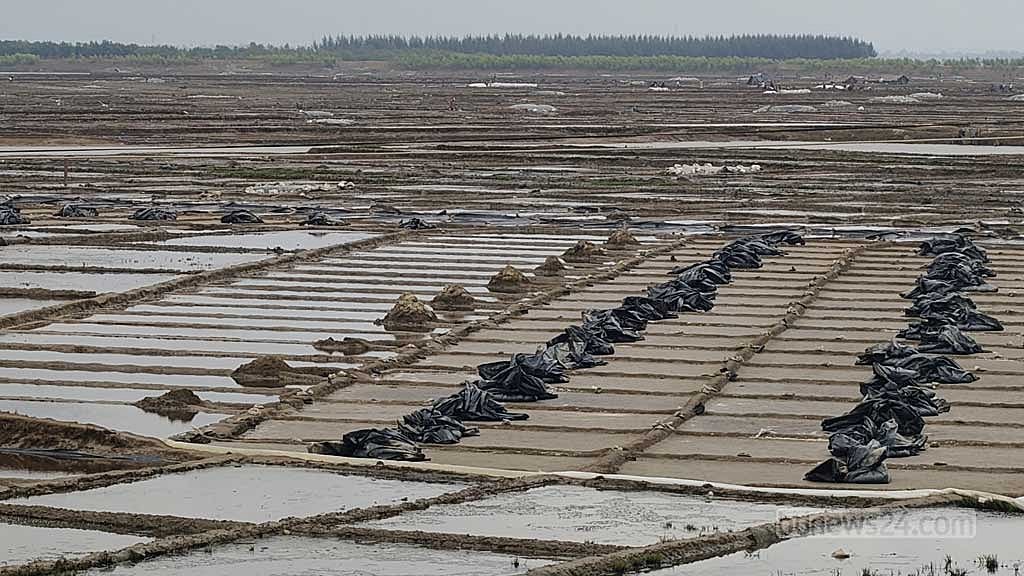
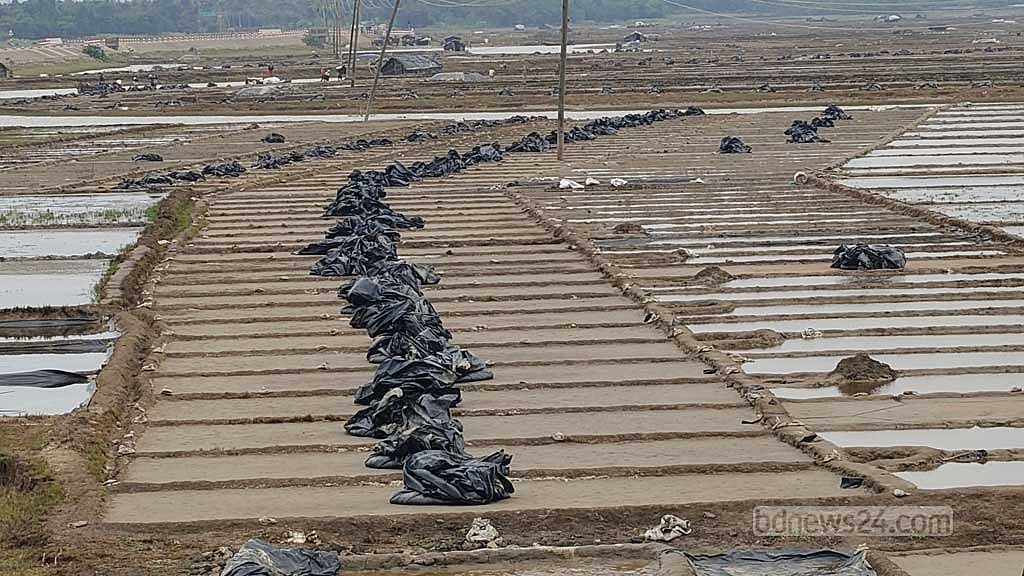
Salt farming grounds across the Teknaf coast in Cox’s Bazar have been devastated by Nor’wester storms and rainfall, leaving farmers and traders in severe distress.
At least 50,000 people involved in salt cultivation and sales have been affected, as market prices remain lower than production costs.
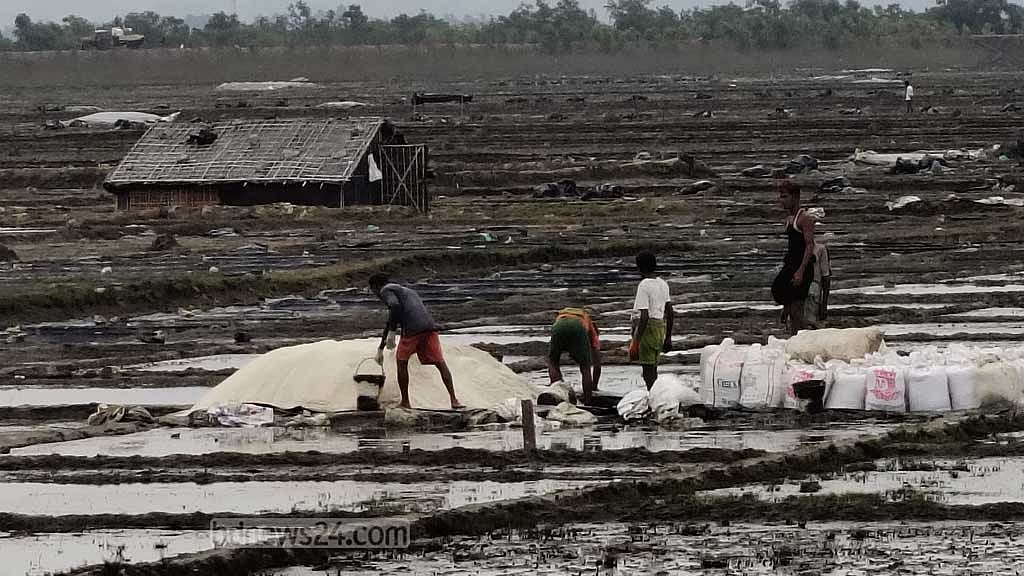
A large quantity of salt produced this week was washed away by Tuesday evening’s stormy winds and rain. Farmers fear that adverse weather may halt salt production before the end of the season.
Under the circumstances, Md Zafar Iqbal Bhuiyan, deputy general manager of the Cox’s Bazar Salt Industry Development Office under the Bangladesh Small and Cottage Industries Corporation (BSCIC), has expressed concern about achieving the national production target.
According to BSCIC, salt has been cultivated this season (Nov 15 to May 15) on 68,505 acres of land in Cox’s Bazar Sadar, Kutubdia, Maheshkhali, Pekua, Chakaria, Eidgaon, Teknaf, and Banshkhali in Chattogram.
As of Apr 6, a total of 1,373,272 tonnes of salt has been produced, which is 449,000 tonnes less than the same period last season (1,822,162 tonnes). The production target for this season is set at 2,810,000 tonnes, while the national demand stands at 2,735,000 tonnes.
Due to unfavourable weather this season, salt farming grounds in areas such as Hnila, Whykong, Baharchhara, Rongikhali, Jhimmongkhali, Kharangkhali, Maulvibazar, Teknaf Sadar, Nazirpara, Sabrang, Nayapara, and Shah Porir Dwip have suffered extensive damage. Not only has salt dissolved in rainwater, but the prepared salt beds have also been destroyed.
Nurul Islam, a salt farmer from Shah Porir Dwip, said: “It will take at least seven to eight days to restart production. We worked day and night in hopes of a good profit, but in just one hour of rain at the end of the season, hundreds of maunds of salt dissolved in water.”
Gias Uddin, a farmer from Nayapara, said that one hour of rainfall on Tuesday halted production across 700 to 800 acres of salt fields along both sides of the canal. He also mentioned that due to the lack of good prices, they are unable to sell the salt produced.
He said, “It costs Tk 300 to produce one maund of salt, but we are forced to sell it at Tk 250–260. How long can we continue selling at a loss?”
“For the past four months, we have been selling salt at a loss. We cannot even repay our loans, let alone provide for our families,” Gias added.
Ali Ahmed, a salt farmer from Sabrang, said: “We worked day and night hoping for better profit, but a single hour of rain at the end of the season caused massive damage to the salt farming grounds. Production will remain halted for another 10 to 15 days.”
“I took loans to lease the fields, and everything is now ruined by the Nor’wester storm. Prices are already low—how will I repay my debts?” he lamented.
Farid Ahmed, President of the Teknaf Sabrang Salt Farmers’ Welfare and Traders Association, said that salt farmers have suffered extensive losses due to storms and rain. At the same time, they are not receiving fair prices for their produce.
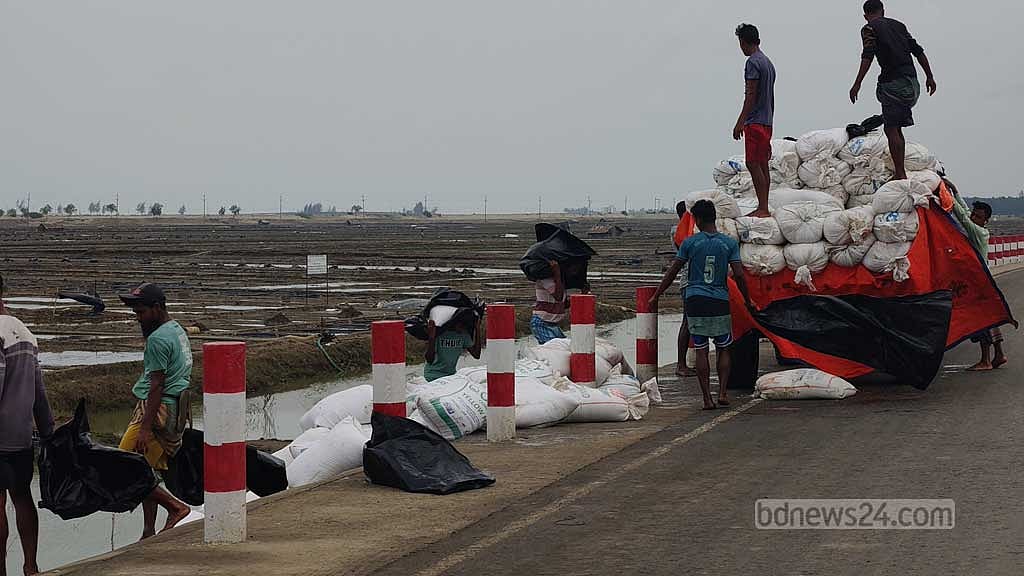
He added, “A syndicate is attempting to import salt using the excuse of a shortage. If salt is imported, the suffering of marginal farmers will increase further. At least 50,000 people in Teknaf are involved in salt production, transportation, marketing, and trade.”
Zafar Iqbal said that recent storms and rain have damaged several thousand acres of salt farming grounds. As the saline water has turned less salty, additional labour and fuel will be required to resume production, raising concerns about meeting the national target.
He also mentioned that there are currently 1,070,000 tonnes of salt in stock at both the farming ground and mill (factory) levels, including new and old reserves.
Mizanur Rahman, head of the Basic Teknaf Salt Centre, said it will take about 10 days for farmers to resume salt harvesting. So far this season, 135,000 tonnes of salt have been produced on 4,550 acres of land in Teknaf.
He hoped that if the weather improves, farmers may be able to produce more salt and recover some of their losses.